


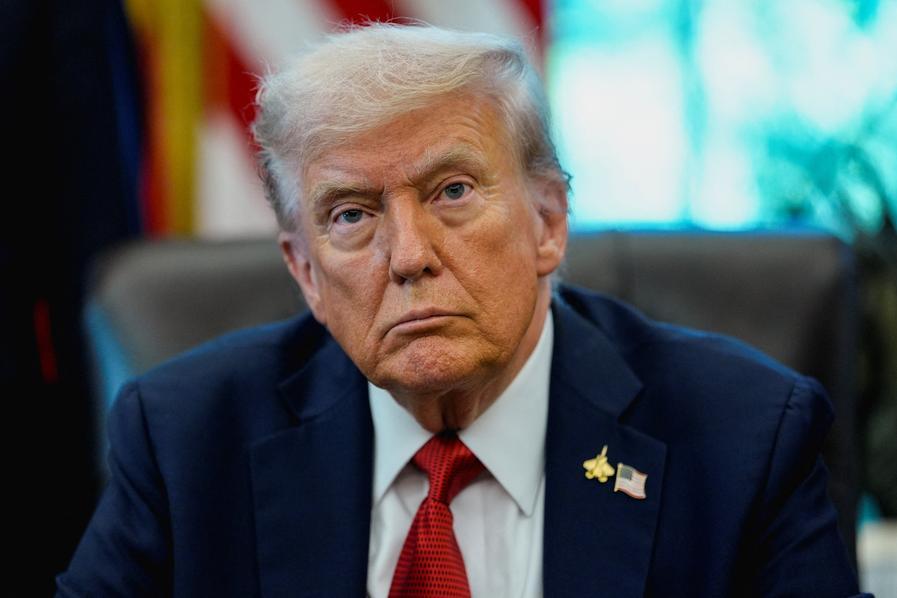
SINGAPORE: The U.S. dollar struggled near four-year lows on Wednesday after President Donald Trump wiped out recent dollar weakness and intensified dollar selling ahead of the Federal Reserve’s policy decision, pushing the yen, euro and pound higher.
Currency markets were digesting heavy dollar selling in the previous session, which pushed the euro above the $1.2 level for the first time since 2021. The single currency was last down 0.36% at $1.1994.
The pound hit its highest since 2021, falling 0.33% to $1.3796, after rising 1.2% in the previous session.
The dollar index, which measures the value of the U.S. currency against six major rivals, rose 0.22% to 96.114, after falling more than 1% in the previous session to a four-year low of 95.566.
Asked Tuesday whether he thought the dollar’s value had fallen too much, President Trump said the dollar’s value was “fantastic.” Traders took his comments as a signal to strengthen dollar selling.
The president’s comments were not necessarily new, but they came at a time when the dollar was under pressure, with traders wary of the possibility of coordinated foreign exchange intervention by Japanese and U.S. authorities to stabilize the yen.
“This shows that confidence in the U.S. dollar is in crisis,” said Kyle Rodda, senior market analyst at Capital.com. “This weakness appears likely to continue while the Trump administration persists with erratic trade, foreign, and economic policies.”
The dollar started the year on a bad note, having fallen more than 9% in 2025, but was already down about 2.3% in January as investors grappled with President Trump’s erratic approach to trade and international diplomacy, concerns about the independence of the Federal Reserve, and a huge increase in public spending.
Investors’ attention will turn to the Federal Reserve’s policy decisions later in the day. The central bank is expected to be on the lookout for a period of hiatus, with investors expecting it to extend beyond Central Bank Governor Jerome Powell’s last meetings in March and April.
The meeting is looming over issues such as the nomination of a candidate to replace Mr. Powell in May, efforts to fire Federal Reserve President Lisa Cook, and the Trump administration’s criminal investigation into the central bank chief.
“Trump’s strategy is simple: keep the economy active in the run-up to the midterm elections and allow the dollar to weaken to get ahead of the Fed, which seems reluctant to cut interest rates,” said Prashant Newnaha, senior Asia-Pacific rates strategist at TD Securities in Singapore.
“Trump has given the green light to sell the dollar.”
grace of yen
The fragile Japanese yen was further caught up by the dollar’s weakness, dropping 0.4% to 152.79 yen on Wednesday, before surging more than 1% on Tuesday to a three-month high of 152.10 yen to the dollar.
The yen’s strength since Friday has been spurred by talk of interest rate checks in the United States and Japan, often seen as a precursor to regulatory intervention.
Japan’s Finance Minister Satsuki Katayama said on Tuesday that the government would take appropriate measures on currency exchange if necessary, but declined to comment on the sharp rise in the yen.
Investors remain unconvinced about the actual impact of the intervention, especially since Prime Minister Sanae Takaichi has called a snap election based on expanding economic stimulus. Japan’s elections are scheduled for February 8th.
“I think they are doing what they have been doing. They will stay in this range. They have delayed 160 by at least three months, which is an achievement in itself,” said Vaibhav Loomba, head of foreign exchange and rates at financial services firm Clay Group.
The Australian dollar rose to $0.70225, its highest level since February 2023, after data showed consumer price inflation rose at a faster-than-annual rate in the December quarter amid widespread dollar weakness, boosting expectations for short-term interest rate hikes by the Reserve Bank of Australia.
The Australian dollar was down 0.34% at $0.6987, and the New Zealand dollar was down 0.5% at $0.6015. (Reporting by Ankur Banerjee in Singapore; Editing by Sam Holmes)
