


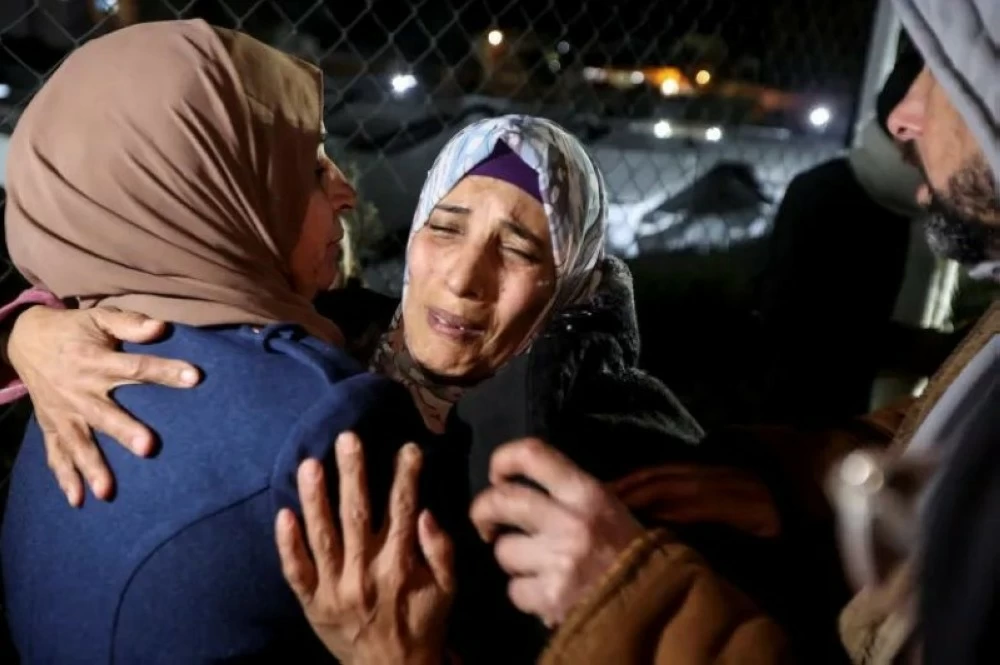
GAZA — Another 25 Palestinians returned to Gaza through the Rafah border early Thursday following a long-awaited partial reopening, while patients in need of emergency treatment abroad are heading to the border.
Meanwhile, Israel continued its attacks across the Strip a day after the killing of 23 Palestinians, the deadliest day since the start of the ceasefire in October.
A Palestinian man was killed by Israeli forces in Bani Suheila, east of Khan Yunis, on Thursday, Wafa news agency reported, as Israeli attacks continued in the Gaza Strip.
Israel carried out airstrikes east of Deir el-Bala in central Gaza and east of Khan Yunis in the south.
Al Jazeera reported that Israeli airstrikes, gunfire and heavy artillery shelling also targeted Gaza City’s East Tufa district, which lies next to the so-called “Yellow Line” that demarcates territory under Israeli military control.
The group of 25 people, the third group of Palestinians to return since border reopenings were severely restricted, entered the Strip at 3am local time (1pm Japan time) on Thursday and were taken by bus to Nasser Hospital in the southern city of Khan Younis, more than 20 hours after leaving the Egyptian city of El Arish.
Hours later, 13 Palestinian patients, accompanied by family members and World Health Organization (WHO) staff, were transferred from the hospital to the border for treatment abroad.
Some returnees were visibly tired from the ordeal and said they were interrogated and insulted by Israeli forces as they passed through security checkpoints.
The footage showed moving scenes of returning Palestinians embracing long-separated loved ones, as well as first-hand accounts of scenes of devastation caused by the war in their homeland.
“I feel torn between happiness and sadness,” one returnee, Aicha Baraoui, told Reuters.
“I’m happy to be back and see my family, my husband, and my loved ones. I thank God. But I also feel sad when I think of my homeland, seeing the destruction. I never imagined the destruction would be this serious.”
The Rafah border with Egypt, the only route into and out of Gaza for almost all of the Gaza Strip’s more than 2 million residents, was partially reopened on Monday after being closed by Israeli authorities for most of the war.
The return of displaced Palestinians and the reopening of crossings to allow patients in need of medical treatment to be evacuated outside the Strip are among the conditions of the US-brokered “ceasefire” agreement to end the war in Gaza.
Only Palestinians who left Gaza during the war are allowed to return, and those traveling in both directions undergo strict security checks, a process that returnees describe as humiliating and abusive.
Palestinian women who returned to the country earlier this week told Al Jazeera that their hands were tied and their eyes covered as part of security checks, and they were interrogated and searched.
The International Committee to Support the Rights of the Palestinian People (ICSPR) said Israel’s strict measures had turned the Rafah border into “an instrument of control and domination rather than a humanitarian corridor.”
He said patients’ families began receiving phone calls late Wednesday telling them to prepare for transfer. Israel briefly suspended coordinating medical transfers, but resumed them a few hours later.
However, the pace of medical evacuations since the intersection’s partial reopening has been slower than promised and far short of the number needed to meet the needs of the approximately 20,000 patients requiring treatment in other countries.
The agreement was for 50 patients to be evacuated each day, along with two family members, but only about 30 have been evacuated so far this week.
Gaza’s health system has been devastated by Israel’s genocidal war in the enclave, with 22 hospitals closed and 1,700 health workers killed, according to the Palestinian Ministry of Health. — Agency
UN Secretary-General warns that expiration of US-Russia nuclear treaty marks a ‘watershed moment’
Related articles

Britain’s Starmer apologizes to Epstein victims over Mandelson appointment
Antonio Guterres: “For the first time in more than half a century, we face a world in which strategic nuclear weapons have no binding force.”
Merve Aydogan |
05.02.2026 – Updated : 05.02.2026
UN Secretary-General warns that expiration of US-Russia nuclear treaty marks a ‘watershed moment’
hamilton, canada
UN Secretary-General António Guterres warned on Wednesday that the expiration of the last remaining nuclear arms control agreement between the United States and Russia marks a “critical moment for international peace and security”, ending decades of legally binding restrictions on the world’s two largest nuclear weapons.
“The expiration of the New START Treaty at midnight today marks a critical moment for international peace and security,” Guterres said in a statement commemorating the treaty’s expiration on February 5.
“For the first time in more than half a century, we face a world in which there is no binding force on the strategic nuclear arsenals of the Russian Federation and the United States, which own the vast majority of the world’s nuclear weapons stockpiles,” he said.
Mr. Guterres said nuclear arms control between the two countries has long served as a stabilizing force, helping to prevent catastrophe and reduce the risk of catastrophic miscalculation.
He noted that bilateral agreements, from Strategic Arms Limitation Talks (SALT) to New START, have led to the reduction of thousands of nuclear weapons and improved global security.
“The collapse of decades of gains could not come at a worse time,” he warned, stressing that “the risk of nuclear weapons being used is at its highest in decades.”
He warned that the lack of verifiable limits on strategic weapons would increase global anxiety amid rising geopolitical tensions and rapid technological change.
Still, Guterres said this should also be seen as an opportunity to reset arms control efforts.
“The world is now counting on the Russian Federation and the United States to translate words into action,” he said, calling on the two countries to return to negotiations without delay and agree on a successor framework that “restores verifiable limits, reduces risks and strengthens collective security.”
The New Strategic Arms Reduction Treaty (New START) was signed by the United States and Russia in Prague on April 8, 2010, and entered into force on February 5, 2011. The treaty replaces the 1991 START I treaty, which expired in December 2009, and replaces the 2002 Strategic Arms Reduction Treaty (SORT), which ended with New START. According to the US-based Arms Control Association — Agency
