


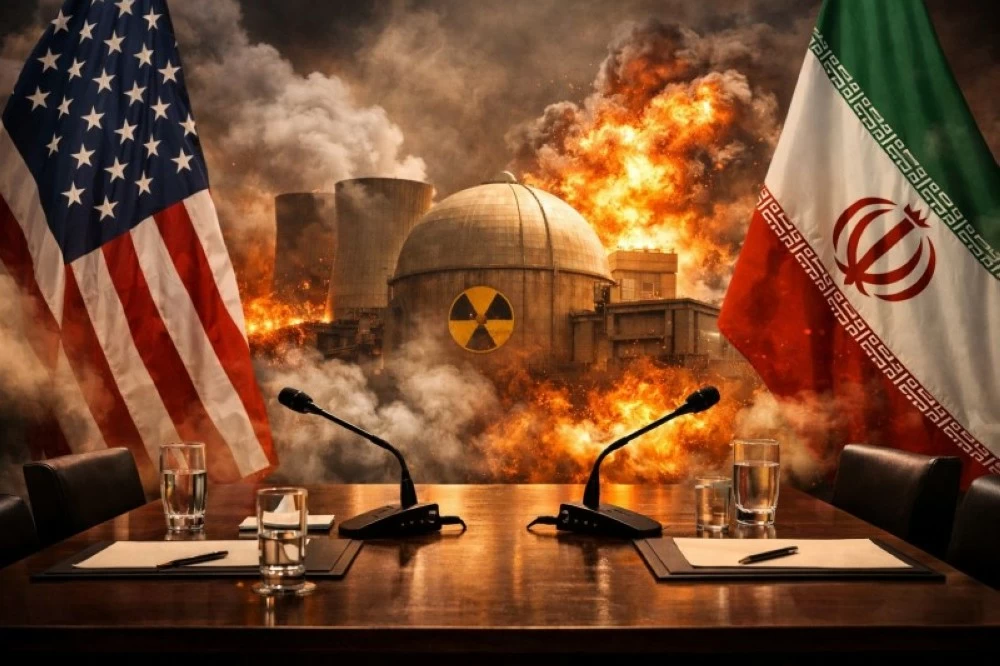
Amid a cautious atmosphere and significant military escalation, the White House yesterday (Thursday) lowered expectations for future negotiations with Iran on its nuclear program, scheduled to be held today (Friday) in Oman’s capital Muscat.
Take note at the White House
White House Press Secretary Carolyn Levitt said that US President Donald Trump would receive a briefing directly from the participating delegates after the meeting, and stressed that given the increased US military presence in the Middle East, President Trump is awaiting the outcome of the meeting to see if it is possible to reach an agreement with Iran.
Diplomacy first
Noting that diplomacy remains the American president’s first choice when dealing with countries around the world, whether allies or adversaries, Levitt explained that prior disagreements between the two sides arose over the location and format of negotiations before a consensus was reached to retain the Sultanate of Oman.
American delegation close to President Trump
The US is joined by Trump’s top foreign envoy Steve Witkoff and son-in-law Jared Kushner, but Levitt acknowledged the US president is waiting for a detailed report on the results.
Military pressure and political messages
President Trump hopes that a major U.S. military buildup in the region will serve as a pressure card to elicit concessions from Iran, including an end to Iran’s nuclear program, its ballistic missile program, and its support for militias loyal to Iran in the region.
Tehran: Resolute negotiations and an unforgettable experience
Meanwhile, Iran’s Foreign Ministry announced that Foreign Minister Abbas Arakchi would lead the negotiating delegation, stressing that the negotiations would be “robust” and aim to reach a “fair, satisfactory and honorable” understanding on the nuclear file for both sides.
Ministry spokesman Ismail Baghaei explained that Iran is approaching this round fully aware of its past experiences, which he described as foreign interference in recent popular protests, as well as a breach of commitments and military aggression last June, and stressed that these experiences continue to cast a shadow on Iran’s diplomatic approach.
Ambiguous topics and disagreements over priorities
Although the agenda for the negotiations has not yet been formally disclosed, Iran’s Foreign Ministry confirmed that Iran seeks to limit talks to its nuclear program and sanctions relief, while the United States seeks to expand the topic to include Iran’s missile program and support for its allies, including Hamas in Gaza, Hezbollah in Lebanon, and the Houthis in Yemen.
Amid a cautious atmosphere and significant military escalation, the White House downplayed expectations for talks with Iran over its nuclear program scheduled for today (Friday) in Oman’s capital Muscat.
Expectations at the White House
White House Press Secretary Caroline Levitt said President Donald Trump would receive a briefing directly from the participating delegates after the meeting, and stressed that Trump is awaiting the outcome of the talks to see if an agreement can be reached with the Iranian government as the U.S. military presence in the Middle East increases.
Diplomacy first
Mr. Levitt suggested that diplomacy remains the president’s first choice when dealing with countries around the world, whether allies or adversaries, and revealed that there had been previous disagreements between the two sides over the location and format of the negotiations before the decision was made to hold them in Oman.
US delegation approaches President Trump
Trump’s foreign envoy Steve Witkoff and son-in-law Jared Kushner are participating on behalf of the United States in negotiations, and Levitt acknowledged that the president expects a detailed report on the outcome of the negotiations.
Military pressure and political messages
President Trump hopes that a significant U.S. military buildup in the region will act as leverage to extract concessions from Iran, including not only its nuclear program but also a halt to its ballistic missile program and support for allied militias in the region.
Tehran: Resolute negotiations and an unforgettable experience
Meanwhile, Iran’s Foreign Ministry announced that Foreign Minister Abbas Araghchi would lead the negotiating delegation, insisting that the negotiations would be “robust” and aim to reach “a fair, satisfactory and honorable understanding for both sides” on the nuclear file.
Ministry spokesperson Ismail Bacaei made it clear that Iran is approaching this round fully aware of its past experiences, which it described as foreign interference in recent popular protests, as well as a breach of commitments and military aggression last June, and stressed that these experiences continue to cast a shadow on Iran’s diplomatic approach.
Ambiguous agenda and mismatched priorities
The agenda for the negotiations has not yet been formally disclosed, but Iran’s Foreign Ministry has confirmed Tehran’s efforts to limit discussions to its nuclear program and lift sanctions, while Washington is seeking to expand the agenda to include Iran’s missile program and support for its allies, including Hamas in Gaza, Hezbollah in Lebanon and Yemen’s Houthis.
