

DAMASCUS – Saudi Arabia and Syria signed 80 agreements and memoranda of understanding on Saturday worth more than 40 billion riyals.
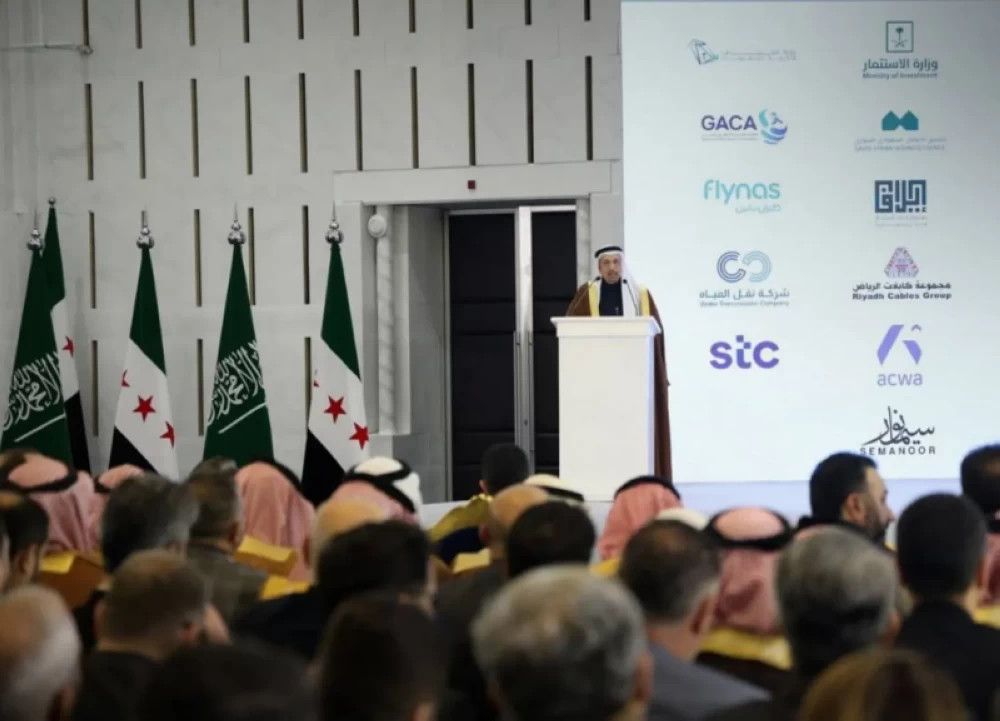
A signing ceremony for the new investment agreement took place on Saturday in Damascus in the presence of Saudi Arabia’s Minister of Investment Khalid al-Falih. Al-Falih, who will lead a high-level Saudi delegation visiting Syria, announced the signing of five strategic agreements aimed at supporting Syria’s economy and strengthening cooperation between the two countries.
Agreements signed between Saudi companies and Syrian government entities include the Aleppo Airport Project Agreement between the Syrian Civil Aviation Authority and a Saudi investment consortium led by Bindawood Investment Group.
The agreement is the first investment by the Elaf Fund and aims to develop the new Aleppo International Airport, operate and improve the existing airport during its development phase, and finance an integrated navigation radar system covering all of Syria’s airspace.
Prime Minister Falih also announced that Saudi Arabia will invest 7.5 billion riyals to develop two airports in the Syrian city of Aleppo in several stages. In addition to the agreement with the Syrian sovereign wealth fund to develop a Syrian cable company, a joint airline company called Nas Syria will also be established between the two countries.
The telecommunications infrastructure agreement signed between the Syrian Ministry of Communications and Information Technology and the Saudi Telecommunications Company (STC) aims to upgrade Syria’s telecommunications infrastructure by extending fiber optic cables and installing data centers, thereby strengthening internet services and enabling Syria to become a regional hub for data transmission and international connectivity.
An agreement for the operation and development of the Modern Syria Cable Company was signed between the Syrian Government Fund and Riyadh Cable Group. The agreement aims to manage, operate and develop Modern Syrian Cables Company’s Syrian factory, localize technical knowledge and develop local capabilities in the energy and wire sectors.
The announced agreements also include agreements on the development of water desalination and transportation in Syria. A water desalination and transportation project development agreement was signed between the Syrian Ministry of Energy and the Saudi company ACWA Power and the national water company.
Related articles
Saudi Arabia deports 11,656 illegal immigrants in one week
The agreement aims to carry out the necessary economic, technical and financial studies and find suitable solutions to evaluate both the desalination project with a processing capacity of approximately 1.2 million cubic meters per day and the water pipeline project with its associated facilities.
Mr. Al-Falih spoke on the occasion and announced that remittance channels between Saudi and Syrian banks will be activated. The Minister said that there had been a qualitative leap forward in cooperation with Syria through strategic projects.
Mr. Al-Falih asserted that the partnership with Syria is progressing steadily and systematically. The minister said the announcement in Riyadh of the lifting of sanctions against Syria was a historic moment. He pointed out that the Saudi-Syrian Business Council will oversee strategic projects.
The head of the Syrian Investment Authority said that the agreements signed with Saudi Arabia will contribute to infrastructure development, stressing that these agreements will benefit the Syrian people.
Al-Falih arrived in Damascus on Saturday at the start of an official visit aimed at strengthening economic and investment cooperation between Saudi Arabia and Syria and advancing the bilateral partnership to the stage of practical implementation of joint projects.
The visit takes place within the framework of supporting the strategic partnership between the two countries, strengthening the role of the private sector in supporting development projects, and building a path for sustainable economic integration that serves common interests and keeps pace with the next phase of development trends. The agreements signed cover the areas of aviation, telecommunications, infrastructure and development initiatives.
The visit also included a series of high-level official meetings with a number of officials and stakeholders to explore opportunities for investment cooperation, as well as discuss how to implement joint projects and create an environment conducive to attracting high-quality investments.
