

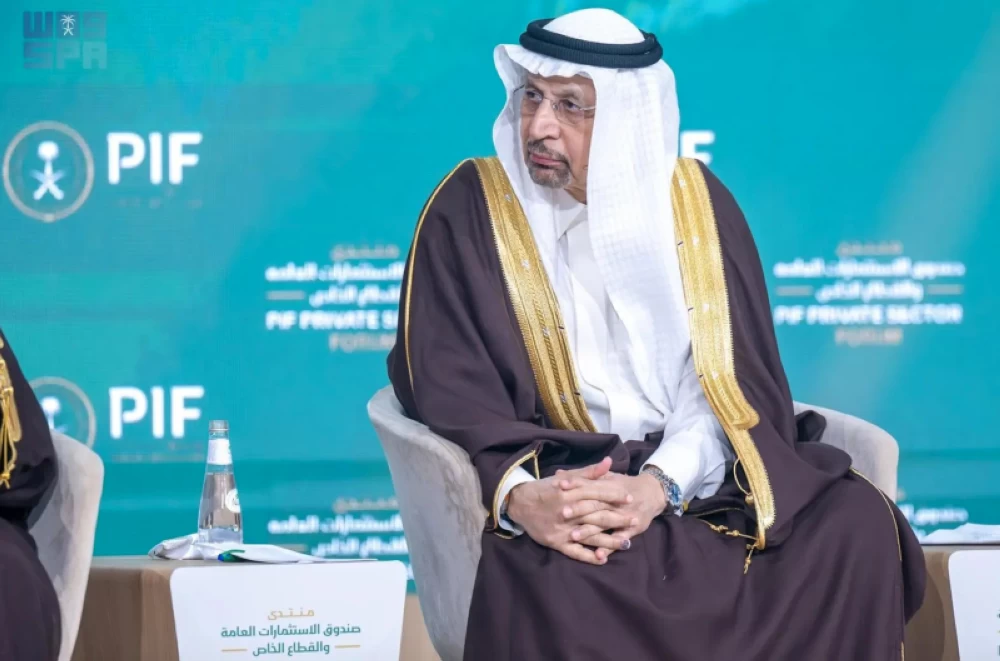
RIYADH – Minister of Investment Khalid Al Falih said global events, technological changes and the Kingdom’s hosting of major international milestones are reshaping national investment priorities, prompting flexibility in project planning and realignment of some large-scale developments.
Speaking at the PIF Private Sector Forum on Monday, Al-Falih said today’s investment plans require continuous reassessment. “We sometimes change plans twice a year,” he said, citing his experience at Aramco.
He explained that projects must be withdrawn and replaced in the event of “rapid and unexpected changes in demand, competition or feasibility,” noting that all investment entities operate within capital limits.
He said the public investment fund has experienced “unprecedented” growth from about 560 billion to 600 billion riyals to nearly 4 trillion riyals, with the majority going to stimulate the domestic sector through “bold and unprecedented projects such as NEOM and THE LINE.”
However, Al-Farih said new national priorities have emerged. “Our plans for the World Cup have become a reality,” he said, stressing that hosting the tournament requires more than just building stadiums. “Each stadium becomes a cell of the surrounding economic zone, connecting logistics, quality of life and healthcare not only for visitors but also for residents of the surrounding area.”
He said these priorities are part of a broader pipeline that also includes Expo 2030, expansion of King Salman International Airport and King Khalid International Airport.
“These are priorities,” he said, adding that changes in the feasibility of some projects, including THE LINE, are being assessed at sector level and are “very normal”.
Al Falih said the pace of global change is unprecedented, with Saudi Arabia simultaneously accelerating investments in artificial intelligence and advanced technology value chains.
“We are still in the early stages of artificial intelligence,” he said, noting that the field will require “trillions of dollars of investment at a global level.”
Related articles
PIF urges private sector to be bolder as funding shifts from construction sector to growth expansion
He cited PIF-backed AI company HUMAIN’s short- to medium-term plans to develop 3 to 6 gigawatts of capacity, saying 1 gigawatt equates to an investment of $30 billion to $50 billion worldwide.
He said much of this investment will flow into Saudi Arabia through partnerships with global chipmakers and local companies.
Al Falih said the fund has forged partnerships across sectors such as data, food production and telecommunications as part of building national champions, expanding value chains from power grids to digital and cyber infrastructure, professional development and smart cities.
He also highlighted the launch of a national investment strategy and said Crown Prince Mohammed bin Salman had directed the Ministry of Investment to act as an enabling agency across all sectors.
The strategy targets investment of SAR 12 trillion and aims to embed investment throughout the economy.
Al Falih said more than half of the strategic objectives have already been achieved since its launch in October 2022, and investments now account for around 30% of the Saudi economy. He said that excluding oil, investment accounts for more than 40% of the non-oil economy, a level that only a few major economies have historically reached.
He said the PIF injection accounts for about 10% of total investment, along with cuts in direct government spending to avoid crowding out to the private sector. This has led to a surge in the number of foreign companies attracting global investors and capital, expanding tourism and infrastructure value chains, and using Saudi Arabia as a regional and global platform, he added.
“The world is coming to Saudi Arabia,” Al-Falih said, describing the current phase as one of holistic growth driven by investment, diversification and partnerships with the private sector.
