

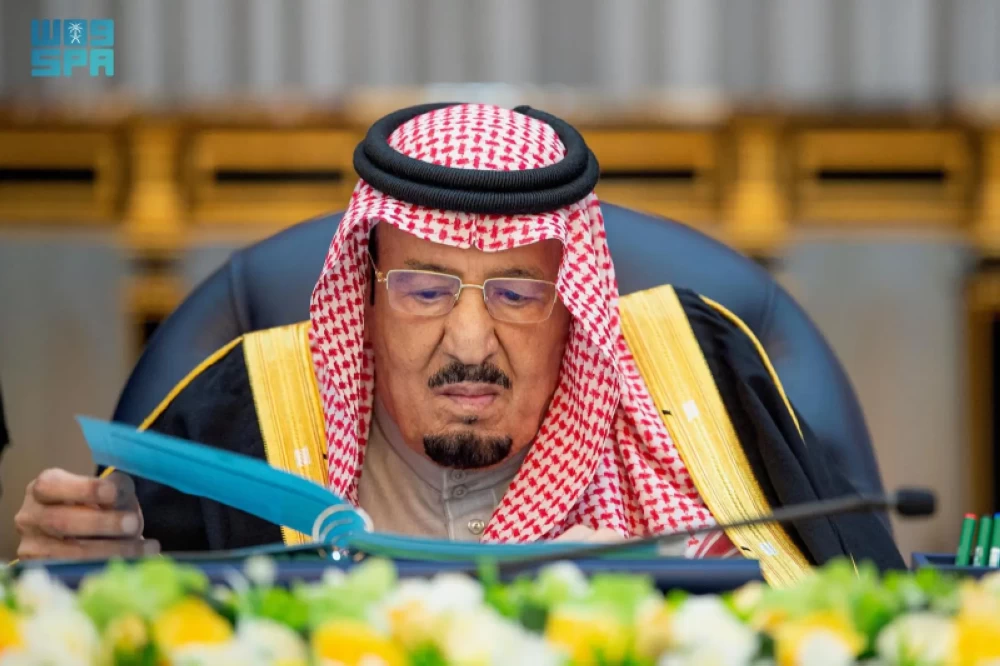
RIYADH — The Saudi Council of Ministers on Tuesday approved an agreement on electric high-speed rail connectivity between the Saudi and Qatari governments. Custodian of the Two Holy Mosques King Salman chaired a cabinet meeting in Riyadh.
The 785km high-speed electric railway connecting Riyadh and Doha will connect major stations such as Dammam and Al-Ahsa at speeds of over 300km/h, reducing travel time to around two hours.
At the beginning of the session, the Cabinet was briefed on the recent telephone conversation between the Crown Prince and Prime Minister Mohammed bin Salman and Russian President Vladimir Putin. The Council also reviewed the talks the Crown Prince had with Turkiye President Recep Tayyip Erdoğan and German Chancellor Friedrich Merz during his official visit to the Kingdom.
The Cabinet praised the positive outcomes of these visits, which highlighted the strength of bilateral relations and mutual commitment to promoting relations at all levels. The conference also praised the agreements and memorandums signed with Mr. Turkiye, as well as between the Saudi and German public and private sectors, which aim to expand cooperation and collaboration across various sectors, promote common interests, and support development priorities.
In a statement to the Saudi Press Agency after the session, Issam bin Said, Minister of State for Shura Council Affairs and Acting Minister of Media, said the Cabinet reviewed the latest developments in the region and the Kingdom’s continued engagement with the international community in support of regional security and stability. They called for respect for the ceasefire agreement in the Gaza Strip, its full implementation, and progress towards a political solution leading to the establishment of an independent Palestinian state.
The Cabinet reaffirmed its support for the results of the Global Coalition to Defeat ISIS hosted by Saudi Arabia and emphasized the importance of continued international cooperation and concrete measures to combat cross-border terrorism, which poses a direct threat to society’s security and stability.
The Cabinet praised efforts to strengthen bilateral cooperation between Saudi Arabia and Syria, including the visit of a Saudi delegation to Damascus to launch strategic projects and contracts in the aviation, communications, water, industry, and education sectors, which will contribute to strengthening Syria’s infrastructure and boosting economic growth.
The Cabinet praised the achievements of the Second Al-Ula Conference on Emerging Market Economies in 2026, hosted by Saudi Arabia in cooperation with the International Monetary Fund. The conference aimed to strengthen international cooperation, promote economic and financial reforms, and enable emerging countries to cope with global change in a way that achieves inclusive and sustainable growth.
The Cabinet also considered Saudi Arabia’s election as Chairman of the Institute of Internal Auditors for the term 2027-2028 to be confirmation of Saudi Arabia’s commitment to supporting cooperation with international organizations at various levels and strengthening its leadership in this field.
The Cabinet approved the organizational procedures for the Crown Prince Mohammed bin Salman World Arabic Calligraphy Center. The board approved the establishment of a standing committee to address all issues related to asbestos and monitor its ban.
The Cabinet authorized the Minister of Energy or his representative to consult with the Jordanian and Turkish sides and sign the draft Framework Agreement and Cooperation Agreement on Nuclear and Peaceful Uses between the Saudi, Jordanian and Turkiye governments.
Related articles

Minister of National Security meets with Minister of Defense of South Korea
The Council approved two agreements between the Government of Saudi Arabia and the Council of Ministers of Bosnia and Herzegovina and the Government of Mongolia on mutual exemption of short-term visas for holders of diplomatic, special, official and work passports.
The Cabinet approved a Memorandum of Understanding (MoU) on cooperation in the field of culture between the Saudi Ministry of Culture and the Ministry of Culture of Uzbekistan, and a Memorandum of Understanding (MoU) on cooperation in the field of health between the Saudi Ministry of Health and the Syrian Ministry of Health.
The Council authorized the Minister of Industry and Mineral Resources and the Chairman of the Board of the Saudi Geological Survey or his representative to consult with the Yemeni side and sign a draft memorandum of understanding between the Saudi Geological Survey and the Yemeni Geological Survey and Mineral Resources Authority for technical and scientific geological cooperation.
The Cabinet authorized the Secretary of National Security or his deputy to consult with and sign a draft memorandum of understanding between the Directorate General of Financial Investigations of the Saudi Presidency for National Security and the United Nations, represented by the United Nations Office on Drugs and Crime.
