

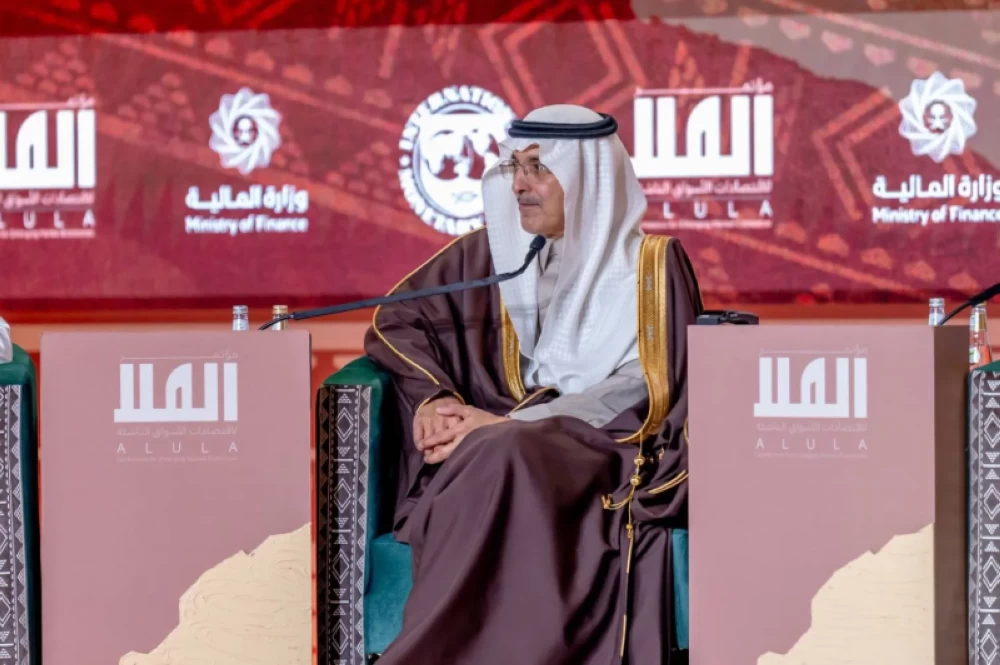
ALURAH — Saudi Arabia’s Minister of Finance Mohammed al-Jadaan said that the kingdom’s most important goal remains economic diversification, stressing that the means used to achieve it are flexible and can change depending on the situation.
Speaking at a session of the Al-Ula Emerging Markets Economics Conference, co-hosted by the Ministry of Finance and the International Monetary Fund, Al-Jadaan said a review of policies and an assessment of priorities is underway.
“We’re looking at what to stop, what to restart, and what to expand,” he said.
“We have a lot to announce and will be announcing more in the coming weeks and months.”
After years of fiscal expansion, Saudi Arabia is adjusting its approach under Vision 2030 to reduce dependence on oil revenues while focusing on spending efficiency.
The transformation is aimed at increasing resilience to fluctuations in oil prices and revenues.
Mr. Al Jadaan said Vision 2030 has achieved strong results over the past decade, noting that more than 87% of initiatives have been completed or on track, and 93% of key performance indicators have been achieved or are on track.
He added that the government was preparing to unveil an updated strategy, explaining in comments to Bloomberg that discussions began this week on a revised five-year plan focused on tourism, manufacturing, logistics and technology.
The Minister highlighted key achievements under Vision 2030, including lower unemployment rates and higher home ownership rates.
Related articles
Saudi Ministry of Defense signs 28 military contracts with WDS
“Remember, we started this 10 years ago, and things may change in 20 years,” he said.
Mr. Al-Jadaan emphasized the importance of maintaining fiscal discipline and warned against cyclical spending patterns.
“What we want to avoid is being undisciplined in a year of strong earnings and resorting to deep cuts that hurt the economy and growth in a bad year,” he said.
He noted that Saudi Arabia has adopted very conservative oil price assumptions in its budget planning, as oil continues to serve as an important source of revenue, and said this approach is essential to strengthen fiscal discipline.
Commenting on the AlUla conference, Al-Jadaan said it succeeded in amplifying the voices of emerging countries and clearly presenting their needs to the international community, especially the IMF, World Bank and other multilateral institutions.
“It’s easy to complain that developed countries aren’t paying attention to us or that international institutions are dominated by the great powers, but that’s not entirely accurate,” he said, adding that such forums can help bridge the gap and align global institutions more closely with the needs of emerging markets.
The AlUla Emerging Markets Conference was held from February 8th to 9th under the theme “Policies in an Era of Global Trade and Financial Rewiring”, focusing on changes in the global economy and the challenges and opportunities facing emerging economies.
