


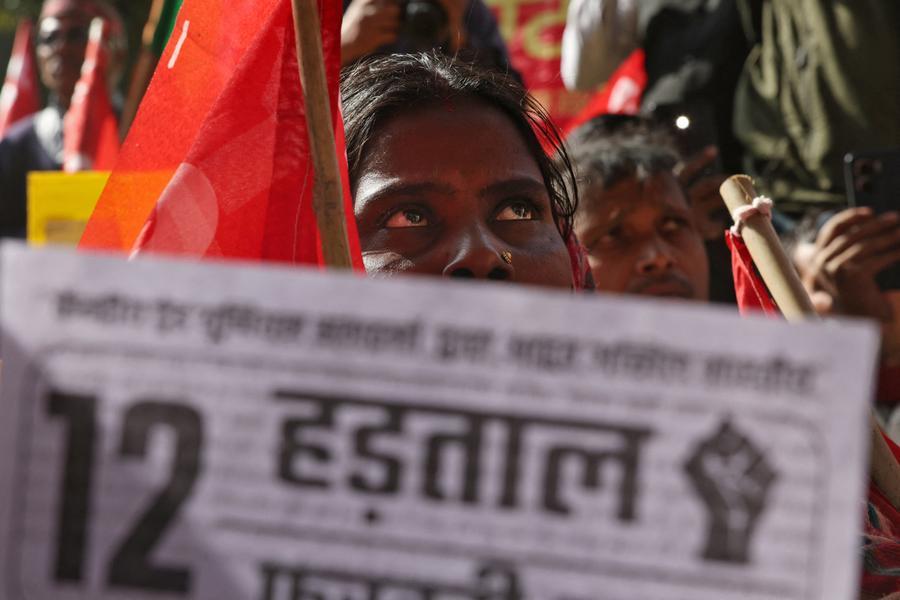
NEW DELHI: Thousands of Indian farmers staged protests across the country on Thursday, alleging the government has violated their interests in the US-India Interim Trade Framework, while the trade minister said safety measures were in place.
Farmers burned symbolic copies of the India-US trade deal in fields and at protests, claiming the government had proceeded without consulting them.
Opposition parties led by members of Congress also protested outside Parliament House, holding placards with slogans such as “Trap Deal” and “America’s Deal Destroys Farmers,” accusing the government of “abandoning” the interests of farmers and domestic industry.
The agreement revived memories of the 2020-21 protests that forced the government to withdraw and repeal three laws aimed at deregulating agricultural markets.
Trade Minister Piyush Goyal said most of India’s agricultural products are excluded from trade deals with the US and farmers’ interests are protected.
Goyal accused the opposition of misleading farmers and said key items such as dairy products, poultry, rice, wheat and some fruits and vegetables were not covered by the deal.
Rakesh Tikait, a prominent farmer leader, said, “Protests were held in states like Bihar, Haryana, Odisha, Karnataka and Tamil Nadu, where farmers asserted their rights to their land and vowed not to cede their fields to market forces.”
The Samyukt Kisan Morcha (SKM), a coalition of more than 100 farm organizations and opposition trade unions, had called for nationwide protests, saying the deal could allow subsidized imports of U.S. agricultural products, driving down domestic prices and hurting rural incomes.
Purushottam Sharma, another farmer leader protesting in Delhi, said the deal would hurt India’s farmers and the poor by lowering tariff barriers.
Workers also took part in demonstrations in industrial cities against the US deal and the government’s labor policies, said Amarjeet Kaur, general secretary of the All India Trade Union Congress, one of the main trade unions.
Local media reported that economic activity remained largely normal.
Goyal also said that once a bilateral trade agreement is signed, Indian textile and apparel exporters could benefit from zero tariffs on the use of US cotton. (Reporting by Manoj Kumar and Mayank Bhardwaj; Additional reporting by Bawika Chhabra; Editing by Muralikumar Anantharaman and Philippa Fletcher)
