


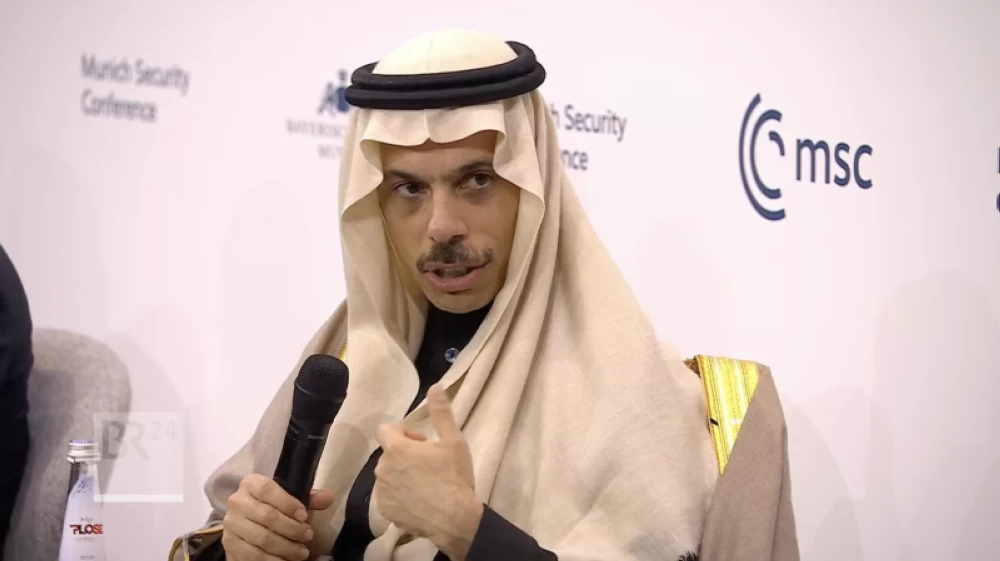
MUNICH – Saudi Arabia’s Foreign Minister Prince Faisal bin Farhan said the international order is “not working” and has failed to provide fairness and stability, noting that the war in Gaza and other global conflicts have exposed systemic flaws that can no longer be ignored.
Crown Prince Faisal spoke on Friday at the Munich Security Conference’s panel titled “Breaking Point: The International Order Between Reform and Destruction” and said the current ceasefire in Gaza cannot be considered credible if violence continues.
“It’s not a ceasefire unless the shooting stops,” he said.
He added that even if active fighting subsides, the humanitarian crisis will still persist.
“Even if the killings stop, the dying hasn’t,” he said, noting continued obstacles to accessing aid. “Access to aid remains an issue.”
The foreign minister said the immediate priority was to end the suffering in Gaza and stabilize the situation on the ground.
“The priority must be to stop the deaths in Gaza, stabilize the situation, start rebuilding, and build a sense of security that Gaza no longer poses a threat to its neighbors.”
Prince Faisal stressed that any resolution must ultimately address the rights of the Palestinian people.
He pointed out that the recently adopted resolution includes language affirming “the right of Palestinians to self-determination,” which he described as “a step on the path to self-determination for the Palestinian people.”
He stressed that durable solutions require a comprehensive approach that includes both Gaza and the West Bank.
“If we do not comprehensively address the rights of Palestinians, including Palestinians in the West Bank, and this is very important, the unity of the West Bank must be maintained,” he said. “That can only happen if we stabilize the situation in Gaza.”
With the hostages freed, Prince Faisal said his focus had to shift. “All the hostages have already been released, so now we need to focus on returning the lives of Palestinians in Gaza to a much better place,” he said.
Related articles

Saudi FM arrives in Munich to attend security conference
Turning to the broader international situation, Prince Faisal said the world system was undergoing a period of transition with significant risks.
“We are entering a period of significant risk,” he said, describing the shift “between the system we have had and the system we are likely to see.”
He warned that economic disparities and inequalities, particularly those driven by technological advances, could increase instability before delivering long-term benefits. “There’s going to be some pain along the way to get there,” he said.
Prince Faisal said the current international order, rooted in post-World War II reconciliation, reflects a “Eurocentric perspective” shaped by the European crisis.
“The reality is that many of us have witnessed the breakdown of the rules-based order and the reality that allows justice to be front and center long before the crisis occurs,” he said.
He added that countries in the developing world have long felt that the system has failed to deliver fair outcomes. “That’s what many of us have believed for over a decade,” he says.
But he expressed cautious optimism that world powers are now confronting these shortcomings more openly.
“We haven’t reached an agreement yet, but we are in the process of actually discussing it,” he said. “Everyone is telling us how they really feel about the system and how it didn’t work from their perspective.”
He noted that discussions about burden-sharing and equality between states are now taking place more openly, including among traditional supporters of the existing order.
“This is the first time I’ve actually heard that even in a large country, the system isn’t working and isn’t producing results,” he said.
Prince Faisal concluded that while reforms may be difficult, honest dialogue offers hope for a more balanced future international system.
“Over time, we will arrive at a better world, albeit with some pain,” he said.
