

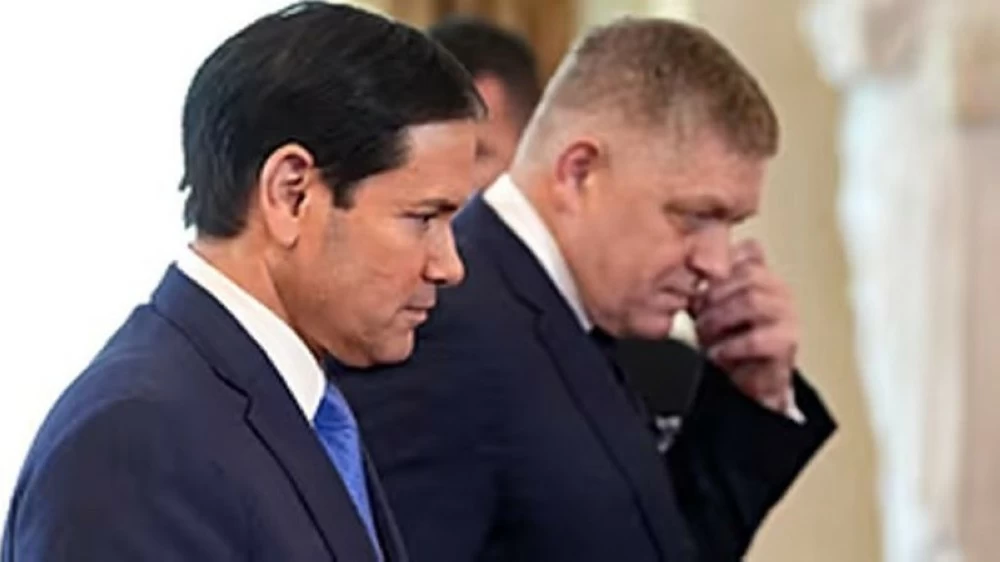
BRATISLAVA — U.S. Secretary of State Marco Rubio said the United States is not asking European allies to become client states, but they need to become less dependent on the United States. Rubio made the remarks at a joint press conference in Bratislava after meeting with Slovak Prime Minister Roberto Fico.
Slovakia is Rubio’s first stop on a tour of two Central European states, which he began on Sunday after attending the Munich Security Conference in recent days.
He traveled to Hungary after Slovakia, where he met with Prime Minister Viktor Orbán to discuss bilateral relations and strengthen ties with President Trump’s allies in the region.
Mr. Fico and Mr. Orban are key allies of the Trump administration in Europe, aligned with the U.S. government’s anti-immigration policies and sharing Mr. Trump’s vision for ending the war in Ukraine.
In response to questions from journalists, the top US diplomat downplayed the recent US decision to withdraw a limited number of US troops from the continent.
“We’re not leaving NATO. We may move thousands of troops from one country to another, but that’s business as usual,” Rubio told reporters.
“We don’t want Europe to depend on us, we don’t ask Europe to become a vassal of the United States. We want to be your partner. We want to work with Europe. And our argument is that the stronger you are, the stronger NATO members become, and the stronger NATO becomes.”
In a speech at the Munich Security Conference on Saturday, Rubio said the United States and Europe share a common destiny, but warned that Europe must reverse its cultural and economic decline and stop mass immigration.
Related articles

Palestinians condemn Israel’s move to seize land in the West Bank as ‘de facto annexation’
In January, many EU leaders expressed concern that US President Donald Trump’s ambition to occupy Greenland could weaken NATO.
Rubio declined to discuss recent negotiations with Denmark regarding Greenland in detail. He also downplayed Slovakia’s criticism of the U.S. military raid in Venezuela that led to the arrest of Nicolas Maduro.
Robert Fico said in January that the attack was a violation of sovereignty and international law.
“A lot of countries didn’t like what we did in Venezuela, and that’s fine. It was in our national interest. Someday he’s going to do something we don’t like, and we’re going to say, ‘Hey, we didn’t like what you did.’ So what? That doesn’t mean we won’t be friends,” the US secretary of state said.
Rubio also emphasized that Central Europe will be an important region for the current administration’s engagement with Europe during Trump’s second term as president.
Mr. Fico and Mr. Rubio discussed nuclear and military cooperation and continued peace efforts to end the war in Ukraine, which marks its fourth anniversary later this month.
The Slovak prime minister criticized the EU’s approach to continuing to support Ukraine financially and militarily.
Fico recalled that when the EU approved a 90 billion euro aid package for Ukraine at the EU summit in December, Slovakia, Hungary and the Czech Republic abstained.
Fico also harshly criticized the European Union’s decision to phase out Russia’s fossil fuel imports by 2027, saying it would have dire consequences for Russia and other countries. — Agency
