

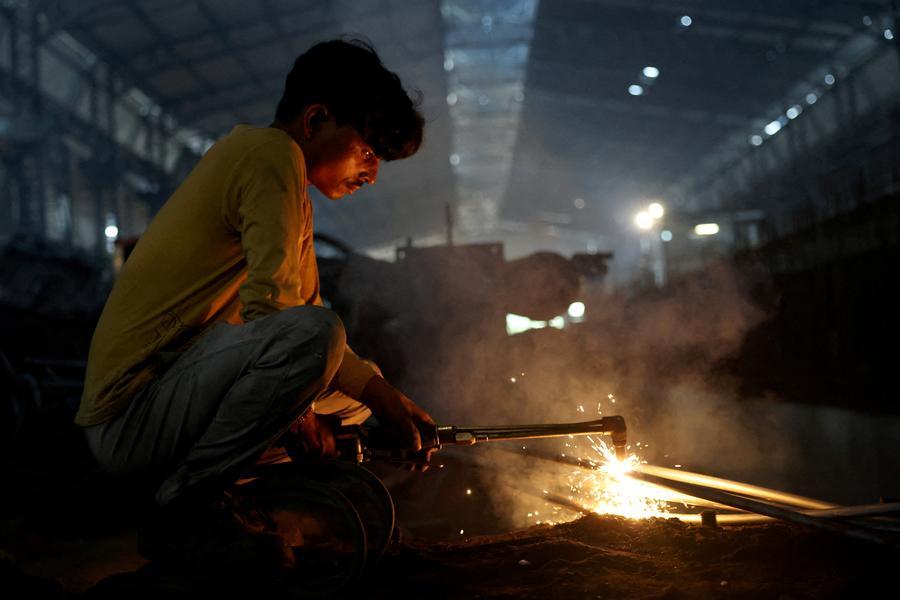
NEW DELHI: India is exploring new steel export markets in the Middle East and Asia to offset the impact of the European Union’s carbon tax, which took effect in January, government officials said.
India, the world’s second-largest producer of crude steel, ships about two-thirds of its steel exports to Europe, but flows are being squeezed by the EU’s carbon border adjustment mechanism.
Steel Secretary Sandeep Poundrik said last week the government needed to take action to support exports hit by the European carbon tax.
“In terms of exports, we are looking at new markets and trying to reach agreements with countries in the Middle East and Asia where a lot of infrastructure is going to be built,” said a person directly involved in the decision-making, declining to be named as the deliberations are confidential.
“Until now, our exports have been concentrated in Europe, but we are working to diversify,” the official added.
India’s federal steel ministry did not respond to an email seeking comment.
An executive at a major steel company said the mills were seeking government support to help them compete in non-EU markets dominated by China.
Steel exports from China, the world’s largest producer, have been on a recovery trend since 2023, hitting a monthly high in December. The Chinese government plans to introduce a licensing system this year to control alloy exports, as strong shipments have sparked a protectionist backlash around the world.
Securing raw materials
The official described India’s expanding efforts to secure supplies of raw materials such as coking coal, limestone, manganese and other critical minerals, and said New Delhi was increasingly pursuing long-term offtake agreements and asset acquisitions.
State-owned Steel Corporation of India (SAIL) and mining company NMDC are considering Brazil, Argentina, Australia and the Middle East, sources said.
SAIL and NMDC did not respond to emails seeking comment.
“We are considering Australia for acquiring coking coal assets,” the person said.
Currently, around 95% of the sector’s coking coal demand is met by imports, with Australia supplying more than half.
Last year, NMDC announced it was exploring coking coal assets in Indonesia and Australia. (Reporting by Neha Arora; Editing by Mayank Bhardwaj and Mark Potter)
