


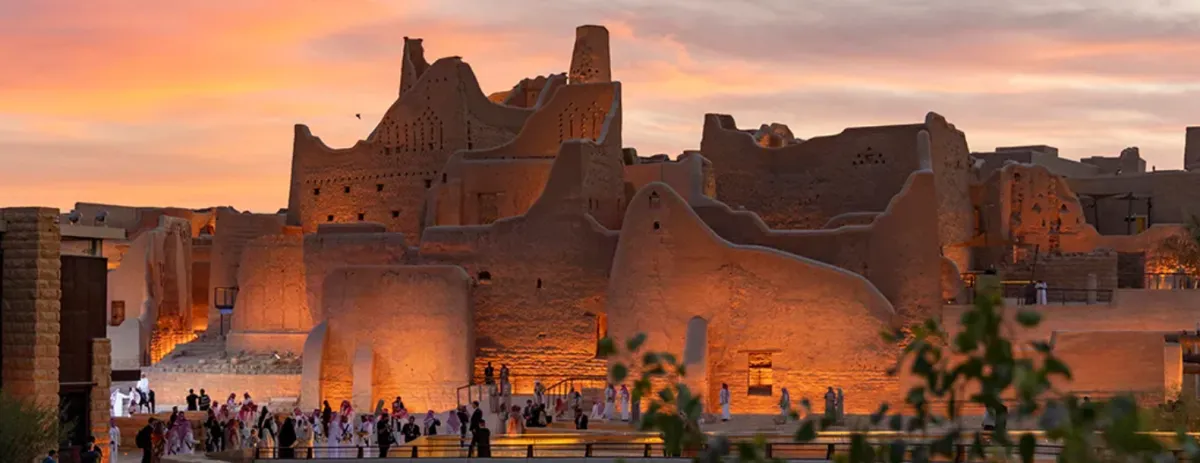
Women’s resistance during the Ottoman expedition against Diriyah and other parts of the First Saudi State and later the Second Saudi State was a severe test of the society’s ability to endure.
The conflict was not limited to the battlefield. It spread throughout the social fabric, with women playing a crucial role in preserving and maintaining the cohesion of communities under siege and in the face of destruction.
Dr. Fatma bint Hussein Al-Fardan al-Kutani, a professor of history at King Saud University, told Asharq Al-Awsat that acknowledging the presence of women in the resistance does not mean giving them a typical combat role. It means recognizing the practical responsibilities imposed by society and the historical moment itself.
Daily resilience under siege
During the Ottoman siege, Diriyah was more than just a battlefield. It was a community under total pressure, and women were at the center of it.
They ran households in the absence of men, protected children and property, cared for the wounded, secured all the food they could, and held the social fabric together at critical moments of survival.
Ottoman reports treated Diriyah not as an isolated army, but as a complete society, al-Kutani pointed out. This helps explain the drastic capture and deportation measures imposed on women and children after the fall of the city. Resistance is not just about weapons, but an implicit recognition of a community that believed in the cause and defended it to the end.
Foreign accounts add another layer. Harford Jones, on the British Empire’s mission in the region, cited the French historian Félix Menzin, who was at the court of Muhammad Ali Pasha at the time and had access to correspondence related to Ibrahim Ali Pasha’s campaign.
According to the account, when Imam Abdullah bin Saud learned that Ibrahim Pasha was not in the camp, he ordered an attack on the entire Turkish line. The battle lasted for hours in the scorching heat, with continued gunfire and fierce exchanges.
Amid the clashes, Saudi women were seen carrying water bottles and moving through live ammunition to resupply defending fighters. The image is clear. Rather than being distant symbols of morale, women are active participants in danger, embodying sacrifice and solidarity in defense of the nation and identity.
From the trenches to alert status
Al-Kutani cited the events at Shakra in 1233 AH (1818) as a clear example of women’s direct involvement during Ibrahim Pasha’s march to Diriyah.
The town is surrounded by trenches, the construction of which began during the time of Tusun Pasha and then stalled. As the threat intensified, the chief ordered the completion of trenches in anticipation of a prolonged siege.
Both men and women were mobilized together. Women participated in digging and support work, enduring harsh conditions. According to al-Kutani, their role went beyond moral support. They were physically involved in fortifying the town and defending the community.
Women also participated in a widespread sense of security against the war. During the siege of Al-Ras, Ottoman forces attempted to enter the city by digging tunnels under the city walls at night. A woman who was grinding grain until late at night heard an unfamiliar sound near her house and felt threatened.
She reported it to Sheikh Qurnas bin Abdulrahman bin Qurnas, Emir of Al Ras. This alert allowed the defenders to act quickly. The chief ordered counter-entrenchments to be built to thwart this attempt.
The episode emphasizes that women’s role in the resistance is neither emotional nor symbolic, al-Kutani said. It acted with vigilance and responsibility as part of a collective defense effort that spanned all strata of society.
When survival meant having a weapon
Women’s involvement was not limited to patience and support. Reading Nazidi and Ottoman sources in context suggests that some women participated in armed defense in moments of extreme danger, especially during sieges.
“In a besieged society, where survival itself is a battle, carrying weapons is not strictly limited to men,” Alqutani said. “It can be a direct act of protecting yourself and your place.”
Although the sources do not record the names of the specific women in these cases, references to the participation of “the people of Diriyah” in fighting within the city and in its defense allow for a broader understanding of women as members of an armed internal front in case of need.
Al-Kutani cited Gharia al-Bakamiya as one of the most notable examples of women directing military leadership during the Ottoman Empire’s military campaign against the Saudi First State.
Félix Mengin, the French consul in Cairo at the time, described the circumstances surrounding the Ottoman advance, including the arrival of troops in Turba and the three-day siege they faced to quell it.
The town took a resolute stance. Gharia al-Baqamiyyah played a central role, boosting the morale of the fighters of her tribe, al-Bukum. Some sources said she went out at the head of a group of her men to confront the attackers.
This confrontation coincided with the arrival of Saudi reinforcements and led to the Battle of Wadi al-Slam. The fighting was fierce and ended with the Ottoman army being defeated and retreating towards Taif, leaving behind casualties and considerable spoils, one of the most serious setbacks of the campaign.
According to al-Kutani, this episode makes one point clear: women are not at the edge of resistance. At key moments, they assumed leadership roles that directly shaped the course of battle, embedding their presence in the history of defending nations and societies.
