

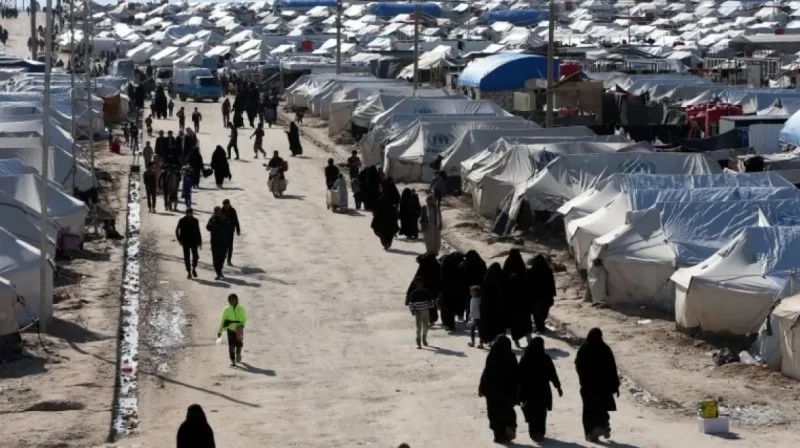
Today (Sunday), Syrian authorities announced the closure of al-Hawl camp, the country’s largest camp run by Kurdish forces and which has housed families of ISIS terrorist fighters for years, after its last residents were evacuated.
Camp director Fadi al-Qassim confirmed that the camp was closed today after all Syrian and non-Syrian families were transferred, explaining that the government had drawn up a development plan to reunite the families away from the media.
Integrate the population of Al Hawl Camp
Al Qassim pointed out that women and children in the camp need support to integrate into society.
Meanwhile, a source from a humanitarian aid organization working in Al Khor camp said, “All teams belonging to organizations working in the camp have been evacuated, and all equipment and prefabricated rooms have been dismantled and taken out of the camp.”
About 24,000 people are in the camp, including about 15,000 Syrians and about 6,300 foreign women and children of 42 nationalities, and although most countries are refusing to take them in, their numbers have fallen significantly in recent weeks.
Six buses carrying around 400 residents of al-Hawl camp arrived at the well-equipped camp near the town of Akhtarin in the northern countryside of Aleppo.
Arab and Syrian media confirmed that after Kurdish forces withdrew from the camp in late January, most of the foreigners in the camp left, while Syrian security forces, who were deployed across large areas in the north and east of the country, took control of the camp.
Stages of Al Hawl Camp Establishment
Al-Hawl camp was established in 1991 to take in Iraqi refugees fleeing the Iraq war, and reopened after the 2003 invasion of Iraq to take in a new wave of refugees. In April 2016, the Self-Defense Forces reopened the camp as a shelter for thousands of refugees who had fled areas controlled by the terrorist group ISIS.
The camp has experienced significant demographic changes since its reopening in the late 20s of the 21st century. The population grew from 10,000 displaced people at the beginning of 2019 to 74,000 by April 2019, due to an influx of families of ISIS fighters following consecutive defeats at the hands of international coalition forces, the last of which was the Battle of Baguz Foqani in February. September 2019.
In early 2025, dozens of Iraqi families departed for their home countries in several batches as part of a repatriation plan coordinated by Baghdad authorities in cooperation with the North and East Syrian Autonomous Government, significantly reducing the number of displaced people in the camps. As of June 2025, there are approximately 37,000 people in the camp, most of them from Syria and Iraq, including approximately 6,500 displaced persons from 42 nationalities from different countries around the world, including Europeans and Asians.
In late May 2025, the Autonomous Government announced that it had reached an agreement with the Syrian government in the capital, Damascus, providing for the evacuation of Syrian nationals from al-Hawl camp. The agreement followed a tripartite meeting that included representatives from the autonomous government, the Syrian government and the United Nations, which approved a “joint mechanism” for the return of Syrian families.
Syrian authorities today (Sunday) announced the closure of Al-Hol camp, the country’s largest camp controlled by Kurdish forces, which has housed families of ISIS fighters for years, after evacuating its last residents.
Fadi al-Qassem, the camp director, confirmed that the camp was closed today after all Syrian and non-Syrian families were relocated, explaining that the government was developing a family reunification plan away from the media.
Integration of Al-Hol Camp Residents
Ms. Al Qassem noted that women and children in the camps need support to integrate.
Meanwhile, an official from a humanitarian aid organization working in Al-Hol camp said, “All the organization’s teams working inside the camp have been evacuated, and all equipment and prefabricated rooms have been dismantled and moved outside the camp.”
The camp holds about 24,000 people, including about 15,000 Syrians and about 6,300 foreign women and children from 42 countries, whose numbers have declined significantly in recent weeks, although most countries are refusing to send them back.
Six buses carrying about 400 residents of Al-Hol camp arrived at the ready camp near the town of Akhtarin in the northern countryside of Aleppo.
Arab and Syrian media confirmed that the majority of foreigners in the camp had left after Kurdish forces withdrew from the camp in late January, while Syrian security forces took control of the camp, which spread across large swaths of the country’s north and east.
Stages of establishing Al-Hol camp
Al-Hol camp was established in 1991 to host Iraqi refugees fleeing the Iraq war, and was reopened after the 2003 invasion to host a new wave of refugees. In April 2016, the Syrian Democratic Forces (SDF) reopened the camp as a shelter for thousands of displaced people who had fled ISIS-controlled areas.
The camp experienced a major demographic change after its reopening in the late 2010s, with its population increasing from 10,000 in early 2019 to 74,000 by April 2019, following an influx of families of ISIS fighters who were successfully defeated by international coalition forces. The most recent battle was the Battle of Bugs Forkani on February 9, 2019.
By early 2025, the number of displaced people in the camps had significantly reduced as dozens of Iraqi families successfully returned to the country as part of a repatriation plan coordinated by Baghdad authorities in cooperation with the Autonomous Government of North and East Syria. As of June 2025, the camp is housing approximately 37,000 people, most of them from Syria and Iraq, and approximately 6,500 displaced people from 42 nationalities from around the world, including Europeans and Asians.
In late May 2025, the “Autonomous Government” announced that it had reached an agreement with the Syrian government in the capital Damascus to evacuate Syrian nationals from Al-Hol camp. The agreement followed a tripartite meeting that included representatives from the autonomous government, the Syrian government and the United Nations, which approved a “joint mechanism” for the repatriation of Syrian families.
