

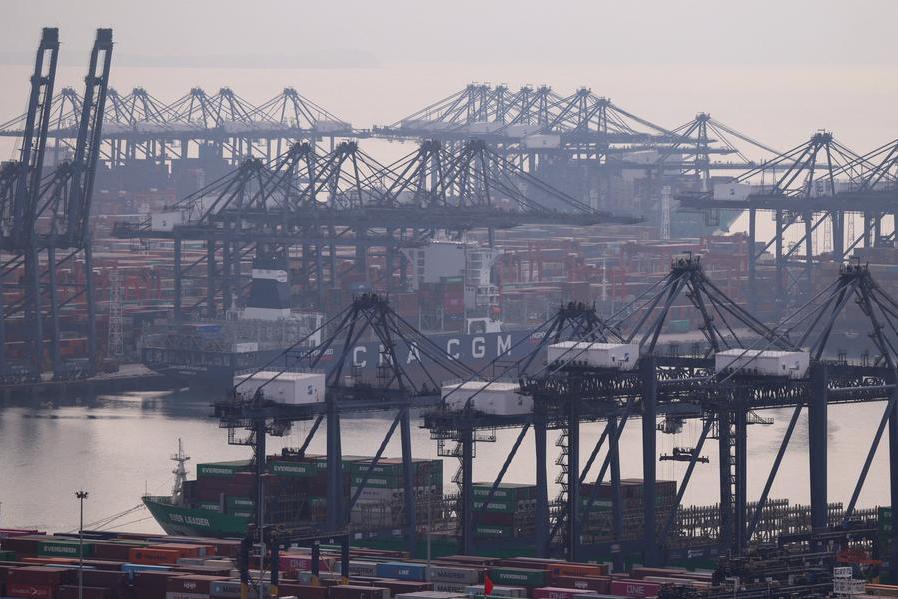
BEIJING/HONG KONG/SEOUL – China has “fully evaluated” the US Supreme Court’s tariff ruling, warned that fighting between the two countries is “harmful” and urged the US government to lift “unilateral tariff measures” against trading partners.
China’s Commerce Ministry’s comments on Monday came days after the U.S. Supreme Court handed President Donald Trump a stinging defeat on many of the tariffs he has imposed in the global trade war, including against rival China.
Within hours of the ruling, President Trump said he intended to impose a new 10% tariff on all U.S. imports starting Tuesday, and later said he would raise it to 15%, a move that appeared to surprise some officials at home.
“The US’s unilateral tariffs… violate international trade rules and US domestic law, and are not in the interests of any party,” the Chinese ministry said.
“Cooperation between China and the United States is beneficial to both sides, but fighting is harmful,” he said.
Trade and tariffs are expected to dominate the agenda for both China and the United States ahead of President Trump’s long-awaited visit to China in late March or early April, when he is expected to meet with Chinese President Xi Jinping.
President Trump’s new levy is based on a separate, untested law known as Section 122, which would allow tariffs of up to 15%, but any extension beyond 150 days would require Congressional approval. No president has ever invoked Section 122, so its application could lead to further legal challenges.
“China will continue to pay close attention to this matter and firmly protect its interests,” the Commerce Ministry said.
Gao Lingyun, a researcher at the Chinese Academy of Social Sciences, was quoted in the state-run Global Times as saying the US tariff decision was “highly arbitrary” and was being used as a “political weapon”.
“Tariff policy should be based on rigorous evaluation, not political preferences,” he was quoted as saying.
The U.S. court ruling invalidated a number of tariffs imposed by the Trump administration on Asian exporting powers from China and South Korea to Japan and Taiwan, the world’s largest semiconductor maker and key player in the high-tech supply chain.
Uncertainty looms amid new global tariffs
South Korea said it would continue to consult with the United States to maintain a “balance of interests” between the two countries, but the industry minister said there were concerns among officials across industries, including autos, batteries and chips.
“The public and private sectors need to work together to ensure the export competitiveness of Korean companies and diversify markets,” Industry Minister Kim Joong-kwan said on Monday.
India has postponed plans to send a trade delegation to Washington this week to finalize an interim trade agreement, a trade ministry official said. This is mainly due to new uncertainties regarding tariffs from the United States.
US tariffs on Indian goods will be reduced to 18%, while India has agreed to buy $500 billion worth of US goods over five years, ranging from energy supplies to aircraft and parts to precious metals and technology products.
Meanwhile, in Europe, European Central Bank President Christine Lagarde warned of business risks, saying companies wanted predictability rather than legal battles. He said any new tariff plans must be clearly defined to avoid further challenges and ensure compliance with the U.S. Constitution.
“To shake things up again would be chaotic,” Lagarde said on CBS’ “Face the Nation.”
(Reporting by Xiuhao Chen, James Pomfret and Ryan Woo in Beijing and Hong Kong; Manoj Kumar in India and Hyunjoo Jin in South Korea; Editing by Anne Marie Roantree, Christian Schmollinger and Michael Perry)
