


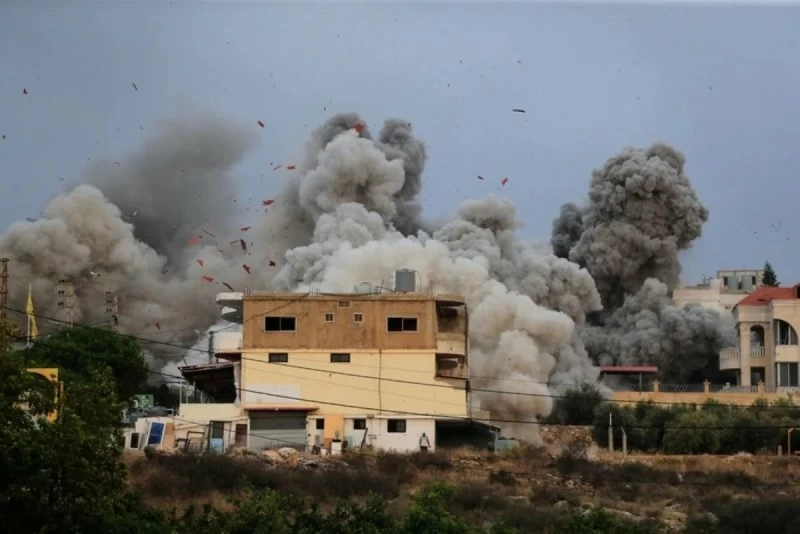
Last Friday night, the Bekaa moved from the fringes of the conflict to the center. The Israeli Air Force carried out a series of simultaneous raids targeting al-Nabi Sheet, Rayak, Ali al-Nahri and Tamunin in what is said to be the largest operation in the region since the cease-fire agreement.
The airstrikes, carried out without prior warning, hit residential buildings, one of which was said to contain a local Hezbollah gathering, with Hezbollah mourning scores of members and the Ministry of Health announcing deaths and injuries.
The timing of the operation was not disclosed in detail, as it came amid rising tensions in the region and returning talk of a possible direct confrontation between Israel and Iran, but the attacks here in particular go beyond the on-the-ground dimension.
The choice of Friday night was not arbitrary. The airstrike came at the end of a political and security week filled with statements and leaks regarding escalation scenarios in the region. In reality, Israel acted in advance of any possible deployment by taking clear field measures to shift fire to the depths of what were considered the party’s logistics arteries, after the operation was concentrated in the south.
The first sign is that geography is no longer an obstacle. What had been seen as a reserve, relatively far from the line of engagement, became a direct target. This means that any Lebanese or regional calculations regarding the existence of a “safe distance” disappeared on Friday night.
A second importance is related to regional timing. Given the rising tensions between Tel Aviv and Tehran, the strike appears to be an attempt to rebalance the risks before any major developments occur. The message is simple. If the conflict escalates, Lebanese military institutions will be under pressure from the first moment, and this will not be just a local response, but a process of reducing profit margins.
But on the other hand, so far there is no sign of a decision for all-out war, no widespread call-up of reservists, no transition to continued heavy artillery bombardment, no political announcement of goals beyond a specific attack. What’s happening is more like pushing the ceiling on engagement even higher than completely turning the tables.
What is dangerous is the fact that this limit is higher than before. When Bekaa is targeted with such intensity, subsequent reactions become governed by more complex equations. Long silences are costly, and large-scale responses open the door to escalation that is difficult to control.
Is Lebanon on the brink of a delayed attack? So far, it does not appear that the time for comprehensive confrontation is ticking, but on Friday night a new line was drawn on the scene. The southern part is no longer the only place where the fires occur, and the depth of the fire is no longer out of the question.
Between these two transformations, Lebanon stands in a very sensitive area. A single local decision can turn a limited attack into an open conflict within days or even hours.
So this scene is not a declaration of war, but it is also not a momentary detail. The next stage depends on one question: will the message remain in control or will it turn into a spark beyond the owner’s intentions?
Last Friday night, the Bekaa moved from the periphery to the center of the conflict as the Israeli Air Force carried out a series of simultaneous airstrikes targeting Nabi Sheet, Riyak, Ali al-Nahri and Tamunin. The operation is said to be the largest in the region since the cease-fire agreement.
The airstrikes, carried out without prior warning, hit residential buildings, one of which was reportedly hosting a local Hezbollah rally, and mourned several Hezbollah members, while the Health Ministry announced casualties.
The timing of the surgery was not detailed. It occurred at the peak of regional tensions, coinciding with renewed discussions about the possibility of direct confrontation between Israel and Iran. The attack here goes beyond a direct military dimension.
The choice of Friday night was not arbitrary. The airstrike comes at the end of a politically and security-intensive week that saw a flurry of statements and leaks about escalation scenarios in the region. In fact, after concentrating its operations in the south, Israel pre-empted a potential deployment with a clear military step, shifting fire deep into what was considered a major logistical artery for the party.
The first implication is that geography is no longer a barrier. What was considered a stockpile relatively far from the line of battle became a direct target. This means that the Lebanese or regional calculations regarding the existence of a “safe distance” were made on Friday night.
The second meaning is related to regional timing. With tensions rising between Tel Aviv and Tehran, the strike appears to be an attempt to rebalance the risks before any significant developments occur. The essence of the message is simple. If the conflict escalates, Lebanon’s military will be under pressure from the first moment, and this will be a process of closing the gap, not just a local response.
On the other hand, so far there has been no sign of a decision on a comprehensive war, no call-up of large-scale reserves, no shift to continuous intensive bombing, no political announcement of targets beyond specific attacks. Rather than completely turning the tables, what’s happening is more like pushing the ceiling on engagement even higher.
The danger lies in the fact that this limit is higher than before. When Bekaa is targeted with such intensity, subsequent reactions are bound by more complex equations. Long silences are costly and serious responses open the door to escalation that is difficult to control.
Is Lebanon on the brink of postponing the strike? So far, it does not seem like the time for comprehensive confrontation has arrived, but last Friday a new line was drawn in this situation. The South is no longer the only battlefield, and depth is no longer far from the calculation.
Between these two transformations, Lebanon stands in a very sensitive area. A single local decision can turn limited airstrikes into open conflict within days or even hours.
So this scene is not a declaration of war, but it is also not a momentary detail. The next stage depends on one question: Will the message remain under control or will it turn into a spark beyond the sender’s intentions?
