


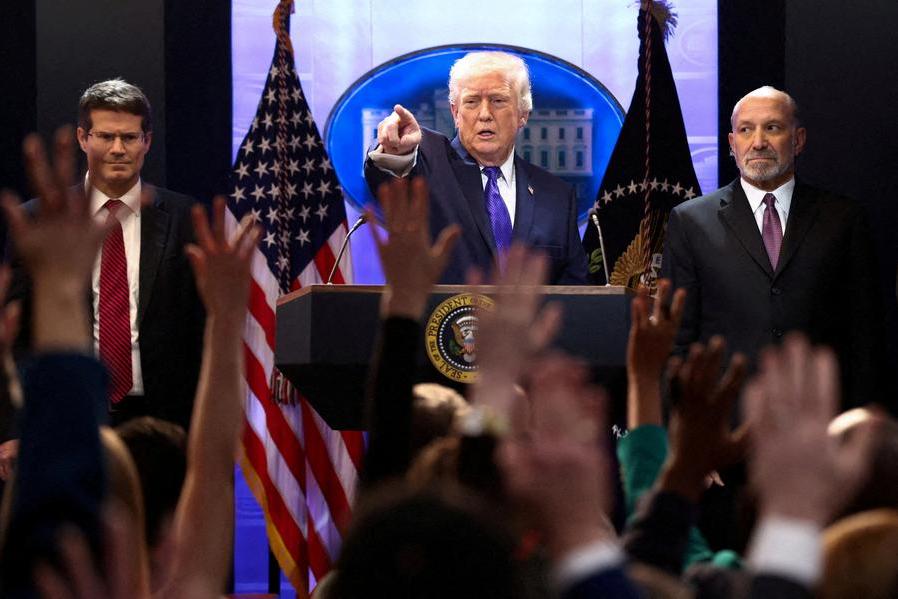
President Donald Trump renewed his condemnation of the U.S. Supreme Court on Monday after it ruled against his comprehensive tariff program last week, vowing to look to other tariff powers and authorizations, without providing details.
“The court has approved all the other tariffs, and there are many, all of which can be used in far more powerful and offensive ways, with more legal certainty than the tariffs originally used,” he said in a social media post.
A day after a court ruled that Trump exceeded his presidential authority when he imposed a series of high tariffs under the Economic Emergency Act, Trump announced on Saturday that he would increase interim tariffs on U.S. imports from all countries from 10% to 15%, the highest level allowed under the law.
In a post on Monday, Trump also raised the possibility of using licenses to pressure countries, writing: “Inexplicably, according to the ruling, (I) can’t charge a license fee, but all licenses charge a fee, so why can’t the United States do that? We’re getting licenses to get fees! The opinion doesn’t explain it, but I know it.” The answer is! ”
Wall Street futures and the dollar fell early Monday amid turmoil over U.S. trade policy, while oil prices initially fell on global economic growth and uncertainty in fuel demand over recent tariff hikes, but stabilized on news that talks between the U.S. and Iran were planned.
The decision and President Trump’s subsequent actions have already affected trade deals struck over the past year, with China urging the United States to lift tariffs, the European Union seeking to freeze the deal and India postponing scheduled talks.
Trump used social media posts to again slam the judges who ruled against him, including two he appointed during his first term in the White House. In the decision, written by conservative Chief Justice John Roberts, the court reasserted its authority to check the president’s power.
The president also expressed concern that the Supreme Court could rule against the administration’s efforts to limit birthright citizenship in a future decision in this case.
(Reporting by Susan Heavey; Editing by Doina Chiak and William MacLean)
