


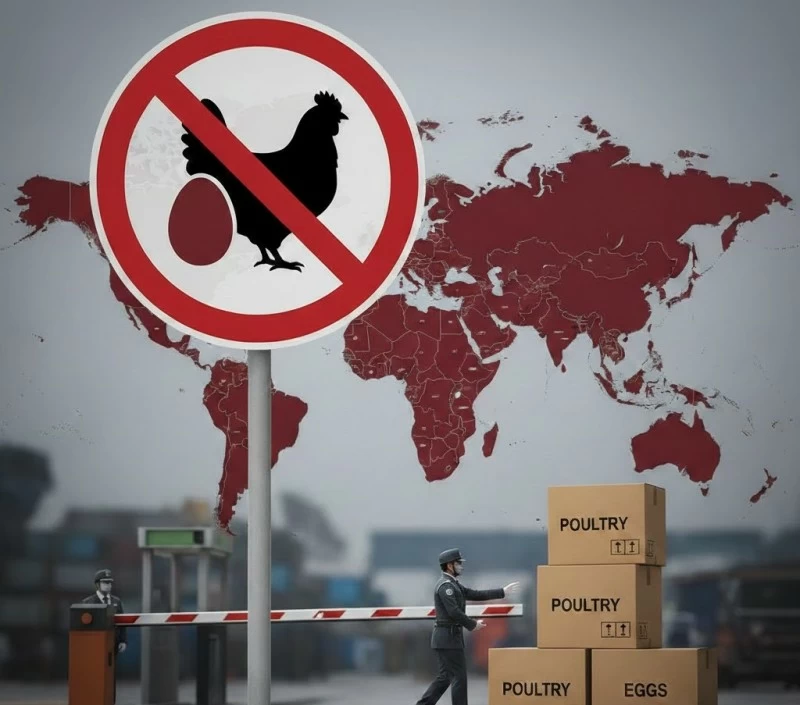
As part of precautionary measures aimed at protecting public health and improving food safety on the local market, the Saudi Food and Drug Authority has banned the import of poultry and table eggs from 40 countries into the Kingdom of Saudi Arabia, and imposed a partial ban on provinces in 16 other countries, stressing that the list will be regularly reviewed in response to global health developments.
According to the list of banned countries in the latest update (reviewed by Okaz), some banning decisions have been in place since 2004, while others have been added successively over the past few years based on risk assessments and international reports related to animal diseases, in particular “virulent avian influenza outbreaks”, reflecting a continuous surveillance approach to track the development of the global epidemiological situation.
According to the latest information, the total ban includes “Afghanistan, Azerbaijan, Germany, Indonesia, Iran, Bosnia and Herzegovina, Bulgaria, Bangladesh, Taiwan, Djibouti, South Africa, China, Iraq, Ghana, Palestine, Vietnam, Cambodia, Kaza Fustan, Cameroon, South Korea, North Korea, Laos, Libya, Myanmar, United Kingdom, Egypt, Mexico, Mongolia, Nepal, Niger, Nigeria, India, Hong Kong, Japan, Burkina Faso, Sudan, Serbia, Slovenia, Ivory Coast, Montenegro.
Partial prohibition
The partial ban also includes states and cities in 16 countries: “Australia, the United States, Italy, Belgium, Bhutan, Poland, Togo, Denmark, Romania, Zimbabwe, France, the Philippines, Canada, Malaysia, Austria, and the Democratic Republic of the Congo.”
The authorities have confirmed that poultry meat and products thereof that have been heat-treated or processed by other methods capable of eliminating avian influenza/Newcastle virus are exempted from the temporary ban only if they comply with health requirements and controls and approved standards and are accompanied by a health certificate certifying that the product has been heat-treated or processed by other methods capable of eliminating avian/Newcastle virus. It’s from the facility. Certified.
The Saudi Food and Drug Authority has banned the import of poultry and table eggs from 40 countries into the Kingdom of Saudi Arabia and imposed a partial ban on 16 other countries, as part of precautionary measures aimed at protecting public health and improving food safety in the local market, and has confirmed that the list will be regularly reviewed in response to global health developments.
The latest update (reviewed by Okaz) shows that the list of banned countries indicates that some of the bans have been in place since 2004, while others have been added gradually over the past few years based on risk assessments and international reports on animal diseases, most notably the “highly pathogenic avian influenza outbreak,” reflecting a continuing regulatory approach to monitoring the evolution of the global epidemiological situation.
According to the latest information, the total ban includes “Afghanistan, Azerbaijan, Germany, Indonesia, Iran, Bosnia and Herzegovina, Bulgaria, Bangladesh, Taiwan, Djibouti, South Africa, China, Iraq, Ghana, Palestine, Vietnam, Cambodia, Kaza Fustan, Cameroon, South Korea, North Korea, Laos, Libya, Myanmar, United Kingdom, Egypt, Mexico, Mongolia, Nepal, Niger, Nigeria, India, Hong Kong, Japan, Burkina Faso, Sudan, Serbia, Slovenia, Ivory Coast, Montenegro.
Partial prohibition
The partial ban also includes states and cities in 16 countries: “Australia, the United States, Italy, Belgium, Bhutan, Poland, Togo, Denmark, Romania, Zimbabwe, France, the Philippines, Canada, Malaysia, Austria, and the Democratic Republic of the Congo.”
The Authority confirmed that poultry meat and products thereof that have been thermally treated or otherwise processed to eliminate avian influenza/Newcastle virus are exempt from the temporary ban, provided that they meet health requirements, meet approved standards and are accompanied by a health certificate issued by the official competent authority of the exporting country certifying that the product has been thermally treated or otherwise processed to eliminate avian influenza/Newcastle virus. Certified facility.
