


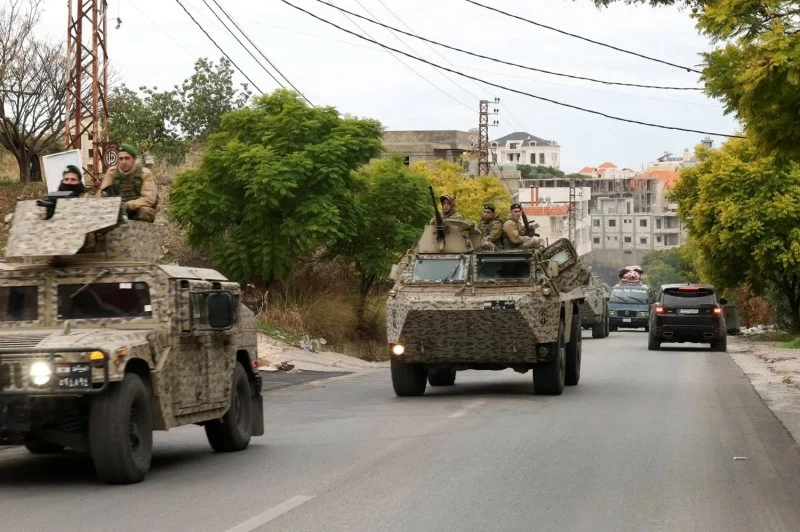
North of Litani, one fact is indisputable. This means that without pressure, nothing moves.
The second phase of the arms control program was not initiated because the Lebanese situation suddenly matured or because the contradictions were resolved, but rather because the balance of pressures escalated to an unprecedented level. Some countries are aware of the pressure from the United States to link support for the military to results on the ground, the daily threat of Israeli artillery fire far beyond their borders, and the threat to their credibility and that of foreign countries if they delay implementation.
But north of the Litani River is not just an extension of what happened south of the river under the watchful eye of UNIFIL forces. This area is larger, more complex, and more sensitive. According to information and data, the presence of public buildings, warehouses and tunnels means that any military action has political and security implications, and even the smallest mistake can become a testing ground for internal and external balances.
Variation between parties
The first thing that strikes you at this stage is the contrast. How can speeches refusing to surrender arms and disciplined government engagement coexist? How could such a sensitive decision be passed without Hezbollah opposition within the Council of Ministers? Are we facing contradictions and calculated divisions of labor?
Publicly, Hezbollah Secretary-General Naim Qasem’s speech was decisive in refusing to hand over the arms, but inside the agency the situation appeared to be different. Party ministers did not oppose the announcement of the second phase of the arms control plan and did not withdraw from last week’s cabinet meeting, which passed the decision to move to northern Litani. This difference is not a formal detail, but rather reflects dual management on the ground after Hezbollah was forced to go through this stage, both internally and externally.
On the other hand, states are operating under pressures of a different kind. Announcing a second phase and setting an extendable four-month deadline gives everyone the right to implement rather than extravagant maneuvers. States now need to prove that the decision is not an additional political statement and that the transition between stages is not just a linguistic arrangement.
international pressure
The international pressure is clear. The United States views the second phase as a measure of the Lebanese government’s seriousness. Any postponement, even leaving the deadline open without a decision, could be interpreted as an opportunity to rebuild the party’s capabilities, reducing confidence and possibly hindering military and financial support for the army, where time also turns into an element of pressure. Each week the start of the second phase is delayed, there may be more gray areas for Hezbollah.
In this context, the Lebanese Armed Forces Support Conference scheduled for March 5 could give further impetus to the second phase of the arms control plan. International funding and support provides countries with additional guarantees and increases their ability to implement measures on the ground, but does not eliminate the realities on the ground and the complexity of the Israeli threat. Postponement still carries risks, making a political solution more urgent than ever.
Israeli attack
Meanwhile, Israel is not just a bystander. Escalating strikes, assassinations, increased vigilance, and daily reconnaissance all pose constant risks and require the Lebanese state to leave no strategic vacuum. Stagnation in any field or politics can lead directly to a reallocation of power.
The reality is, however, that although the Lebanese military has set deadlines, he will carry out what is asked of him within the available capabilities. Because he does not have enough political resolve to move, deploy, or move on to another phase of arms transfer. Because he needs clear and final political cover. So, like moving chess pieces on a board where the end of the game is unknown, every step inside Northern Litani may be merely a tactical move rather than a strategic one.
The final equation for the second stage is that the military has a plan without deadlines or full political cover, the international community has pressure tools, and Israel has firepower, but none of this will be enough without a complete political solution.
This is the real test. It is not about proliferation or rhythm control, but about declaring a clear end to the course of weapons.
