


TOKYO – Sentiment remained subdued during Friday’s Asian trading day as concerns over technology companies’ valuations weighed on stock prices and tensions in the Middle East kept energy markets on edge.
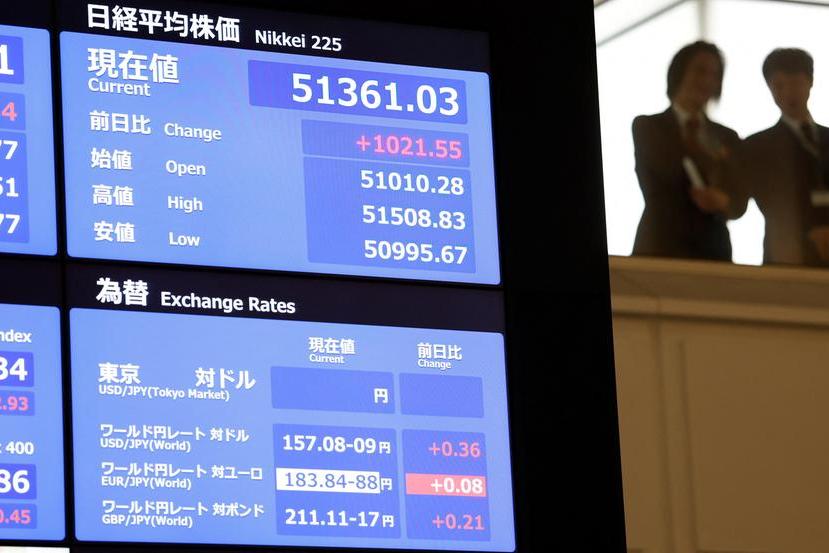
Japanese stocks followed Wall Street in falling after the stellar performance of Nvidia, a pioneer in the AI field, failed to impress investors. The yen and US Treasuries rose, but gold held firm after two consecutive days of gains.
The Omani mediator in the US-Iranian nuclear talks expressed optimism about the latest round of negotiations, but uncertainty remains in the energy market and there is no sign of a breakthrough averting a potential US attack.
“AI and geopolitics remain at the heart of financial markets, prompting an exit from risk assets and a shift towards safe assets,” Mantas Vanagas, senior economist at Westpac Group, said in a note.
“With no significant progress announced in US-Iranian talks, oil markets remained in wait-and-see mode and continued to price in a significant risk of military escalation between the two countries,” he said.
MSCI’s broadest index of Asia-Pacific stocks outside Japan fell 0.4%, while Japan’s Nikkei average fell 0.8%.
Nvidia on Wednesday announced better-than-expected results for the January quarter and expected revenue for the current quarter to beat market expectations. However, U.S. stocks ended lower and the company’s shares were flat in after-hours trading.
U.S. stock futures fell in Asian trading, with the S&P 500 E-mini down 0.41% and the tech-heavy Nasdaq 100 E-mini down 0.36%.
IG market analyst Tony Sycamore said in a note about NVIDIA’s performance that “it appears ‘The Street’ simply wanted more or was not ready to chase the stock at its current lofty valuation.”
The dollar index, which measures the US dollar against a basket of currencies, rose 0.04% to 97.77, while the euro was little changed at $1.1797.
The yen rose 0.2% to 155.86 yen to the dollar. The pound stabilized at $1.3482.
Omani Foreign Minister Sayyid Badr al-Busaidi said in a post on X after the same day’s talks in Switzerland that the United States and Iran plan to resume negotiations over Tehran’s nuclear program after talks in both countries’ capitals.
A significant step forward could curb the possibility that U.S. President Donald Trump will carry out threatened attacks against Iran that many fear could lead to a broader war.
The yield on the benchmark 10-year U.S. Treasury note fell 1.5 basis points to 4.002%. The 30-year bond yield fell 1.3 basis points to 4.6565%.
Japanese data showed slower-than-expected inflation and lower-than-expected factory output in Tokyo, complicating the case for the central bank to raise policy rates. The data was released shortly after Prime Minister Sanae Takaichi recommended two candidates for the Bank of Japan’s board of directors who share his fiscally dovish views.
The People’s Bank of China announced on Friday that it would eliminate currency risk reserves on some futures contracts in a move to reduce the cost of buying dollars.
Last year, the renminbi recorded its biggest annual rise against the dollar since 2020, rising above the psychologically important 7 yuan to dollar level, and the upward momentum has continued into the new year.
A by-election in the UK will be closely watched as a defeat for Labor following criticism of recent policy changes could put further pressure on Prime Minister Keir Starmer.
Opinion polls show that in Gorton and Denton, in Greater Manchester in northwest England, the vote is too close to be decided between Labor, the populist British Reform Party and the left-wing Green Party.
Spot gold fell 0.23% to $5,175.03 per ounce, while U.S. crude oil rose 0.09% to $65.27 per barrel.
Among virtual currencies, Bitcoin fell 0.3% to $67,290.45, and Ethereum fell 0.68% to $2016.78.
(Reporting by Rocky Swift; Editing by Tom Hogue)
