


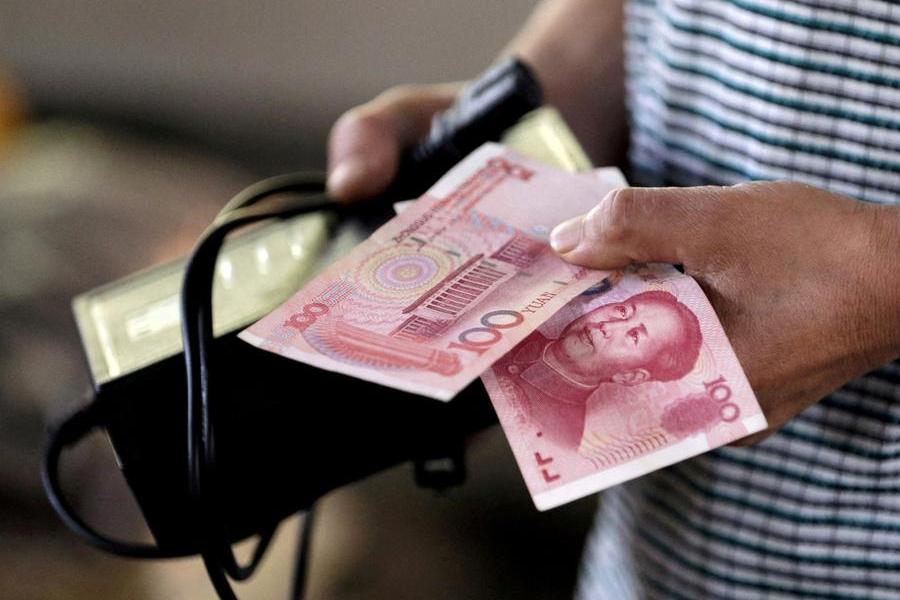
SINGAPORE – The Australian dollar was poised for a sharp monthly rise on Friday amid hopes of a more hawkish central bank, but the yuan lost momentum after China put the brakes on its prolonged appreciation.
The People’s Bank of China announced on Friday that it had moved to slow the pace of rapid renminbi appreciation.
scrap
Currency risk reserves in some futures contracts are seen as a way to encourage dollar buying.
This, combined with a lower-than-expected midpoint correction of the renminbi, caused the onshore yuan to fall by 0.2% to 6.8553 yuan to the dollar, ending its 10-day winning streak. It will rise by more than 4% in 2025, but it is still up about 2% this year.
“It is clear that the central bank wants the pace of renminbi appreciation to slow,” Maybank analysts said.
“Many have suggested that China is gaining influence following the (U.S. Supreme Court) reversal of Trump tariffs, and recent gains may be evidence of that.”
Elsewhere, the Australian dollar rose 0.3% to $0.7127, up more than 2% for the month.
It has gained more than 6% since the beginning of the year, making it the best-performing G10 currency so far, as the domestic economic downturn raises expectations for a more hawkish Reserve Bank of Australia.
Currency movements this month have been largely driven by changes in interest rate expectations, even as investors grapple with geopolitical tensions and a pivotal U.S. Supreme Court ruling that invalidated President Donald Trump’s earlier tariffs.
“Interest rates reflect changes in the macro environment,” said Sim Moe Xiong, currency strategist at OCBC.
“Last year, the focus was on which central banks would cut rates and by how much. This year, the focus has shifted to which central banks will take the lead in raising rates.”
The Bank of Japan is also on this upward trajectory, but despite Bank of Japan Governor Kazuo Ueda’s willingness to raise interest rates in the short term, this has had little effect on supporting the yen as domestic politics complicate the outlook for interest rates.
In Asia, the yen rose 0.2% to 155.78, but was down 0.45% for the week and 0.64% for the month.
This week, the Japanese government appointed two academics seen as strong proponents of economic stimulus to the Bank of Japan board, sending a message about Prime Minister Sanae Takaichi’s distaste for rising interest rates.
“The politics surrounding the appointments have left the market questioning the pace and confidence of policy normalization,” said Charl Chanana, chief investment strategist at Saxo.
Evaluation of interest rate outlook
The pound was stable at $1.3494, down 1.4% in February and on track to post its third consecutive month of gains.
Markets have been hurt by the Bank of England’s dovish tilt, with traders currently pricing in an 83% chance of a March rate cut.
Meanwhile, the dollar rose 0.55% for the month, helped by the Federal Reserve’s slightly more hawkish stance after several policymakers indicated at its January meeting that it was open to raising interest rates if inflation remained high.
Nevertheless, investors continue to price in two more rate cuts from the Fed this year.
Analysts said the Supreme Court’s ruling on President Trump’s tariffs also tightened checks and balances on presidential power, ultimately boosting the dollar.
“This suggests the long-term outlook for the dollar may not be as bleak as previously imagined,” said Gareth Berry, currency and rates strategist at Macquarie Group.
The euro moved more slowly, with the common currency little changed at $1.1808 on Friday, heading for a monthly decline of 0.35%.
