


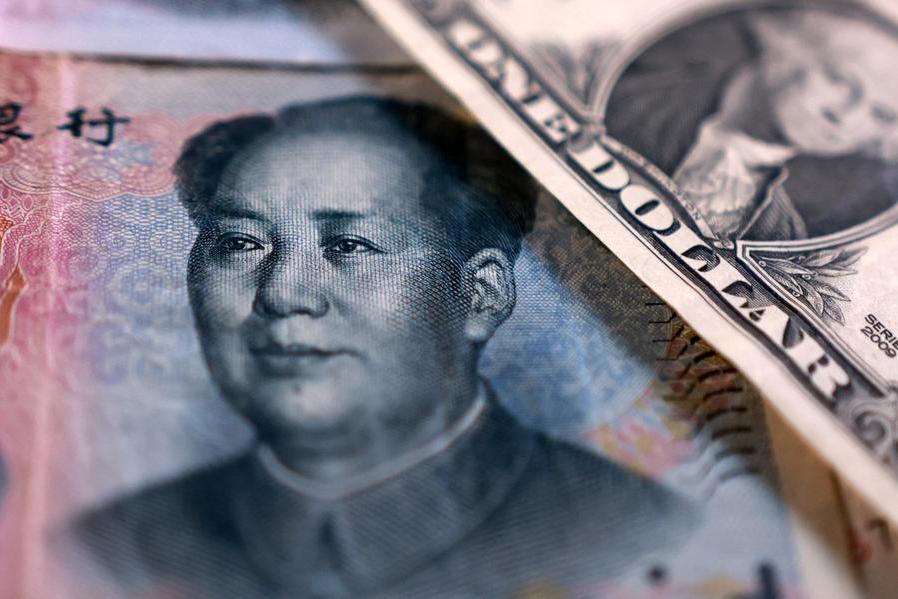
BEIJING/SHANGHAI – The People’s Bank of China on Friday moved to curb a sharp rise in the yuan by eliminating risk reserve requirements for foreign exchange contracts, in a move to encourage dollar buying as exporters begin to feel the pinch from the currency’s strength.
The decision came after the yuan hit its highest value against the dollar in nearly three years on Thursday. It pulled back on Friday, pausing a stellar rally driven largely by an unexpected export boom.
China’s currency has appreciated more than 7% against the dollar since April last year. The central bank’s move, combined with a weaker-than-expected setting of the yuan’s trading band on Friday, represents the strongest rebound yet in a multi-month bull market.
“The renminbi is rising too fast, which means the central bank is intervening,” said Yuan Tao, an analyst at Orient Futures.
But he said the move would only slow the yuan’s appreciation and predicted the dollar would continue to weaken.
The People’s Bank of China (Central Bank) has vowed to maintain the renminbi exchange rate at a “reasonable and balanced level” and announced that the 20% reserve requirement for forward exchange contracts will be abolished from March 2.
Maybank said in a note to clients that the move “reduces the penalties for market participants to bet against the renminbi.”
“It is clear that the People’s Bank of China wants the pace of renminbi appreciation to slow.”
A stronger yuan will make Chinese assets more attractive to foreigners and make imports cheaper, but it will hurt Chinese exporters, who settle most of their receipts in dollars.
Beijing Ultrapower Software Co. on Friday blamed the strong renminbi for contributing to a 28% plunge in its 2025 profits, joining a growing list of corporate victims.
“As our revenues are primarily settled in dollars, we suffered a foreign exchange loss due to the weaker dollar,” the company said in its preliminary financial report.
rush to sell dollars
The People’s Bank of China’s move comes as exporters rush to sell dollars in both the spot and forward markets, while importers delay buying dollars for payments.
As a result, net foreign exchange inflows totaled $79.9 billion in January, the third largest on record, according to official foreign exchange payments data. Record inflows continued in December.
Liu Yang, director of the financial market division of Zheshang Development Group, said that the People’s Bank of China’s latest move will release some of the pent-up demand for dollar purchases through forwards in the short term, and will help balance supply and demand in the market.
However, the benign nature of this measure suggests that “the People’s Bank sees little risk of further renminbi depreciation, but still believes there is significant scope for renminbi appreciation.”
Last year, the yuan posted its biggest annual rise against the dollar since 2020, and the momentum continues into the new year as analysts expect Chinese exports to remain strong this year.
Chinese shippers have been able to find more buyers in markets outside the U.S. after the U.S. government tightened tariffs, helping offset weak domestic demand weighing on the economy.
“The renminbi has held firm even as the dollar has remained mostly stable, suggesting the market’s strong belief that the renminbi is undervalued,” said Shu Tiancheng, senior economist at the Economist Intelligence Unit.
A growing number of listed companies are stressing the urgent need for Chinese companies to implement currency hedging, claiming that the strong renminbi is having a negative impact on their profits.
Suzhou Junchuang Automobile Technology, whose sales are mostly settled in dollars, said on Wednesday that a stronger renminbi contributed to a 31% decline in profit in 2025.
Robot manufacturers Ninebot, Shenzhen Hello Tech Energy Co, and Shenzhen Hui chuang Da Technology also revealed the negative impact of the yuan appreciation.
(Reporting by Winni Zhou and Joe Cash; Additional reporting by Samuel Shen; Editing by Jacqueline Wong and Kim Coghill)
