


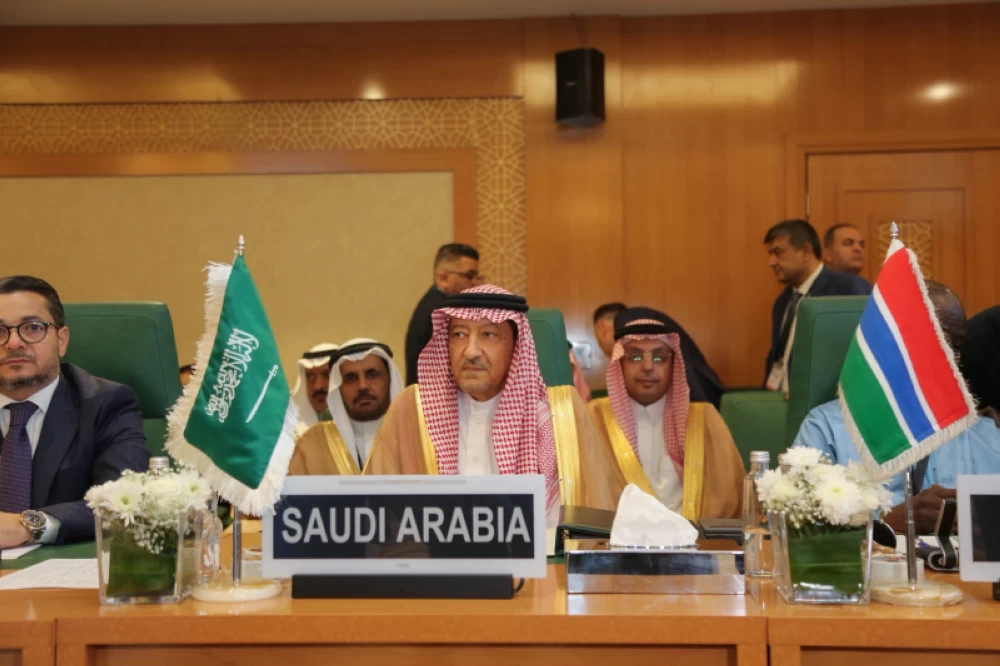
JEDDAH – Saudi officials said the Israeli occupation authorities’ policies and practices pose the greatest threat to security and peace, reiterating that Israel has no sovereignty over the occupied Palestinian territories.
Speaking on behalf of Foreign Minister Faisal bin Farhan, Deputy Foreign Minister and Undersecretary of Engineering said: Foreign Minister Waleed El-Khereij on Thursday participated in an emergency public meeting of the Organization of Islamic Cooperation (OIC) Foreign Minister-level Executive Committee held in Jeddah to discuss Israel’s decisions regarding the occupied Palestinian territories.
At the beginning of his remarks, Mr. El-Khereij expressed his gratitude to the State of Palestine for convening the extraordinary meeting.
“We come together today with a common belief that the policies and practices of the Israeli occupation authorities pose the greatest threat to security and peace, and with a determination to confront this threat by coordinating positions, building cooperation mechanisms between our countries, and strengthening joint Islamic action,” he said.
He added that Israel’s unprecedented invasion of the Occupied Palestinian Territories, through expanded settlement activities, deepened annexation, and measures aimed at imposing Israeli sovereignty claims over the occupied West Bank, continues to flagrantly violate international law and humanitarian norms, undermining prospects for peace and violating international legitimacy resolutions.
El-Khereij reaffirmed Saudi condemnation of the occupation authorities’ decision to classify land in the West Bank as so-called “state land” and of the Israeli parliament’s decision to accelerate settlement expansion and allow land purchases in the West Bank. He said such plans aim to impose new legal and administrative realities and undermine efforts to achieve peace and stability.
“Saudi Arabia reiterates that Israel has no sovereignty over the occupied Palestinian lands,” he said, expressing its absolute rejection of these plans and all illegal measures that violate international law and UN Security Council resolutions, in particular resolution 2334. It also condemned settlement activities aimed at changing the demographic composition and legal status of the Palestinian territories occupied since 1967, including East Jerusalem.
Related articles
OIC foreign ministers condemn Israeli annexation measures, call for international action
Mr. El-Khereij underlined the importance of the Global Alliance for a Two-State Solution in uniting international efforts, mobilizing political and economic support, translating commitments into practical steps, and advancing relevant implementation tracks to accelerate the realization of a two-State solution. He affirmed Saudi Arabia’s commitment to continue this path with brotherly and friendly countries to achieve a just and comprehensive peace that fulfills the aspirations of the Palestinian people for self-determination and an independent state in line with the Arab Peace Initiative.
He said the New York Declaration, the Comprehensive Plan for Peace and UN Security Council Resolution 2803 constitute an integrated framework aligned with their respective objectives. He stressed the need to support the Palestinian National Authority, build its institutional capacity, and ensure institutional and geographical linkages between Gaza and the West Bank in order to maintain the integrity of the Palestinian territories, while safeguarding the inalienable rights of the Palestinian people, in particular the right to self-determination and the right of return. He also reiterated his call for the urgent access of humanitarian and relief assistance, in full coordination with international mechanisms.
Mr. El-Khereij praised the efforts led by US President Donald Trump in this regard, noting that coordination with the United States towards the implementation of a comprehensive peace plan represents a real opportunity to end the conflict and move towards regional integration and sustainable stability.
Finally, he reaffirmed that Saudi Arabia condemns and denounces any violation of the sovereignty of OIC member states due to its commitment to stability and peace.
He expressed concern about rising military tensions and increasing hostile rhetoric, and called for restraint, de-escalation and diplomatic resolution of the conflict.
He stressed that sustainable peace and security can only be achieved through dialogue, diplomacy, mutual respect, non-interference in the internal affairs of states and peaceful resolution of conflicts.
