


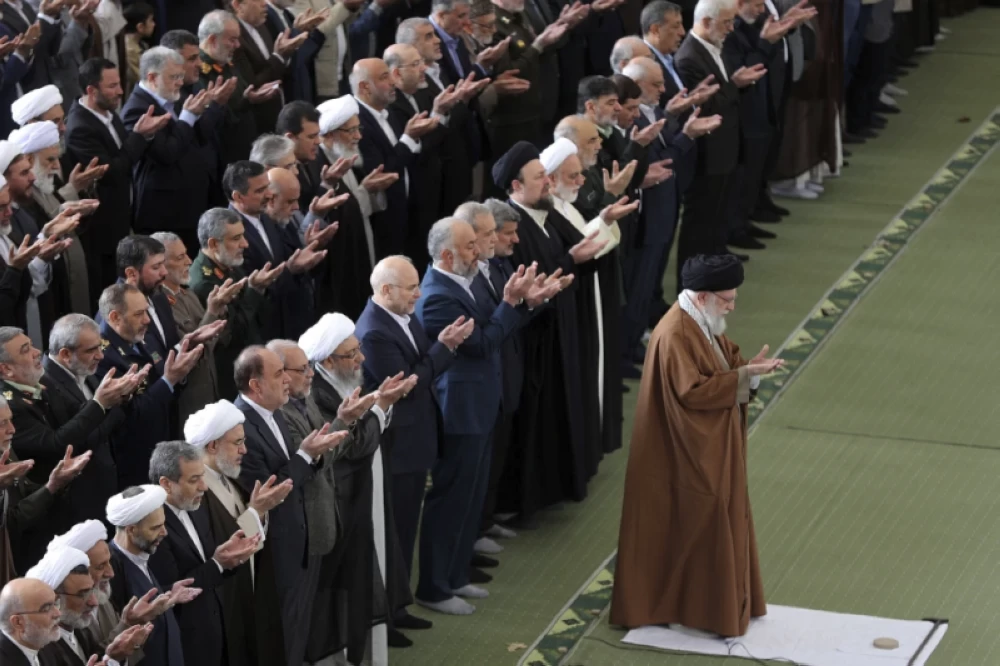
TEHRAN — Supreme Leader Ayatollah Khamenei’s death after nearly 37 years in power has begun a constitutional succession process to determine Iran’s future leadership.
Iran’s constitution establishes an interim leadership council to take over the duties of the supreme leader until a permanent successor is appointed.
The Transitional Council is made up of the incumbent president, the attorney general, and members of the Guardian Council selected by the Council of Expediency, which advises the supreme leader and mediates disputes with parliament.
Iranian President Masoud Pezeshkian and Attorney General Gholamhossein Mohseni Ejei are among those stepping in to temporarily assume leadership responsibilities.
While the council will govern on an interim basis, the Iranian Council of Experts, made up of 88 Shiite clerics, is tasked with choosing the next supreme leader “as soon as possible” in accordance with the law.
Members of the Council of Experts are elected every eight years, but candidates must first be approved by the Guardian Council. The Guardian Council is Iran’s constitutional watchdog known for disqualifying candidates it deems unsuitable.
Deliberations over succession traditionally take place behind closed doors, making it difficult to predict who will emerge as a likely candidate.
Related articles
The fall of Khamenei
Hardline President Ebrahim Raisi was previously seen as a possible successor, but he died in a helicopter crash in May 2024.
Since then, all eyes have been on the late supreme leader’s son Mojtaba Khamenei, 56.
Mr. Mojtaba, a Shiite cleric, has never held formal government office and the possibility of paternity could draw criticism from both reform-minded Iranians and conservatives opposed to the emergence of dynastic rule.
Iran has experienced only one change in the position of supreme leader in the past.
In 1989, after leading the 1979 Islamic Revolution and guiding Iran through eight years of war with Iraq, Grand Ayatollah Ruhollah Khomeini died.
Khamenei then took over the role and consolidated his power over the next few decades.
The Supreme Leader holds the highest authority within Iran’s political system and serves as commander-in-chief of the military and powerful Revolutionary Guards.
This position has final say on major domestic and foreign policy decisions and is at the center of Iran’s complex power structure.
