


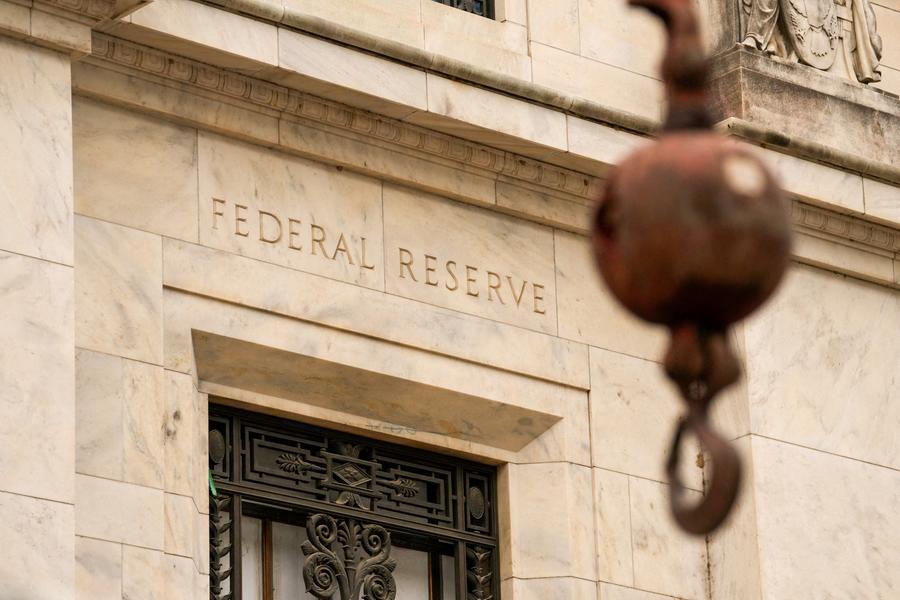
U.S. Federal Reserve officials, who have largely accepted that artificial intelligence will bring about dramatic changes to the economy, are now divided over its potential to impact the labor market and prices, and are struggling to understand the pace and scope of what’s to come.
The dangers were highlighted Thursday when technology company Bloc announced that it would lay off 40% of its workforce, or about 4,000 people, because AI “changes something” in the way it uses its workforce.
Traditionally, when layoffs increase, central bankers would lean toward easing monetary policy. But the shift to AI is triggering a different reaction, with officials saying higher unemployment rates may be a given going forward, as displaced workers take longer to find new jobs, and higher returns on capital and wages for those still working keep upward pressure on inflation.
“This is part of a cycle where there are positive, real shocks, but most of them in the form of positive real incomes and higher inflation,” Adam Posen, director of the Peterson Institute for International Economics, said during a debate on inflation.He said he expected U.S. price pressures to pick up from here, noting that rising stock prices have inflated the wealth of some households, and in some regions, large capital investments have weighed on electricity and construction costs. Those who see AI as a short-term inflation suppressor are “simply wrong.”
Is Warsh ready to fund AI inflation?
The group, which includes Federal Reserve Chairman candidate Kevin Warsh, believes interest rates should fall because AI-driven productivity gains are keeping inflation in check.
Warsh, who still needs to be formally nominated and confirmed by the Senate, argued in a Wall Street Journal op-ed in November that AI is “an important inflation-control force that will boost productivity and strengthen America’s competitiveness,” and that the Fed can best respond by lowering interest rates.
Mr. Warsh’s story echoes the positivity of former Fed Chairman Alan Greenspan in the mid-1990s, but there is growing concern among Fed policymakers about how quickly AI will be reflected in staffing and whether the historical rule of thumb that new technologies displace jobs but ultimately create more holds true.
Last week’s Citorini Research thought exercise warned of an employment apocalypse and triggered a short but significant stock price decline. This shows how anxious investors and perhaps the broader public are about AI. The announcement by Block, owner of fintech services Square and Cash App, seemed to signal its disruptive potential. Unlike previous automation developments, which have primarily affected blue-collar production jobs, AI may be well suited to perform white-collar tasks such as coding and data analysis.
While coding assistants have the potential to improve employee productivity, Block CEO Jack Dorsey said AI is “enabling new ways of working with smaller, flatter teams that fundamentally change what it means to build and run a company. And that’s rapidly accelerating.” A growing body of research consistently concludes that AI can perform a wide range of tasks, including tasks in knowledge areas that are a focus for high schools, universities, and local chambers of commerce who want to future-proof their workforces. A 2024 paper by analysts at the Brookings Institution found that more than 30% of U.S. workers could see half of their work “interrupted,” and that percentage could be growing.
Fed efforts gather strength
The Fed is trying to keep pace. If you count the number of AI-driven Fed research papers and policymaker talks on AI, machine learning, and related topics, there were very few until ChatGPT’s release in late 2022. That will increase to five in 2023, with about 17 cases last year and 14 this year already, a much faster pace.
Minutes from the Fed’s January meeting show a rich discussion on productivity and AI, including what it means for monetary policy, and at least five policymakers spoke on the topic last month. As a group, they are not looking to AI as a reason to cut rates in the near future. While they agree that productivity appears to be increasing, they are not prepared to evaluate AI against the more mundane efficiencies achieved during pandemic-era labor shortages.
Even as the productivity baton is being passed, policymakers appear to be leaning toward the view that AI will structurally cause higher unemployment that cannot be easily offset by lowering interest rates without risking higher inflation.
Underpinning the Fed’s framework is the long-term “natural” unemployment rate, currently thought to be around 4.2%, below which inflationary pressures increase. “If AI continues to improve productivity, economic growth could remain strong, even if labor market fluidity leads to increased unemployment.In such a productivity boom, rising unemployment may not be indicative of growing slack. “Therefore, normal demand-side monetary policy may not be able to reverse the AI-induced unemployment spell without increasing inflationary pressures,” Fed Governor Lisa Cook said last month, a comment echoed by several colleagues.
This problem remains largely unresolved. Krishna Guha, vice chairman of Evercore ISI, cited the loss of workers’ bargaining power as a reason for the natural rate of unemployment to fall as employees stay in their jobs and accept lower wage increases, putting downward pressure on inflation. This argument reaches a similar conclusion to Warsh’s in terms of lowering interest rates, but for slightly different reasons.
But public comments from Fed officials paint a more complicated picture. This means employment pressures for some workers, new productivity possibilities for others, wealth gains that drive consumption in some households, resource constraints while building AI, and expectations of higher investment returns that are likely to drive base interest rates higher.
“There are a lot of predictions about the adoption of AI, the effectiveness of AI, the energy efficiency of AI, the impact of AI on the labor market, but the only thing we know for sure is that those predictions will be wrong,” Richmond Fed President Tom Barkin said last week. “We need to find out whether they are too optimistic or too pessimistic.”
(Reporting by Howard Schneider; Editing by Dan Burns and Andrea Ricci)
