


DUBAI/WASHINGTON: The US and Israeli air war against Iran escalated on Monday with no end in sight as Israel attacked Lebanon in response to Hezbollah attacks and Iran continued its attacks on Gulf states that host US military bases.
US President Donald Trump said the operation could last several weeks and it was unclear who was responsible for Iran after Supreme Leader Ali Khamenei was targeted and killed during the opening hours of the US-Israel war over the weekend.
The attack on Iran drew the Gulf into war, killed scores of civilians in Iran, Israel and Lebanon, disrupted global air transport, halted shipping through the Strait of Hormuz, where a fifth of the world’s oil trade bypasses Iran’s coast, and sent oil prices soaring.
Underscoring the risks, Kuwait accidentally shot down three American F-15E fighter jets during an Iranian attack, US Central Command said. All six crew members escaped and were recovered safely.
The US military announced it had struck more than 1,250 targets in Iran and destroyed 11 Iranian warships. Six U.S. military personnel have been killed so far, all in Iranian retaliatory attacks on Kuwait over the weekend.
On Monday night, Israel warned of an impending attack on the Lebanese town and announced that it had attacked the compound housing Iranian state broadcaster IRIB in Tehran. Explosions shook buildings across Tel Aviv as air defense forces intercepted incoming Iranian missiles.
Two drones attacked the U.S. embassy in Riyadh early Tuesday, causing minor damage and starting a fire, the Saudi Ministry of Defense said.
For President Trump, joining Israel in attacking Iran would represent the biggest U.S. foreign policy gamble in decades, and a major political risk for Republicans in this year’s midterm elections. A weekend Reuters/Ipsos poll found that only one in four Americans supports the Iranian operation. The average retail price of gasoline in the United States has risen by more than $3 a gallon, in part due to the conflict and in the face of President Donald Trump’s growing frustration over his bread and butter issues.
War spreads to Lebanon
President Trump said the United States faces an imminent threat from Iran that warrants war, but he did not elaborate, and some U.S. lawmakers said he had provided no evidence to support that assessment.
Secretary of State Marco Rubio told reporters Monday before briefing lawmakers that the United States took preemptive action because it was aware of Israel’s close determination and plans to attack Iran.
“We knew that it would provoke an attack on U.S. forces. We also knew that if we didn’t get ahead of them and pursue them before they launched an attack, there would be more casualties,” Rubio said.
President Trump said Monday, in his most extensive public comments yet on the conflict, that he ordered the strikes to halt Tehran’s nuclear program and what he claims is a rapidly growing ballistic missile program.
Trump gave no indication that the operation would end anytime soon, and military officials said more U.S. troops were being sent to the region.
“From the beginning, we expected four to five weeks, but it could be much longer than that,” Trump said at the White House.
A new front in the war began on Monday when Lebanon’s Hezbollah militia, one of Tehran’s main allies in the Middle East, fired missiles and drones at Israel.
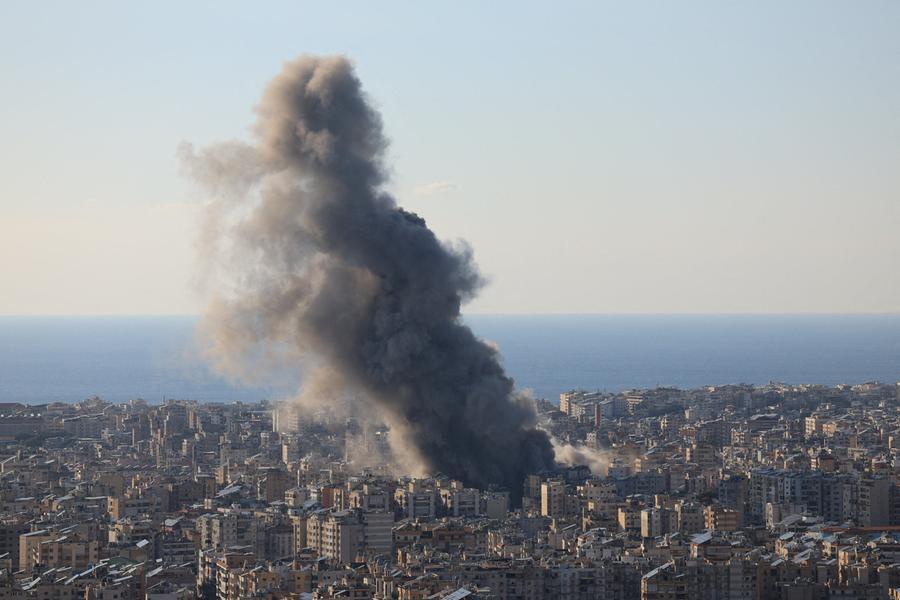
Israel responded by carrying out extensive airstrikes on Beirut’s southern suburbs, which are controlled by Hezbollah. Lebanese state news agency NNA said at least 31 people were killed and 149 injured.
State Department Warning
The U.S. State Department on Monday urged Americans to immediately leave more than a dozen countries in the region, including all states in the Gulf and Levant, although airspace closures make it neither easy nor cheap to do so.
Turkey joined Russia and China in condemning the war, which President Tayyip Erdogan called a “clear violation” of international law.
Iran has denied seeking nuclear weapons and said the U.S. attack was unprovoked and came as Tehran was negotiating a nuclear deal with President Trump’s envoys. During his first term in 2018, Trump withdrew from a prior international agreement to curb Iran’s nuclear program.
Iran’s top security official, Ali Larijani, said on social media that Iran will not negotiate with President Trump, who has “delusional ambitions.”
There was a sense of uncertainty about the future, a mix of elation, fear and anger, as residents clogged highways to escape bombings.
Many are openly celebrating the death of Ayatollah Khamenei, 86, who ruled since 1989 and commanded security forces that killed thousands of anti-government protesters earlier this year.
But conservative clerical leaders show no signs of bowing to power, and military experts say airstrikes without ground troops may not be enough to dislodge them, a possibility Trump has not ruled out.
Meanwhile, scores of Iranians are reported to have been killed in airstrikes, some of which apparently targeted civilians.
“They are killing children and attacking hospitals. Is this the democracy Trump wants to bring us?” Morteza Sedighi, a 52-year-old teacher, said by phone from Tabriz in northwestern Iran. “Innocent people were killed first by the regime and now by Israel and the United States.”
Plumes of black smoke rose around the US embassy in Kuwait as US allies in the Gulf came under renewed attack from Iranian missiles and drones. Loud explosions were also heard in Dubai and Samha in the United Arab Emirates, and Doha, the capital of Qatar.
Qatar, one of the world’s largest exporters of liquefied natural gas, has halted production due to uncertainty over whether it will be able to safely transport it through the difficult Strait of Hormuz. Saudi Arabia has shut down its largest oil refinery after a drone attack caused a fire. The refinery was one of many energy facilities targeted.
(Reporting by Alexander Cornwell, Laila Bassam in Lebanon, Yana Choukir in Dubai, Andrew Mills in Doha, Michele Kambas in Nicosia and Yanis Kurtoglou in Akrotiri; Parisa Hafezi in Dubai, Emily Ro (Additional reporting by Martin Petty, Peter Graf, James McKenzie, Andy Sullivan) Jonathan Allen; Editing by Timothy Heritage, Kevin Liffey, Ross Colvin, Cynthia Osterman)
