


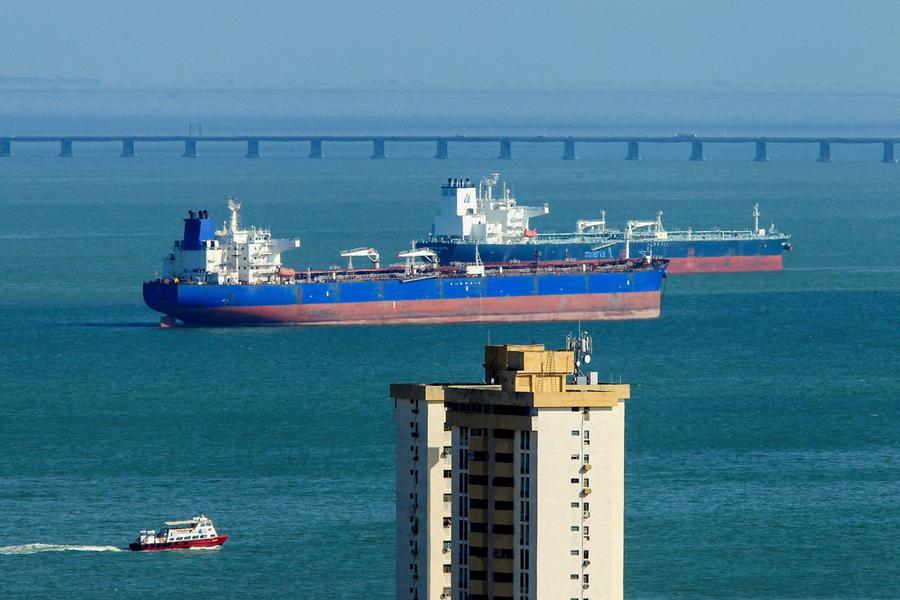
LONDON/SINGAPORE: Insurers are canceling war risk coverage for ships in the Middle East Gulf as the escalating conflict with Iran disrupts shipping, damaging or stranding tankers and killing at least two people.
Shipping through the Strait of Hormuz between Iran and Oman, which carries about a fifth of the oil consumed worldwide and large amounts of gas, has come to a near standstill after ships in the area were attacked as Iran retaliated to U.S. and Israeli attacks.
One tanker caught fire in the region on Monday, at least four others were damaged and about 150 vessels were stranded.
Brent crude oil futures rose as much as 13% as oil and natural gas prices in Europe soared on fears of disruption and prolonged shutdowns, and the conflict triggered multiple oil and gas shutdowns in the Middle East.
At least 150 vessels, including oil tankers and liquefied natural gas tankers, have anchored in the Strait of Hormuz and surrounding waters, according to shipping data on Sunday. About 10% of the world’s container ships are caught up in widespread backups, and cargo could soon start piling up at ports and transshipment hubs in Europe and Asia, Jeremy Nixon, CEO of container shipping company Ocean Network Express (ONE), known as ONE, said on Monday. Iran has announced it has closed a vital waterway to navigation, prompting Asian governments and refiners to assess their oil reserves. The commander of Iran’s Revolutionary Guards Corps said Iran would fire on any vessel that tried to pass through the key 21-mile-wide (34-kilometer-wide) maritime chokepoint, Iranian media reported.
The tankers were concentrated in international waters off the coasts of major Gulf oil producers, including Iraq, Saudi Arabia and LNG giant Qatar, according to ship tracking data from the Marine Traffic platform. In the latest incident, Iran’s Revolutionary Guards said the Honduran-flagged ship Ate Nova was on fire after being attacked by two drones in the Strait of Hormuz, Iranian news agencies reported. The U.S.-flagged product tanker Stena Imperative was damaged by an “aero impact” while anchored in the Middle East Gulf, the ship’s owner Stena Bulk and U.S. manager Crowley said in a statement on Monday. The impact killed a shipyard worker.
On Sunday, the Marshall Islands-flagged tanker MKD VYOM was hit by a projectile while sailing off the coast of Oman, killing one crew member and damaging two other tankers, the ship’s manager said.
Also on Sunday, a projectile struck the Hercules Star, a Gibraltar-flagged oil bunkering tanker supplying ships with fuel, off the coast of the United Arab Emirates, Peninsula management said in a statement. The tanker returned to its berth in Dubai on Sunday morning and the crew was safe, Peninsula added.
Insurance company cancels war risks coverage
As a result of the accident, marine insurance companies are terminating war risk coverage for ships, and oil shipping rates are expected to rise further.
Companies including Gard, Skuld, NorthStandard, London P&I Club and American Club announced that the cancellations will take effect from March 5, according to a notice dated March 1 posted on their websites.
These cancellation notices mean shipping companies operating vessels in the region will need to seek new insurance coverage at higher rates in order to maintain their insurance policies.
“As a result of this rapidly changing situation, underwriters are constantly increasing rates for ships transiting the Strait of Hormuz, or in some cases refusing to offer terms at this time,” said David Smith, head of marine at brokerage firm McGill & Partners.
War risk premiums have risen to as much as 1% of a ship’s value in the past 48 hours, up from about 0.2% last week, adding hundreds of thousands of dollars in costs to each shipment, industry officials said Monday.
“The (war insurance) market is essentially facing a de facto closure of the Strait of Hormuz, based primarily on threat perception rather than a specific blockade,” said Munro Anderson of Vessel Protect, a maritime war insurance firm owned by Penn Underwriting. Meanwhile, the cost of shipping oil from the Middle East to Asia, already at a six-year high, is expected to rise further as the escalating conflict with Iran deters shipowners from sending ships to the region, market participants and analysts said.
(Reporting by Emily Chow and Jeslyn Ra in Singapore, Jonathan Saul in London, and Lisa Bertlein in Long Beach, California; Additional reporting by Trixie Yap and Ruth Chai in Singapore, Nidhi Verma in New Delhi, and Enes Tunagle in London; Writing by Nina Chesney; Editing by Aidan Lewis, Nick Zieminski and Lisa Shoemaker)
