


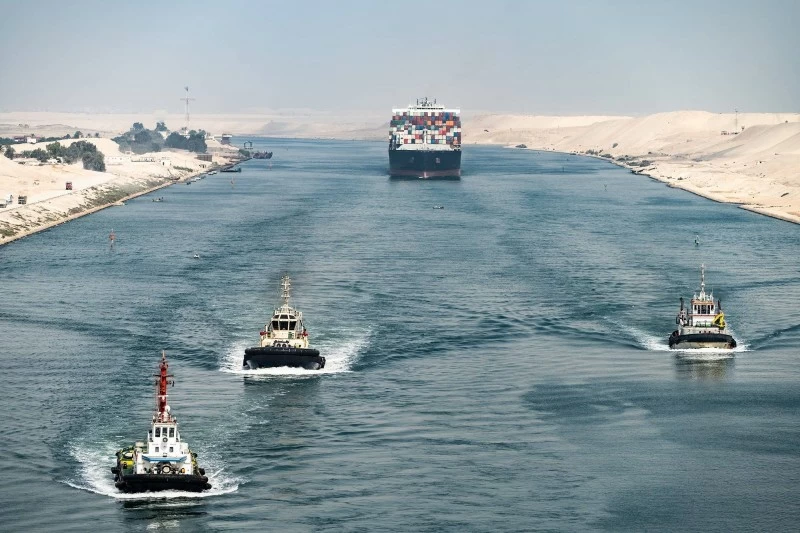
The head of the Suez Canal Authority, Lieutenant General Osama Rabie, confirmed today (Tuesday) that navigation within the canal is taking place regularly from the north and south, and that the canal continues to provide uninterrupted navigation services 24 hours a day.
In an official statement, Rabie explained that 56 vessels with a gross tonnage of 2.6 million tons passed through the canal today, including 24 vessels in the northern convoy with a net tonnage of 1 million tons and 32 vessels in the southern convoy with a net tonnage of 1.6 million tons.
He noted that the announcement of the suspension of canal traffic by some major shipping companies remains a temporary issue in line with the evolving security situation in the region, and emphasized the authorities’ continued efforts in intensive communication with customers and international shipping companies to ensure the sustainability of global supply chains.
Mr. Rabie expressed hope that a breakthrough in the security situation in the region would be achieved soon. This is because it has fundamental implications for the restoration of freedom of navigation and global trade movement through one of the world’s most important sea lanes.
These statements were issued within the framework of regional escalation due to direct war between the United States and Israel on the one hand, and Iran on the other, which began after American and Israeli forces carried out large-scale airstrikes against key Iranian targets, including nuclear facilities and military positions in Tehran and other regions, resulting in the killing of Iran’s Supreme Leader Ayatollah Khamenei and numerous Revolutionary Guards leaders.
Iran quickly responded by firing missiles and drones at Israel, Gulf states, Arab states, and other targets in the region, including the British Akrotiri base in Cyprus.
Brigadier General Ibrahim Jabari, advisor to the commander of the Revolutionary Guards, announced that the Strait of Hormuz was closed and that ships attempting to cross it would be “scorched to death” by the Guard’s navy and regular forces, threatened to attack oil pipelines to stop “a single drop of oil” from escaping, and predicted that oil prices would rise to $200 per barrel.
Meanwhile, Maersk, the world’s largest container company, announced the suspension of transits through the Strait of Hormuz, the suspension of future transits through the Bab al-Mandab and Suez Canals, and the redirection of flights around the Cape of Good Hope, the longest route at thousands of miles and requiring days to travel.
The head of the Suez Canal Authority, Lieutenant General Osama Rabie, confirmed today (Tuesday) that navigation through the canal is taking place regularly from both the north and south directions, and that the canal continues to provide uninterrupted maritime services around the clock.
In an official statement, Rabie explained that 56 vessels with a net gross tonnage of 2.6 tons passed through the canal today. Of these, 24 million ships (1 million net tons) are from the northern fleet and 32 ships (1.6 million net tons) are from the southern fleet.
He noted that the announcement of the suspension of canal traffic by some major shipping companies remains a temporary issue in line with the evolving security situation in the region, and emphasized the authorities’ continued efforts in intensive communication with customers and global shipping companies to ensure the sustainability of global supply chains.
Mr. Rabie expressed hope that the security situation in the region has largely been resolved. This is because it has significant implications for the restoration of freedom of navigation and global trade through one of the world’s most important sea routes.
These statements come against the backdrop of the escalation in the region of direct war between the United States and Israel, on the one hand, and Iran on the other, which began after the US and Israeli militaries carried out extensive airstrikes on key targets in Iran, including nuclear facilities and military sites in Tehran and other regions, resulting in the deaths of Iran’s Supreme Leader Ayatollah Khamenei and several leaders of the Revolutionary Guards.
Iran immediately responded by firing missiles and drones at Israel, Gulf states, Arab states, and other targets in the region, including the British Akrotiri base in Cyprus.
Brigadier General Ibrahim Jabari, advisor to the Revolutionary Guards commander, announced that the Strait of Hormuz would be closed and that ships attempting to cross it would be “burned down” by the Revolutionary Guards’ navy and regular forces, threatened to attack oil pipelines to stop “a single drop of oil” from leaking, and predicted that oil prices would rise to $200 per barrel.
Meanwhile, Maersk, the world’s largest container shipping company, announced the suspension of transits through the Strait of Hormuz, the suspension of future Bab el-Mandeb and Suez Canal crossings, and changes to the route around the Cape of Good Hope, which would be thousands of miles longer and take longer.
