


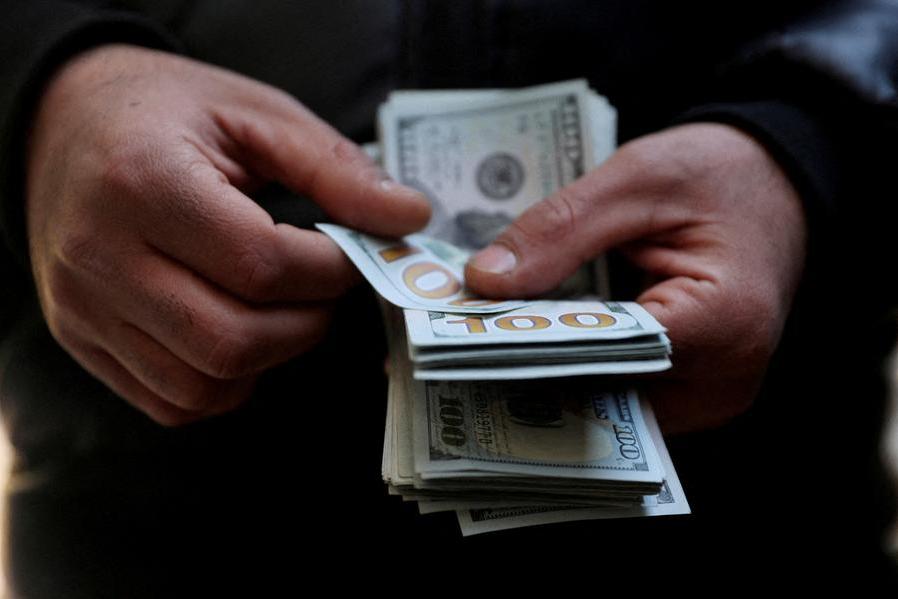
SINGAPORE – The dollar rose on Thursday after briefly retreating from a three-month high as the fallout from war in the Middle East roiled global markets, keeping sentiment fragile and boosting demand for safe-haven currencies.
The dollar’s gains halted in early trading as investors clung to shaky assumptions about the possibility that the conflict might not last as long as initially expected and about the resumption of oil shipments through the Strait of Hormuz.
But the market remains at the mercy of the US-Israel war with Iran, now in its sixth day, after Iran fired a barrage of missiles at Israel, sending millions of residents into air raid shelters.
As a result, the dollar quickly reversed its early losses and rose, leaving the US dollar in favor as the euro fell 0.2% to $1.1608 and the pound 0.27% to $1.3335.
The dollar rose 0.2% against a basket of currencies to 99.00, resuming its rally towards weakness, above a three-month high hit earlier this week.
“There appears to be little or no escape route. Traditional safe-haven assets such as gold are not playing their usual role,” said Bas van Geffen, senior macro strategist at Rabobank.
“Dollar liquidity seems to be king given the sharp rise in the DXY index.”
The dollar has gained nearly 1.4% over the week so far, emerging as one of the few winners in a volatile few trades that have dragged down stocks, bonds and even safe-haven precious metals.
Soaring energy prices caused by wars in the Middle East are raising concerns that a resurgence in inflation could upset major central banks’ interest rate outlooks.
According to the CME FedWatch tool, traders are currently pricing in just a 34% chance that the Federal Reserve will cut interest rates in June, compared to nearly 46% a week ago, in part due to strong U.S. economic data on Wednesday.
Expectations for interest rate easing from the Bank of England have also receded, and expectations in the money market for an interest rate hike from the European Central Bank have increased this year.
“In addition to market participants, central bankers are also increasingly focusing on the resurgence of inflation as a cause for concern,” said Thierry Wismann, global currency and rates strategist at Macquarie Group.
“If energy supplies become constrained, the US interest rate outlook is seen as most likely to be upended by a resurgence in global inflation in 2026.”
The yen similarly reversed its early rise and ended up almost unchanged at 157.08 to the dollar.
The Australian dollar, which had gained 0.57% in the previous session, fell 0.35% to $0.7050, while the New Zealand dollar fell 0.2% to $0.5930, amid the sell-off in the US dollar.
Australia has seen a wide range of price action this week, being used as a proxy for risk sentiment and at times benefiting from a rare safe haven as the country’s energy abundance offsets the impact of higher oil prices.
Elsewhere, China on Thursday set an economic growth target of 4.5% to 5% for 2026, a slight downward revision from the 5% pace achieved last year and, while not definitive, leaves room for greater efforts to rein in industrial overcapacity and rebalance the economy.
The yuan rebounded from a one-month low, rising 0.1% to 6.8904 to the dollar, after the People’s Bank of China set guidance at its strongest level in nearly three years.
“Despite the more pragmatic stance and increased flexibility, we believe Beijing will still aim for the upper end of the 4.5-5% range,” said Juni Tan, North Asia regional economist at Coface.
“More conservative growth targets should not be interpreted as a shift away from a growth-oriented mindset.”
Among cryptocurrencies, Bitcoin and Ether each fell more than 1%, cutting off some of their significant gains from the previous session.
