


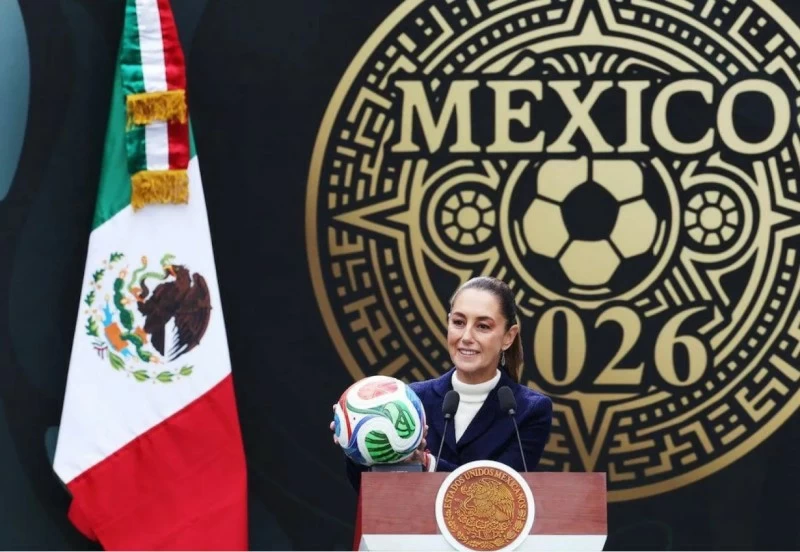
As the start of the 2026 World Cup approaches, Mexican authorities have confirmed that security preparations are proceeding as planned, despite a wave of violence recently witnessed following the killing of one of the country’s most prominent criminal cartel leaders.
A number of representatives from FIFA visited Mexico on Wednesday, less than 100 days until the start of the World Cup, scheduled for June 11 to July 19, 2026, to meet with local officials and review organizational and security arrangements.
FIFA president Gianni Infantino sought to reassure public opinion on February 24, at a time of heightened security tensions in the country following the killing of Nemesio Oseguera, the leader of the drug cartel known as El Mencho, during a military operation, with a statement saying “everything is going well and everything will be great.”
Infantino admitted he was “very relieved”, but Mexican authorities were keen to dispel doubts about whether the tournament could be held in safe conditions. Mexico is participating in the World Cup along with the United States and Canada, and the opening game will be held at Azteca Stadium in Mexico City, the capital, where the national team and South Africa’s national team will meet together.
“The safety of our residents and visitors will be guaranteed during the World Cup,” said Mexico’s Minister of Security and Civil Protection Omar García Halfuch.
He said Wednesday’s meeting, “under the leadership of President Claudia Sheinbaum,” brought together representatives from FIFA, including Gabriela Cuevas, head of organizing for the World Cup in Mexico, and federal government officials, to review logistical and organizational aspects, including intelligence, preventive protocols and plans for security deployment during the tournament.
He added: “Thanks to the joint efforts and coordination of the federal, state and local governments, the safety of the public and visitors during the Games will be guaranteed.”
These statements are in line with the position of Mexico’s President Claudia Sheinbaum, who stressed that “safety is guaranteed” and that “the approved monitoring and testing systems are sufficient to ensure that no problems occur and to ensure a successful World Cup in which visitors can enjoy a safe atmosphere.”
Tournament matches will be held in several Mexican cities, including Guadalajara and the capital Mexico City, as part of preparations to welcome fans in June-July 2026.
As the kick-off date for the 2026 World Cup approaches, Mexican authorities have confirmed that security preparations are proceeding as planned, despite the recent wave of violence witnessed in the country following the killing of one of the prominent leaders of a criminal cartel.
With less than 100 days until the start of the World Cup, scheduled for June 11 to July 19, 2026, several FIFA representatives visited Mexico on Wednesday to meet with local officials and review organizational and security arrangements.
“Everything is fine, everything will be fine,” FIFA president Gianni Infantino sought to reassure public opinion in a statement on February 24, when the country was experiencing security tensions following the death of drug cartel leader Nemesio Oseguera, known as “El Mencho,” during a military operation.
Mexican authorities have sought to dispel doubts about whether the games can be held under safe conditions, despite Infantino’s assertion that he feels “very safe.” Mexico is co-hosting the World Cup with the United States and Canada, and the opening game will be held at Azteca Stadium in Mexico City, where the Mexican and South African national teams will meet.
“The safety of our residents and visitors to our country during the World Cup will be guaranteed,” said Mexico’s Security and Civil Protection Secretary Omar García Halfucci.
He said Wednesday’s meeting, “under the direction of President Claudia Sheinbaum,” brought together FIFA representatives and federal government officials, including Gabriela Cuevas, who is in charge of organizing the World Cup in Mexico, to review logistical and organizational aspects, including intelligence protocols, preventive measures and plans for security deployment during the tournament.
He added: “Thanks to the joint efforts and coordination of the federal, state and local governments, the safety of the public and visitors during the Games will be ensured.”
These statements are in line with the position of Mexican President Claudia Sheinbaum, who stressed that “safety is guaranteed” and asserted that “the monitoring and testing systems in place are sufficient to ensure that no problems occur and to ensure a successful World Cup in which visitors can enjoy a safe atmosphere.”
Several Mexican cities, including Guadalajara, are set to host tournament matches alongside the capital, Mexico City, as part of preparations to welcome fans in June-July 2026.
