


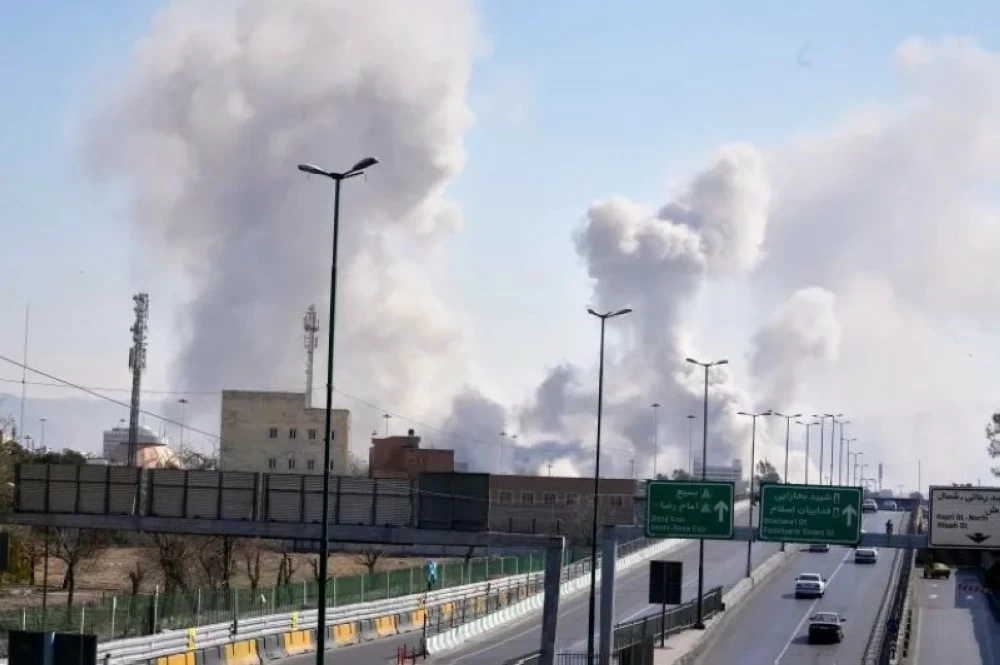
TEHRAN — Fresh attacks rocked Iran and Lebanon on Friday as Israel and the United States stepped up their attacks on the seventh day of the vast Middle East war.
Heavy airstrikes hit Tehran and other Iranian cities as US Defense Secretary Pete Hegseth warned that bombings were “about to increase dramatically.”
In Tehran, worshipers gathered for Friday prayers for the first time since the start of the war that killed Iran’s supreme leader Ayatollah Khamenei on the first day.
Online footage shared by Iranian media showed a crowd of men and women dressed in black streaming into a square outside the Imam Khomeini Grand Mosque in the capital, some holding Iranian flags.
The Israeli military announced Friday morning that it had launched a new attack on Tehran, targeting “regime infrastructure” in a “new phase” of the war, while the United States said Israeli B-2 bombers had dropped dozens of “penetrating” bombs on ballistic missile launch pads buried deep in the country.
Massive explosions occurred across the Iranian capital, including targets linked to the country’s military and political system, as well as residential areas and near Tehran University.
Iran’s military academy was attacked as journalists from Iran’s state broadcaster were broadcasting live near the scene.
“We are witnessing a continuous wave of large-scale strikes from early this morning into the morning,” Al Jazeera reporter Tohid Assadi said, adding that the shockwaves from the explosion may have been felt within Al Jazeera’s bureau.
“I can say that there was more heavy bombing overnight than the previous day, at least in the capital,” he said, reporting large explosions and fighter jets in the sky as thick smoke clouds from the airstrikes choked the city.
He said the airstrikes targeted locations including near Rue Pasteur, a heavily guarded area where Iran’s main government institutions are based and where Iran’s supreme leader and several family members were killed early in the conflict.
The Iranian Presidential Palace is also on the street. The strike reportedly also hit civilian establishments such as residential buildings, parking lots, and gas stations.
On Friday, President Massoud Pezeshkian said mediation efforts should be directed toward the United States and Israel. “Let me be clear: We are committed to lasting peace in the region, but we do not hesitate to protect the dignity and sovereignty of our nations. Mediation should address those who underestimated the Iranian people and provoked this conflict,” Pezeshkian said in X.
The Iranian Red Crescent said the death toll from attacks since Saturday had reached at least 1,332 people, and explosions were also reported in Iranian cities including Shiraz, Qom, Isfahan and Kermanshah, an area with several missile bases.
Jalil Hassani, deputy governor of Iran’s Fars province, told Iranian state media that 20 people were killed and 30 injured in the attack in Shiraz’s Jibashar district.
Iran’s Tasnim news agency reported that two emergency workers were among the dead.
Related articles

Indonesia bans children under 16 from accessing social media
Tasnim news agency reported that at least six people were injured in an Israeli missile attack on a residential area in Pordukhtar, western Iran’s Lorestan province.
The Israeli military claimed that its air force attacked six Iranian missile launchers overnight, destroying them before they could fire on Israeli territory and destroying “three advanced Iranian defense systems.”
The U.S. military said in a post on X on Friday that Iranian targets were “destroyed by U.S. forces, paving the way for the continued delivery of overwhelming U.S. military firepower.”
Gen. Brad Cooper, head of U.S. Central Command (CENTCOM), said early Friday that a U.S. military B-2 stealth bomber dropped dozens of 2,000-pound “penetrator” bombs on a deeply buried ballistic missile launch pad inside Iran.
“We also attacked what amounted to Iran’s Space Force, reducing Iran’s ability to threaten Americans,” Cooper said.
Mr. Hegseth, alongside Mr. Cooper, spoke about the upcoming surge in shelling.
“More fighter squadrons, more capabilities, more defensive capabilities,” Hegseth said. “And bomber pulses occur more frequently.”
The conflict also engulfed Israel’s neighbor Lebanon after the militant group Hezbollah launched missiles in support of its backer Iran.
Overnight, Israel attacked several towns in the south, causing widespread destruction in the southern suburbs of Beirut, a Hezbollah stronghold and home to hundreds of thousands of people.
AFPTV cameras captured a new attack in the area on Friday, with footage showing smoke billowing from the building.
On Friday morning, the streets were completely empty, with the only movement being a bulldozer removing debris.
AFP correspondents on the ground witnessed scenes of panic and fear on Thursday as residents fled en masse following an unprecedented Israeli order to evacuate immediately if they wanted to save lives.
Hundreds of families wandered Beirut’s beaches, with nowhere to go.
“We fled from the suburbs. We were humiliated,” one man told AFP on condition of anonymity.
Lebanese Prime Minister Nawaf Salam warned of a “looming humanitarian disaster” due to displacement, saying the consequences could be “unprecedented”.
The United Nations refugee agency also announced on Friday that it had declared the crisis a major humanitarian emergency, underscoring the need for immediate response.
The UN rights chief also called for an “impartial investigation” after Iran said it blamed the US and Israel for an attack on a school that killed more than 150 people.
Neither the United States nor Israel have said Israel was behind the attack, but Secretary of State Marco Rubio said Monday that the Pentagon is investigating.
Israeli military commander Zamir announced that 123 people were killed in the airstrikes, according to the Lebanese Ministry of Health, and ordered troops to expand areas under military control in southern Lebanon.
Iran continued its attacks on Israel, firing a volley of missiles toward Tel Aviv, and rocket trails lit up the sky as far north as Netanya.
