

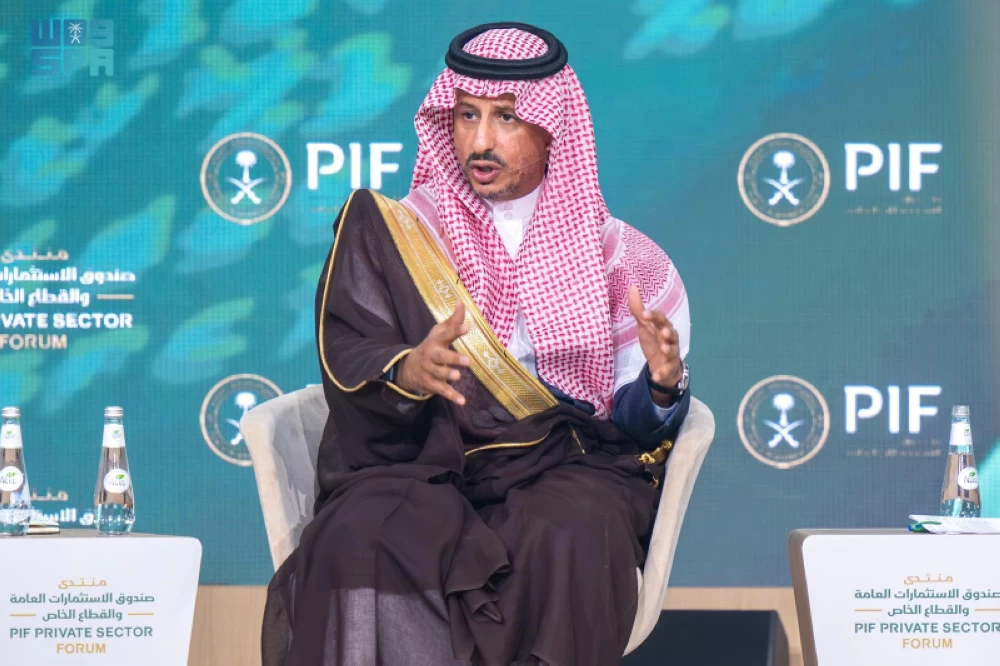
RIYADH — Tourism Minister Ahmed Al-Khateeb said Saudi Arabia is doubling tourism’s contribution to the economy and urged the private sector to accelerate investment as the sector emerges as one of the kingdom’s fastest-growing employment and growth engines.
Speaking at the PIF Private Sector Forum on Monday, Al-Khatib highlighted the scale of the opportunity, citing global tourist numbers.
He said the World Tourism Organization reported that 1.5 billion people, out of a world population of about 8 billion, traveled around the world last year, adding that projections show continued growth over the next five years.
Tourism now accounts for about 5% of Saudi Arabia’s gross domestic product (GDP), up from 3.5% in 2019, he said.
“We want to raise this to 10%,” Al-Khatib said, adding that the goal is to increase the sector’s economic contribution from 300 billion riyals to 600 billion riyals.
He said growth in the sector has been accompanied by strong job creation, with employment numbers increasing from about 750,000 to more than 1 million.
He pointed out that tourism is among the top five employment sectors in the world because it is labor-intensive.
Al-Khatib said the transformation of Saudi tourism began in 2016, when Saudi Arabia deliberately expanded beyond oil and gas and succeeded in building new sectors such as petrochemicals and financial services. Tourism was recognized as the natural next pillar, supported by Saudi religious, leisure and business travel potential.
He emphasized that tourism is basically a private sector-led industry.
“In developed countries, the driving force in this sector is the private sector,” he said, noting that investors build and operate hotels, resorts, airports, airlines, shopping malls and tourism experiences.
Related articles
PIF urges private sector to be bolder as funding shifts from construction sector to growth expansion
“Our participation in forums like this is an opportunity to invite greater investment in this area.”
Al-Khatib said that investments in the tourism sector from 2020 to 2030 will amount to approximately 450 billion riyals, which will be divided equally between public investment funds and the private sector.
He said PIF initially took on projects that would be difficult for private investors to tackle on their own, such as large-scale Red Sea developments that required large upfront infrastructure investments.
“The infrastructure exists today,” he said. “I encourage the private sector to seize the opportunity of this state-of-the-art infrastructure and start building on top of it the hotels, resorts, and tourism experiences that our visitors and residents need.”
He cited recent private sector participation as evidence of momentum, such as the agreement with One&Only to build and operate the Atlantis resort in the Jeddah Central destination and the start of operations at Rixos in King Abdullah Economic City.
He said similar projects would be undertaken across the Kingdom and the sector could record its highest growth by the end of 2025.
Mr. Al-Khatib also highlighted the sector’s role in employing Saudis, praising young Saudi men and women who work in tourism, especially in Red Sea destinations.
He said the government had committed around R300 million to training Saudi nationals in this field, and said the quality of services provided by Saudi Arabia was “really very special”.
He concluded by reiterating that the next phase of tourism will depend on deeper participation of the private sector, building on the foundations already laid to support sustained growth, job creation and economic diversification.
