

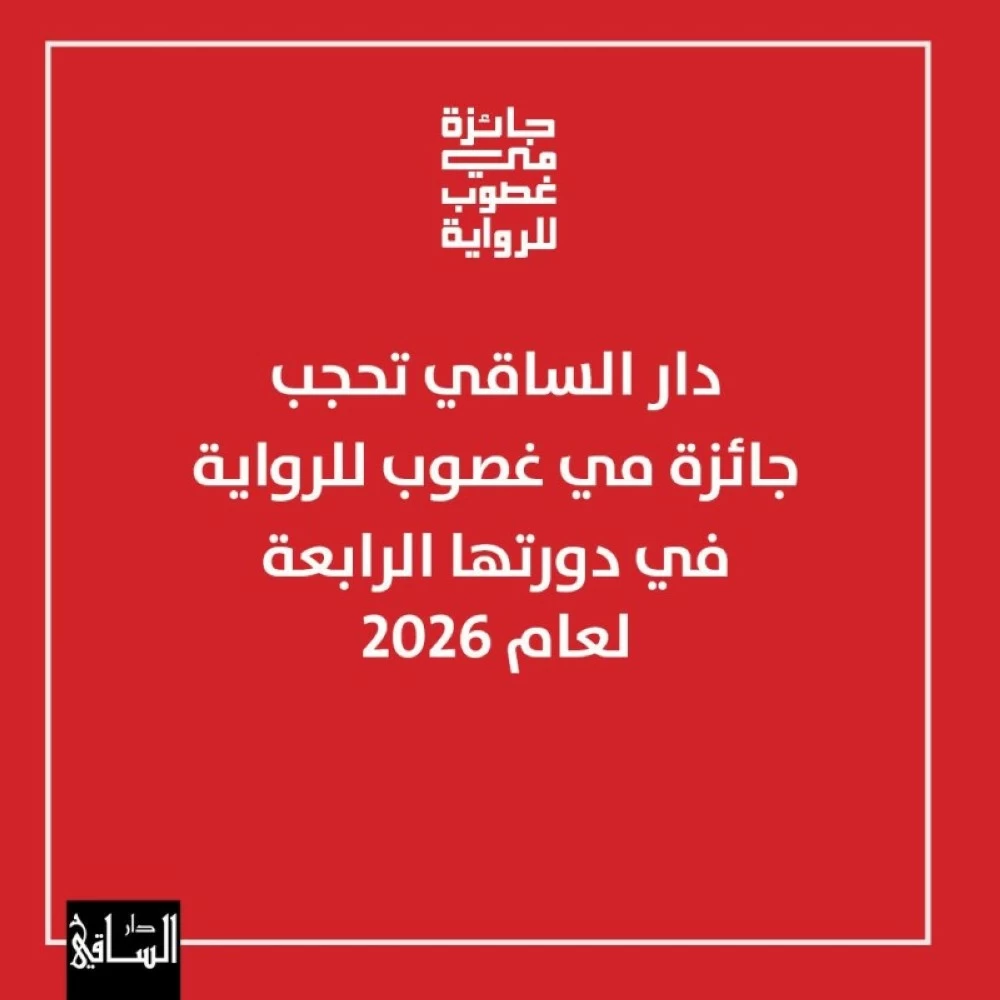
Dar Al-Saqi announced that the awarding of the 4th May Ghousoub Novel Prize in 2026 will be postponed. In a statement, the House of Commons explained that after careful reading and intense discussion, the committee concluded that (while recognizing the efforts) all participating works did not meet the criteria on which the award was based.
It is worth noting that this award is given to writers who have never published a book before and aims to discover and encourage new voices in Arabic literature. She believed that the decision to withhold reflected the committee’s awareness of the responsibility it had to literature, readers, and emerging writers. The publisher received over 100 manuscripts from Tunisia, Egypt, Morocco, Algeria, Lebanon, Sudan, Saudi Arabia, the Emirates, Syria, Iraq, Jordan and Yemen. Oman, Libya, Palestine.
The jury included Lebanese novelist Alawiya Sob, Yemeni novelist Habib Abd al-Rab Souri, and Pierre Fadel, editor of Dar al-Saqi.
The committee’s report states:
“Manuscripts dealt with a variety of real-world socio-political issues in the Arab world, including civil wars, the Arab Spring revolutions, brutal violence, sexual assaults, struggles with disease, mental disorders, and the falsehood of virtual life on social media networks. There was also a noticeable presence in fantasy novels, which revolved around the creation of parallel worlds and the summoning of supernatural elements, a trend in which authors expressed concerns, concerns, and big questions through symbolic reconstructions of the world.”
The committee considered a number of texts that contained within their essence the seeds of distinctive works of fiction, decided that they deserved a chance, and provided important observations to authors in working towards their development. However, the revised text did not meet all the necessary technical conditions, so the award had to be withheld.
Dar Al-Saq has announced that the awarding of the 4th Mi Ghsoob Novel Prize in 2026 will be postponed. In a statement, the hospital said that after careful reading and intensive discussion, it concluded (while appreciating the efforts) that all entries did not meet the criteria on which the award was based.
It is worth noting that this award is designated for writers who have never published a book before, with the aim of discovering and encouraging new voices in Arabic literature. The Committee considered the decision to withhold the award to be a reflection of its recognition of the responsibility it has to literature, readers and emerging writers alike. The house received more than 100 manuscripts from Tunisia, Egypt, Morocco, Algeria, Lebanon, Sudan, Saudi Arabia, the United Arab Emirates, Syria, Iraq, Jordan, Yemen, Oman, Libya, and Palestine.
The jury members included Lebanese novelist Alawiya Sobhi, Yemeni novelist Habib Abdullabh Surour, and Pierre Fadel, editor of Dar al-Saqi magazine.
The committee’s report states:
“Manuscripts dealt with a variety of real-world social and political issues in the Arab world, such as civil wars, the Arab Spring revolutions, brutal violence, sexual assault, struggles with illness, mental disorders, and the falsehood of virtual life on social media networks. The presence of fantasy novels that tackled the creation of parallel worlds and the invocation of supernatural elements was also noticeable. This trend expressed the authors’ concerns, anxieties, and big questions through symbolic reconfigurations of the world.”
The committee worked on several texts that contained at their core the seeds of a distinctive work of fiction, determined that they were worthy of an opportunity, and provided the authors with substantive feedback for development. However, the revised text did not meet all the necessary artistic conditions, so the award had to be withheld.
