

Algerian President Abdelmadjid Tebboune announced that construction of the long-planned Trans-Saharan Gas Pipeline (TSGP) will begin immediately after the holy month of Ramadan, marking an important milestone for one of Africa’s largest regional energy infrastructure projects, Algeria’s state news agency (APS) reported on Monday.
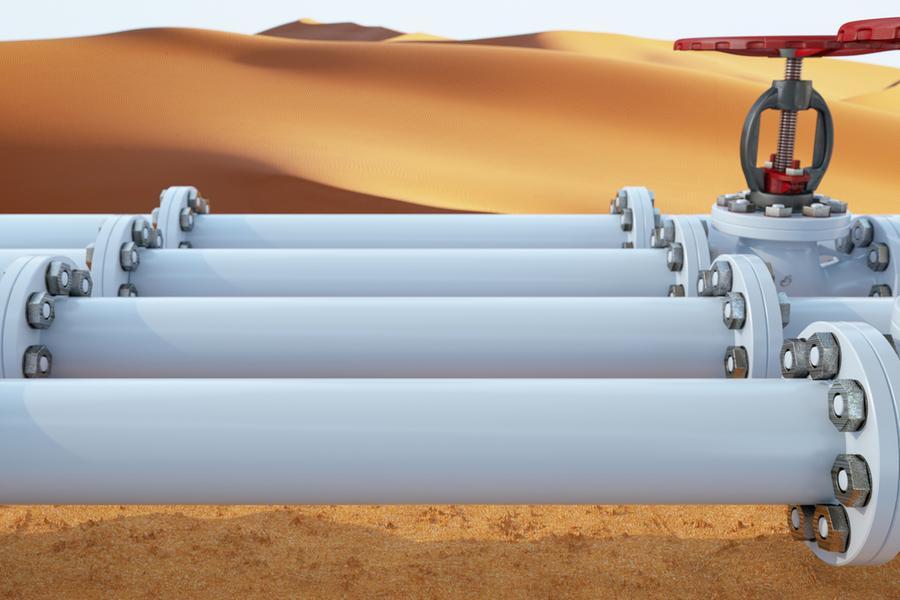
The TSGP is a 4,128-kilometer (km) natural gas pipeline designed to connect gas fields in southern Nigeria to Algeria via Niger and export gas to Europe.
The report said Tebboune confirmed at a joint press conference in Algiers with Niger’s head of state, Abdulrahmane Chiani, that the two countries had agreed to proceed with the construction of a pipeline across Niger’s territory.
He said state-run Sonatrach would manage the project and begin laying a gas pipeline across Niger.
According to previous reports, a significant portion of the project investment is expected to be spent within Niger, with approximately 841km of pipelines being constructed.
Algeria, Nigeria and Niger had signed an agreement in February 2025 that included a feasibility study, financing framework and confidentiality protocols to accelerate the project’s implementation.
The estimated $13 billion cross-border project has an annual gas production capacity of about 30 billion cubic meters. The pipeline will run from the Warri region of southern Nigeria through Niger to Algeria’s Hassi Rumelle gas hub, where it will connect to Mediterranean export routes including the Transmed, Medgaz and Maghreb Europe pipelines.
The Algerian portion of the pipeline is 2,300 km long and the Nigerian portion is 1,030 km long, and pipeline infrastructure support for the project in both countries is 70 percent complete, according to a March 2025 report by French news portal TRT Français.
In March 2025, UK-based international energy consultancy Pencepen was appointed to update the feasibility study for the pipeline, which was delivered in 2006. The new scope included regional gas market analysis. Environmental and social assessment. Economic and financial evaluation. cost estimation. Review of relevant legislation and consultation with stakeholders. Risk analysis and front-end engineering design (FEED) scope of work development
possession
The project is being structured as a tripartite partnership, with Nigeria’s state-owned Nigerian National Petroleum Company (NNPC) and Algeria’s state-owned Sonatrach jointly holding a 90% stake, with Niger holding the remaining 10% stake through SONIDEP.
The TSGP forms part of a wider regional gas infrastructure initiative aimed at improving energy access and strengthening export corridors.
Other major projects include the $25 billion Nigeria-Morocco gas pipeline, which will cross multiple West African countries, and the Mozambique-Zambia pipeline, planned to be announced in 2025.
(Written by Majda Muhsen; Edited by Anoop Menon)
(anoop.menon@lseg.com)
Subscribe to Project’s PULSE newsletter, delivering trusted news, updates and insights on project activities, developments and partnerships across sectors in the Middle East and Africa.
