


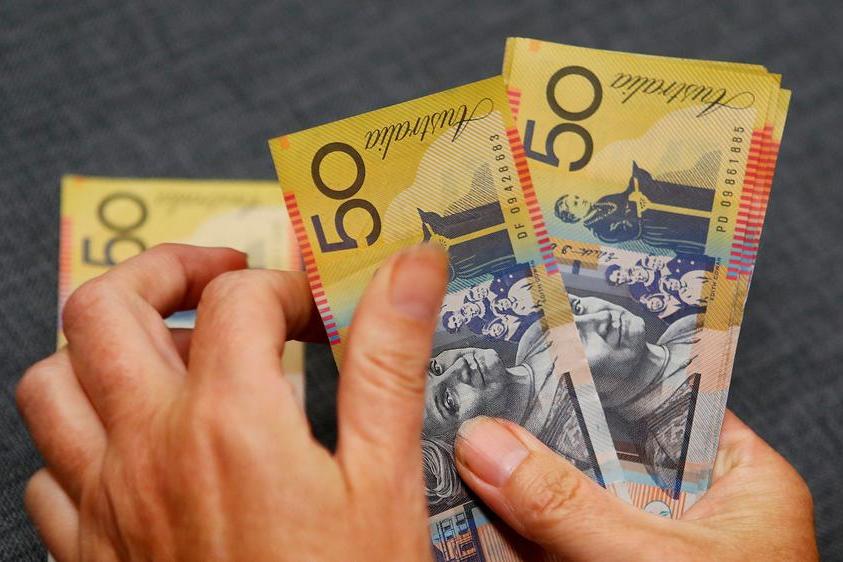
SINGAPORE – The Australian dollar was headed for its biggest monthly gain on Friday amid rising hopes for a more hawkish central bank, while the yen was headed for a slide as the Bank of Japan took on an audacious standoff with the reflationist prime minister.
Investors have had to contend with developments this month, including geopolitical tensions, a pivotal U.S. Supreme Court ruling against President Trump’s tariffs, and the vagaries surrounding artificial intelligence trade.
However, currency movements during the month were mainly driven by changes in interest rate expectations.
“Interest rates reflect changes in the macro landscape,” said Sim Moe Siong, currency strategist at OCBC.
“Last year, the focus was on which central banks would cut rates and by how much. This year, the focus has shifted to which central banks will take the lead in raising rates.”
The Australian dollar, which was stable at $0.7106 on Friday, was on track for a monthly gain of about 2%.
It has gained more than 6% since the beginning of the year, making it the best-performing G10 currency so far, as the domestic economic downturn raises expectations for a more hawkish Reserve Bank of Australia.
“It’s conceivable that the Australian dollar could rise another cent or two from here,” said Carol Conn, currency strategist at Commonwealth Bank of Australia.
“We still think there will only be one more 25 basis point rate hike by the RBA this year.”
The Bank of Japan is also on an upward trajectory, but despite Bank of Japan Governor Kazuo Ueda’s willingness to raise interest rates in the short term, it has done little to support the yen as domestic politics complicate the outlook for interest rates.
In Asia, the yen rose 0.2% to 155.78 yen, but is down 0.4% for the week and 0.6% for the month so far.
This week, the Japanese government appointed two academics seen by markets as strong proponents of economic stimulus to the Bank of Japan’s board.
The surprise move sends a not-so-subtle message about Prime Minister Sanae Takaichi’s aversion to rising interest rates and raises questions about how much further policy can be tightened.
“The politics surrounding the appointments have left the market questioning the pace and confidence of policy normalization,” said Charl Chanana, chief investment strategist at Saxo.
Evaluation of interest rate outlook
The pound was stable at $1.3484, down 1.5% in February, but was on track to rise for the third consecutive month.
Sterling has been weakened by the Bank of England’s dovish tendencies, with traders currently pricing in an 83% chance of a March interest rate cut.
The dollar was expected to rise 0.6% this month, as the Federal Reserve became more hawkish after “several” policymakers suggested at its January policy meeting that it was open to raising interest rates if inflation remained high.
Nevertheless, investors continue to price in two more rate cuts from the Fed this year.
“I think this is because there are still lingering concerns about what will happen to the Fed under new Fed Chairman Kevin Warsh,” OCBC’s Mr. Sim said.
Analysts said the US Supreme Court’s decision to cancel President Trump’s tariffs also strengthened checks and balances on presidential power and provided some support for the dollar.
The euro moved more slowly, with the common currency little changed at $1.1796 on Friday, on track for a monthly decline of just over 0.4%.
The European Central Bank is expected to keep interest rates on hold for the next few months.
In China, the country’s central bank announced on Friday that it would eliminate currency risk reserves on some futures contracts, which would reduce the cost of buying dollars.
The decision comes after the renminbi appreciated by 4.4% against the dollar in 2025, its biggest annual increase since 2020, and the upward momentum continued this year.
The onshore yuan last fell 0.24% to 6.8572 yuan per dollar, while the offshore yuan fell 0.1% to 6.8542 yuan per dollar.
(Reporting by Rae Wee; Editing by Edwina Gibbs)
