


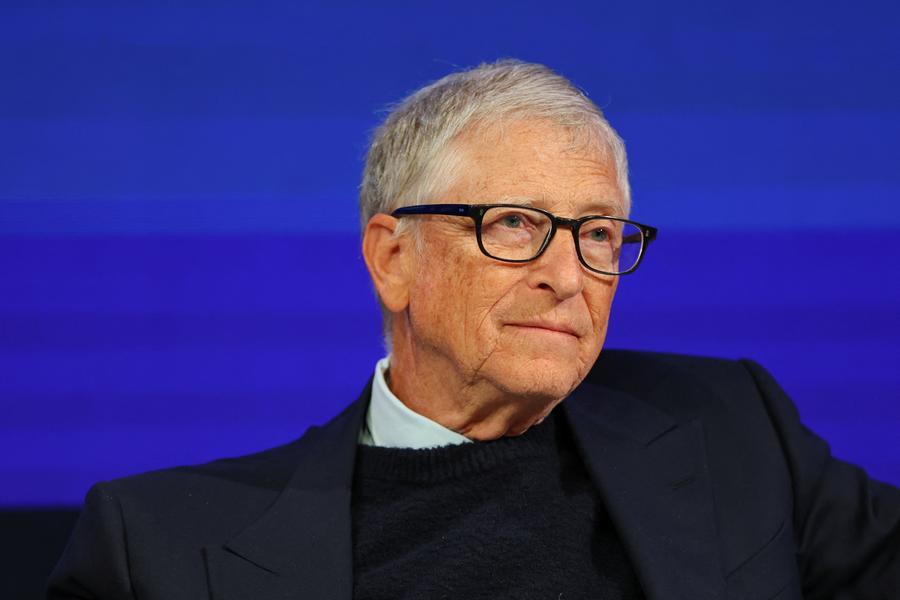
NEW DELHI – Bill Gates withdrew from India’s AI Impact Summit hours before his scheduled keynote address on Thursday, dealing another blow to a flagship event already marred by complaints of organizational missteps, robot brawls and traffic disruptions.
Gates’ absence, followed by another high-profile cancellation by Nvidia’s Jensen Huang, further complicated the opening of the summit billed as the Global South’s first major artificial intelligence forum as India seeks to establish itself as a leading voice in global AI governance.
The Gates Foundation said the billionaire would not give a speech “to maintain focus on the AI Summit’s key priorities.” Just a few days ago, the foundation denied rumors that he would not be attending, insisting that he was scheduled to attend.
Gates’ revocation comes after the U.S. Department of Justice last month released emails containing communications between late financier and convicted sex offender Jeffrey Epstein and Gates Foundation staff.
Gates said the relationship was limited to philanthropy-related discussions and that it was a mistake to meet with Epstein.
In his keynote address, Indian Prime Minister Narendra Modi, along with French President Emmanuel Macron, Google CEO Sundar Pichai, OpenAI CEO Sam Altman, and Anthropic CEO Dario Amodei, spoke at a gathering on Thursday, calling for keeping children safe on AI platforms.
“We have to be more careful about the safety of our children. Just as school curricula are hand-picked, so too should the field of AI be guided by children and families,” PM Modi said after taking to the stage with top AI executives and posing for photos with arms raised in a show of strength.
In the photo shoot, Altman and Amodei, the heads of rival AI companies OpenAI and Anthropic, stood side by side on stage, but while other executives held hands, they did not, creating an awkward moment.
However, the event generated some investment commitments, with India’s Reliance Industries pledging nearly $110 billion over the next seven years to build AI-related infrastructure.
More than $200 billion has been pledged to invest in AI data center projects in India, including Reliance, conglomerate Adani Group, tech giant Microsoft and data center company Yotta.
But analysts warn that the rapid build-out of AI infrastructure risks straining India’s power grid and water supply.
Despite the investment success, India’s first major AI summit was marred by systemic missteps, leaving attendees shocked and angry at the lack of planning from the Indian government.
chaos and traffic jams
The summit’s exhibition hall was abruptly shut down on Thursday, further angering participating companies who had set up booths and pavilions. After three days of large crowds, the venue was mostly deserted.
An Indian university, Galgotias, was asked to leave the venue after a staff member caused a public uproar by presenting a commercially available Chinese robot dog as his own.
Police repeatedly blocked roads to prioritize the movement of VIPs to the summit, causing chaos in the city of 20 million people. The Indian government apologized for the inconvenience caused to participants in the first few days.
But on Wednesday, footage on social media showed scores of summit participants walking for miles through central Delhi as roads were blocked, taxis unavailable and shuttle services unarranged.
Opposition parties attacked the government and the prime minister for sloppy management of the world summit.
“How can we expect engineers and AI people to walk such distances…and we are frustrated that entrepreneurs are leaving India,” said Pawan Khera, a spokesperson for the Congress party.
“Sorry, but the entire summit was meant for researchers, founders, and builders who are grinding in the field every day. Instead, we are treated like we don’t matter and are blocked for hours for ministers and officials to get through,” Microsoft researcher Jay Gala said on social media website X.
(Reporting by Munsif Vengattil, Aditya Soni and Aditya Kalra in New Delhi; Additional reporting by Sakshi Dayal and Abhirami G; Editing by Kim Coghill, Muralikumar Anantharaman, Raju Gopalakrishnan and Christian Schmollinger)
