


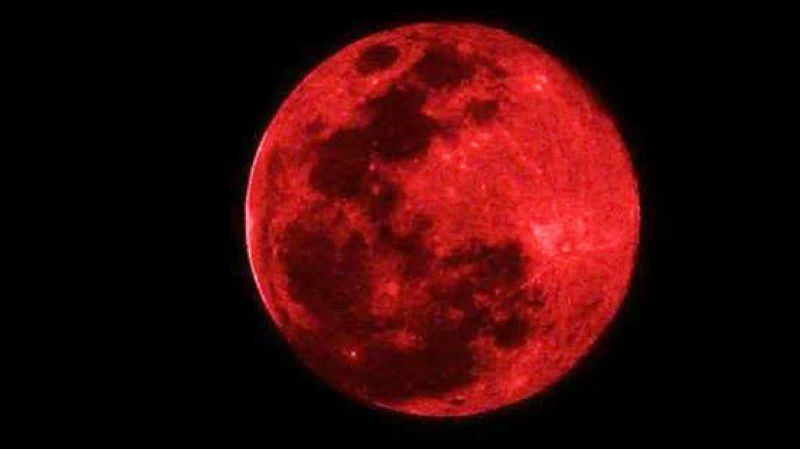
On March 3 next year, the world’s skies will witness a total lunar eclipse, known in astronomical terms as a “blood moon” phenomenon, in which the moon’s color turns bronze as a result of sunlight passing through the Earth’s atmosphere before being reflected off the Earth’s surface, which astronomers say is a direct result of light scattering according to physical principles known as atmospheric optics.
A total solar eclipse occurs when the Sun, Earth, and Moon are aligned. Therefore, the Earth is located between the two celestial bodies, blocking direct sunlight from the Moon. However, the atmosphere does not completely block light; it allows certain wavelengths to pass through. There, the blue color is scattered, while the red waves continue to bend and reach the moon’s surface, giving it a dark red glow.
Unlike solar eclipses that require special visual protection, this type of eclipse can be seen with the naked eye without any health risks, according to astronomical data released by international monitoring agencies. The duration of a total solar eclipse can extend to more than an hour in some areas, but the viewing angle will vary depending on your geographic location and whether the sky is cloud-free.
Experts confirm that “blood moons” are not scientifically rare phenomena, as they repeat within a known solar eclipse cycle precisely calculated in advance, but their unique visual characteristics have given them a wide public dimension, especially with the spread of high-resolution astronomical images and the growing public interest in space science.
