


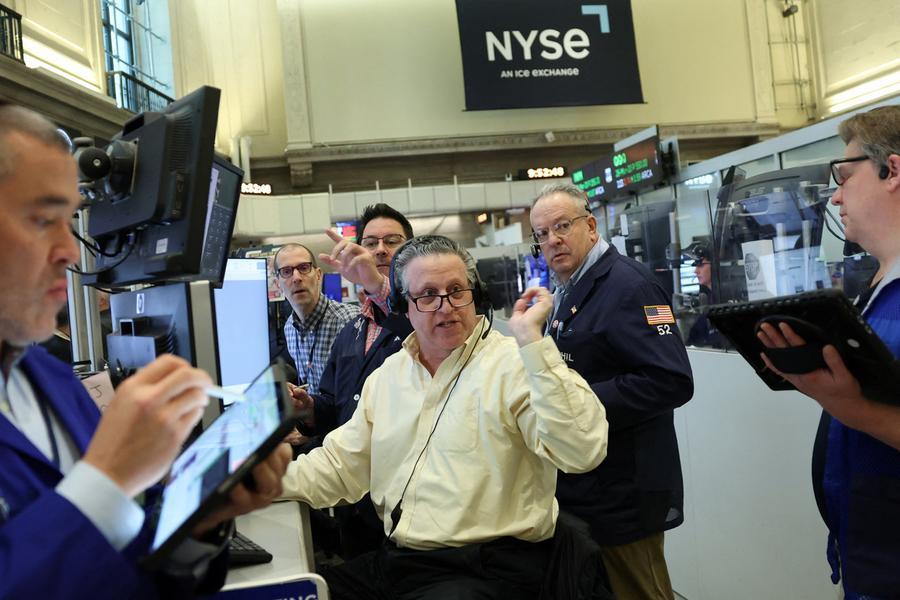
Stocks deepened and the dollar strengthened on Tuesday as escalating conflict in the Middle East accelerated a spike in energy prices and raised investor concerns about the impact on the global economy.
Europe’s benchmark STOXX 600 index fell 2.7% in early trade, following Monday’s 1.7% decline, its biggest single-day decline since April.
U.S. S&P 500 e-mini futures fell 1.6%, after a choppy session on Monday in which the S&P 500 index rose from an early decline to flat and the Nasdaq Composite rose 0.4%, suggesting a subsequent decline could engulf Wall Street.
On Monday, US President Donald Trump said the campaign had exceeded expectations and sought to justify a wide-ranging and unending war against Iran. At the center of traders’ attention is the dramatic rise in oil and natural gas prices.
“The most notable development for Western Europe is another spike in natural gas prices. This raises quite a lot of concern that we could see something like what we saw in 2022 when Russia invaded Ukraine occur again,” said George Moran, European macro strategist at RBC Capital Markets.
“I feel like the market is interpreting this much more as an inflation shock than a growth shock. Of course, it could still impact growth,” he said. In the natural gas market, benchmark European LNG prices rose 39% on Monday, surging 25%, while U.S. natural gas futures prices rose nearly 6%.
Qatar suspended liquefied natural gas (LNG) production on Monday, prompting a precautionary shutdown of oil and gas facilities across the Middle East. Qatar’s LNG production accounts for about 20% of global supply.
Iranian Revolutionary Guards officials said on Monday that the Strait of Hormuz was closed to maritime traffic and that Iran would open fire on ships attempting to pass.
Brent crude oil futures rose another 4.2% to $80.96 on Tuesday, up more than 11% for the week. A basket of European oil and gas stocks rose 1.2% this week.
Deal with risk scenarios
Investors are grappling with the uncertainty of how long the conflict will last, with no end in sight to the hostilities. The US embassy in Riyadh was attacked by two drones, causing limited fire and some property damage, the Saudi Ministry of Defense said in a post on X on Tuesday.
“Such events increase concerns about a protracted conflict,” Deutsche Bank research analysts said in a morning note. They added that there are signs that investors are still pricing in the conflict being temporary rather than protracted.
“In particular, the sharp rise was primarily at the front end of the energy curve, with much smaller fluctuations in long-term contracts,” they wrote.
On Tuesday, Prime Minister Benjamin Netanyahu said he expected a war with Iran “not to take many years.” Rising energy prices are complicating the Federal Reserve’s efforts to curb inflation, and policymakers are already showing signs of division over the impact of artificial intelligence on the U.S. economy.
Secretary of State Rubio said Monday that the United States will take steps to mitigate rising energy prices caused by soaring oil prices.
ISM manufacturing data released on Monday showed U.S. activity rose steadily in February, but a measure of factory-export prices rose to near a 3-1/2-year high amid tariffs, highlighting upward pressures on inflation even before the Iran attack.
Federal funds futures have a 95.4% implied probability that the U.S. central bank will leave interest rates unchanged at the end of its two-day meeting on March 18, according to CME Group’s FedWatch tool. June hold odds, which were previously below 50%, inched up on Monday and are now slightly better than a coin toss.
The dollar index, which measures the performance of the U.S. currency against six other currencies, held near a six-week high at 99.07 as investors shunned currencies they considered most vulnerable to rising energy prices.
The yield on the 10-year U.S. Treasury rose nearly 5 basis points to 4.1%. Gold fell 1.2% to $5,266 per ounce as the dollar continued to strengthen. Bitcoin fell 3.6% to $66,925.7.
(Additional reporting by Gregor Stuart Hunter and Rae Wee in Singapore and Lucy Raitano in London; Editing by Kirsten Donovan and Emelia Sithole-Matarise)
