

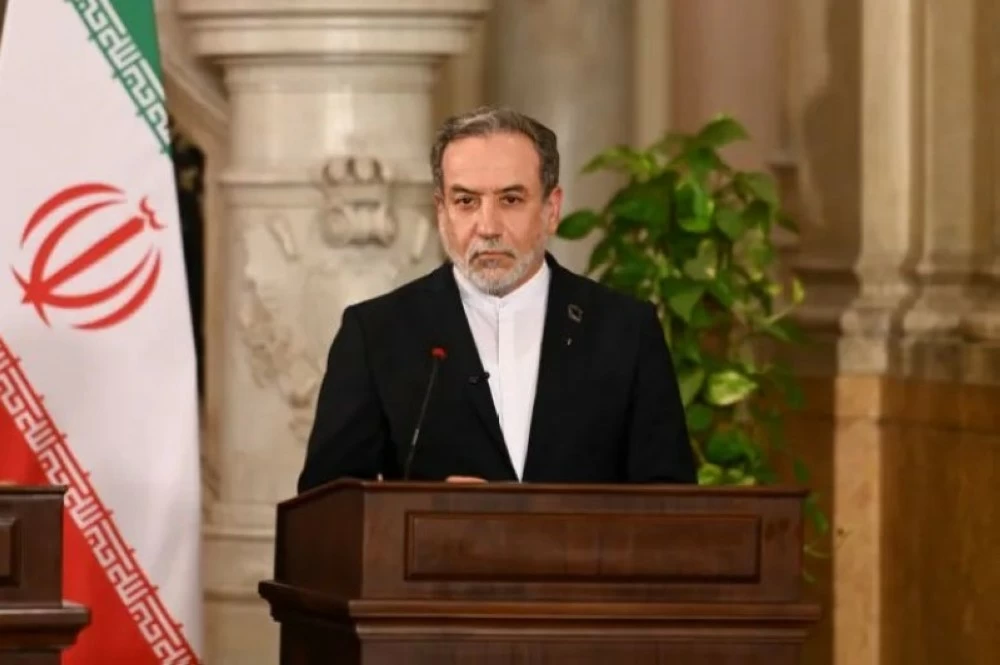
ANKARA – Iranian Foreign Minister Abbas Araghchi has arrived in Turki for high-level talks, intensifying diplomatic efforts to avert military conflict between the United States and Iran.
According to Iran’s Mehr news agency, upon arriving in Istanbul on Friday, Aragushi said Iran and Turkey needed “close consultations” in light of what he described as serious developments in the region, especially in light of the goals and positions presented by the United States.
Araghchi said the visit had been planned for several months and would focus on reviewing bilateral relations and regional and international issues.
Mehr said Araghçi will meet with Turkey’s Hakan Fidan and President Recep Tayyip Erdoğan during his visit.
Saudi Arabia’s Minister of Defense, Prince Khalid bin Salman, met with senior US officials, including Secretary of State Marco Rubio, Secretary of Defense Pete Hegseth, and US Special Envoy for the Middle East Steve Witkoff, the Saudi Press Agency (SPA) reported.
During the meeting, they reviewed the strategic relationship between the two countries and discussed continued efforts to establish peace in the region.
The Trump administration is hosting top defense and intelligence officials from Israel for talks on Iran in Washington this week, two people familiar with the matter said. U.S. officials said President Trump is considering his options but has not decided whether to attack Iran.
Mohamed ElBaradei, former director-general of the United Nations International Atomic Energy Agency, warned that the threat of military action against Iran mirrors the situation leading up to the Iraq war.
Arraguchi criticized Europe as a “continent in decline” that lacks a clear understanding of regional realities. He said the EU’s decision to designate Iran’s Islamic Revolutionary Guard Corps as a “terrorist” organization was a strategic mistake.
The United States welcomed the EU’s decision, calling it Iran’s “main instrument of domestic and foreign terrorism.”
EU foreign policy chief Kaja Karas said on Thursday that EU foreign ministers had taken a “decisive step” to classify the Revolutionary Guards as a “terrorist” group.
“Oppression cannot go unanswered,” Karas wrote on social media. “A regime that kills thousands of its own citizens is working towards its own demise.”
Iran’s Foreign Ministry responded to the decision, calling the move “illegal, political, in violation of international law” and a violation of internal policy.
It added that the Iranian government “reserves the right to take appropriate measures within the framework of international law to protect the sovereignty, national security and interests of the Iranian state, and the European Union and its member states are responsible for the consequences of this action.”
Azerbaijan said it would never allow any state to use its airspace or territory to conduct military operations against neighboring Iran.
Foreign Minister Jeyhun Bayramov said he spoke by phone with Iranian expatriate Aragushi and discussed the recent rise in tensions in the region.
He said Azerbaijan has consistently emphasized the need for all parties to refrain from measures and rhetoric that could lead to instability in Iran and its surrounding region.
He stressed the importance of resolving issues only through dialogue and diplomatic means in accordance with the rules and principles of international law.
Iranian authorities have arrested a number of unidentified people on suspicion of destroying public property during recent anti-government protests in Tehran’s southern Share Rei district, the country’s semi-official Tasnim news agency said.
In a post on X, the agency reported that intelligence surveillance by the Islamic Revolutionary Guards Corps (IRGC) led to the arrest of alleged leaders of “key networks responsible for the destruction of public property” at the protests in Shaare Ray.
The post was accompanied by a video showing surveillance footage of a crowd of protesters on the street, with some protesters appearing to throw projectiles as fires broke out and buildings were damaged.
Oil prices fell on Friday on signs that the United States may hold talks with Iran over its nuclear program, easing fears of supply disruptions due to a U.S. attack.
Brent crude oil futures rose 3.4% and were down $1.10 to $69.61 a barrel by 0707 GMT, after closing at their highest since July 31 on Thursday. The March contract expires later Friday. The more active April contract fell $1.29 to $68.30.
Oil prices rose this week due to the US military buildup in the region. President Donald Trump on Wednesday urged Iran to reach a deal on its nuclear weapons or face attack, but said he planned to speak to the country’s leaders on Thursday. The Iranian government said it would respond harshly to the previous statements. — Agency
Related articles