


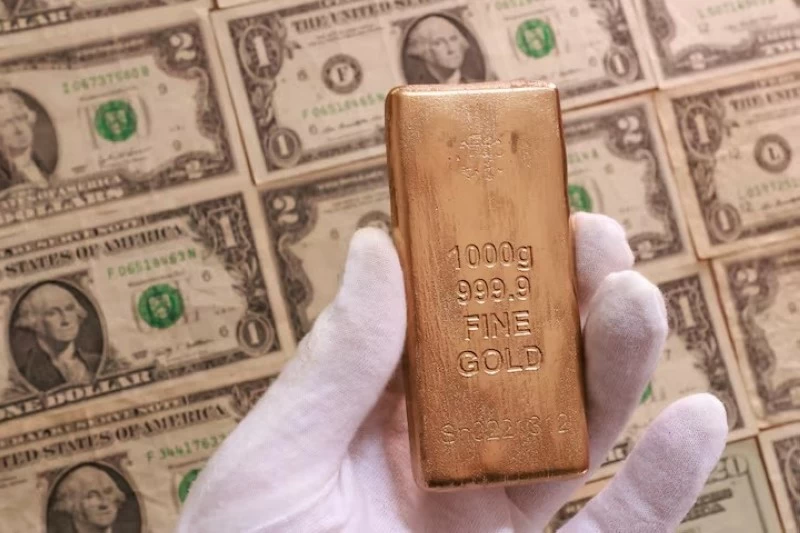
Escalating unrest in the Middle East has triggered a new wave of uncertainty in global markets, prompting investors to once again look for safe havens to protect their funds, but ironically, assets traditionally considered safe havens are no longer behaving predictably as currencies, gold and bonds have seen unusual volatility as geopolitical tensions intensify, according to Reuters.
While the dollar strengthened, gold maintained its position as one of the most powerful hedges during the crisis, although other assets such as government bonds and defensive currencies performed mixedly.
The dollar is temporarily regaining its position.
The U.S. dollar has emerged as one of the best-performing safe-haven assets this week, with the dollar index (.DXY), which measures the strength of the U.S. currency against a basket of six major currencies, up about 1.5%. It’s worth noting that the dollar also appreciated against the Swiss franc and the Japanese yen, two currencies that traditionally appreciate in times of stress.
Analysts say current demand is primarily focused on short-term dollar cash and less on other U.S. assets such as stocks and bonds.
The rise in oil prices, which exceeded $80 per barrel of Brent crude, also contributed to supporting the US currency, especially since the US is considered a major energy exporter.
But experts warn that the dollar’s status as a safe-haven asset could decline in the future due to uncertainties surrounding U.S. economic policy.
Government bonds are losing their luster
In contrast, government bonds did not attract the investment flows typically seen during geopolitical crises.
Investors are now focused on the risks of inflation and high public debt rather than seeking the safety of bonds.
Yields on German 10-year bonds, the eurozone’s main benchmark, rose 14 basis points this week, reflecting weaker demand for defense assets.
Experts believe financial trends in Europe, such as Germany’s loosening of government borrowing rules, are increasing concerns about rising debt and weighing on the attractiveness of bonds.
Gold maintains its reputation as a safe asset
Despite recent fluctuations, gold still maintains its strong reputation as a safe haven, with the yellow metal up around 240% since the start of this decade due to concerns related to inflation, geopolitical tensions and high levels of global debt.
Gold briefly fell in some trades this week, but analysts said this was because investors sold some profitable assets to offset losses in other markets.
Analysts believe that gold remains undervalued in global investment portfolios as it accounts for less than 1% of total global fund assets compared to a strategic proportion of 5-10%.
Some experts have more optimistic predictions, saying the price of gold could reach $6,000 an ounce this year, compared to the current level of over $5,000.
A tough test for defensive currencies
Currencies traditionally considered safe-haven currencies such as the Swiss franc and Japanese yen faced severe challenges this week, with the franc depreciating by about 1.2% and the yen depreciating by about 0.8%.
However, while some analysts believe the Japanese yen may offer better protection for investors if tensions persist, Japan’s political uncertainty is raising new risks, especially following reports that Prime Minister Sanae Takaichi is reluctant to raise interest rates further.
Meanwhile, the Swiss National Bank has warned that it is prepared to intervene in the market if the Swiss franc appreciates too much, meaning the Swiss franc could face limits to its appreciation.
Defensive stocks defy expectations
Even defensive stocks like utilities and consumer staples didn’t offer as much protection this time around as expected.
In the U.S., the utilities and consumer discretionary sectors of the S&P 500 fell 1% and 2.8%, respectively, this week, while the overall index remained mostly stable.
Defensive sector losses widened in Europe, with the STOXX Europe 600 index down about 3%.
Analysts say this is partly because these stocks had already achieved strong performance before the outbreak of the war, as part of an investment trend that focused on so-called “real assets” such as infrastructure and industry.
Escalating unrest in the Middle East has brought a new wave of uncertainty to global markets, prompting investors to once again seek safe havens to protect their funds. But the paradox is that traditionally safe-haven assets are no longer behaving as expected, with currencies, gold and bonds experiencing extraordinary volatility amid heightened geopolitical tensions, according to Reuters.
While the U.S. dollar strengthens, gold remains one of the most powerful hedges in times of crisis, although other assets such as government bonds and defensive currencies have performed mixedly.
dollar temporarily regains ground
The U.S. dollar has emerged as one of the best-performing safe-haven assets this week, with the dollar index (.DXY), which measures the strength of the U.S. currency against a basket of six major currencies, up about 1.5%. Notably, the dollar also strengthened against two currencies that traditionally appreciate in times of stress: the Swiss franc and the Japanese yen.
Analysts believe current demand is primarily focused on short-term dollar cash liquidity rather than other U.S. assets such as stocks or bonds.
Rising oil prices, with Brent crude above $80 per barrel, also supported the US currency, especially since the US is one of the largest energy exporters.
But experts warn that uncertainty over U.S. economic policy could undermine the dollar’s safe-haven status in the future.
Government bonds lose their luster
In contrast, government bonds have not attracted the usual investment flows typically seen during geopolitical crises.
Investors are now focused on inflation risk and rising public debt levels, rather than looking for the safety of bonds.
Germany’s 10-year bond yield, the eurozone’s main benchmark, rose 14 basis points this week, reflecting lower demand for defense assets.
Experts believe that financial trends in Europe, such as Germany’s loosening of government borrowing limits, are increasing concerns about rising debt, weighing on the attractiveness of bonds.
Gold maintains its reputation as a safe asset
Despite recent volatility, gold still maintains a strong reputation as a safe-haven asset, rising approximately 240% since the start of this decade due to concerns related to inflation, geopolitical tensions, and rising global debt levels.
Gold briefly fell in some trades this week, but analysts said this was because investors sold some profitable assets to offset losses in other markets.
Analysts believe that gold remains undervalued in global investment portfolios, as gold-backed exchange-traded funds account for less than 1% of total global fund assets, compared to a strategic allocation range of 5% to 10%.
Some experts have more optimistic forecasts, suggesting that gold prices, above $5,000 an ounce at current levels, could reach $6,000 this year.
A tough test for defensive currencies
Currencies traditionally considered safe-haven currencies such as the Swiss franc and the Japanese yen faced severe challenges this week, with the franc depreciating by about 1.2% and the yen depreciating by about 0.8%.
However, while some analysts believe the Japanese yen may offer relatively better protection for investors if tensions persist, Japan’s political uncertainty adds a new layer of risk, especially after reports that Prime Minister Sanae Takai is reluctant to raise interest rates further.
By contrast, the Swiss National Bank has warned that it is prepared to intervene in the market if the Swiss franc rises too much, so there may be limits to the Swiss franc’s strength.
Defensive stocks disappoint
Even defensive stocks like utilities and consumer staples didn’t offer as much protection this time around as expected.
In the US, the utilities and consumer staples sectors of the S&P 500 fell 1% and 2.8%, respectively, this week, while the overall index remained largely stable.
In Europe, defensive sectors suffered heavy losses, with the STOXX Europe 600 index down about 3%.
Analysts say this is partly because these stocks were already showing strong performance before the war began, as part of an investment trend focused on so-called “real assets” such as infrastructure and industry.
