

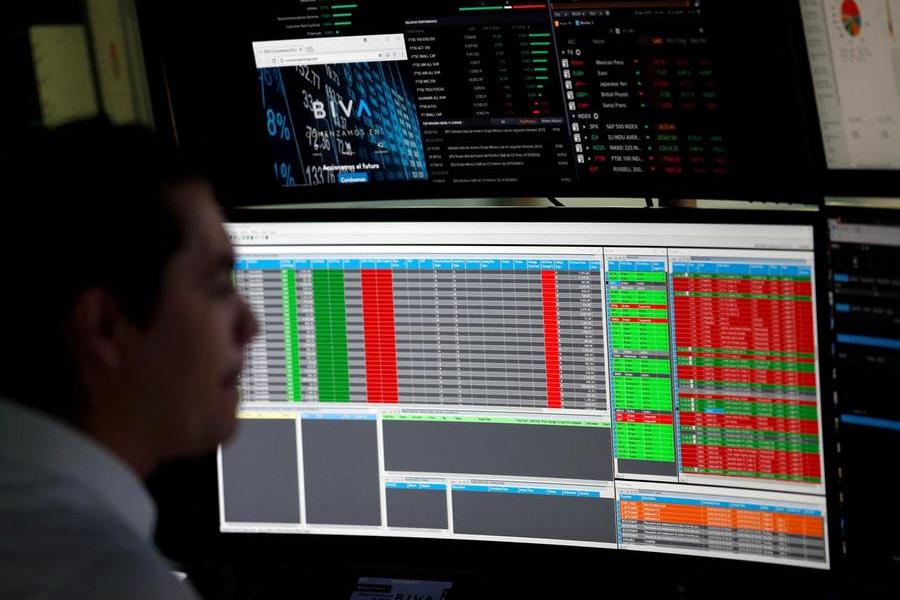
LONDON/SYDNEY – Global stocks rose on Thursday as investors remained optimistic about earnings ahead of Apple’s results, while gold hit a record high and oil prices rose on tensions between the United States and Iran.
The Euro STOXX 600 index rose 0.5% as crude oil and precious metal prices rose, while the British, Spanish and French indexes all rose. German stocks fell 0.6%.
With prospects of a U.S. interest rate cut before the summer fading, the market is counting on earnings to keep stock prices rising.
On Wednesday, the Federal Reserve kept interest rates on hold as widely expected, but Chairman Powell spoke of the “clearly improving” economic outlook and widespread support for the committee’s recess.
Given President Donald Trump’s efforts to pressure the Fed to cut rates more aggressively, it will not be interesting to see whether Mr. Powell will remain on the Fed’s board after stepping down as chairman in May.
Investors have responded by lowering the chance of further interest rate cuts by April to 26%, with the next likely date seen in June.
Deutsche Bank analysts said economists “believe the Fed, led by Powell, has made its final rate cut,” adding: “We believe the risks surrounding expectations for the first rate cut this year in September are now more balanced.”
All eyes are on Apple’s financial results, with JPMorgan predicting that profits will exceed the consensus due to increased demand for the iPhone 17 and slower growth in expenses.
On Wall Street, disappointment over Microsoft’s results was tempered by strong guidance from Meta, with S&P 500 futures and Nasdaq futures each rising about 0.3%.
Meanwhile, gold and silver rose to record highs as investors continued to rush into precious metals.
Gold rose 2.5% to $5,536 an ounce, up about 28% this month alone.
The European Basic Resources Index rose 3%, its highest level since May 2008.
Oil prices rose to a four-month high after President Trump warned Iran of possible attack if it does not agree on nuclear weapons. Brent crude rose 1.5% to $69.44 per barrel, while U.S. crude rose 1.7% to $64.26 per barrel.
So far, MSCI’s broadest index of Asia-Pacific stocks outside Japan has been little changed. However, South Korean stocks rose by 0.6%, making January’s increase rate a whopping 23%. Taiwan’s high-tech market rose nearly 13% over the same period.
Indonesian markets suffered a second loss after Goldman Sachs downgraded the country’s stocks after index provider MSCI warned about ownership and trading transparency.
AI capital investment vs. revenue
Microsoft’s stock price fell 6.5% on Wednesday on concerns that capital spending won’t generate enough returns to justify its lofty valuation.
Meta raised its 2026 revenue and capital spending outlook, sending the stock up 8% in after-hours and adding about $140 billion to its market value.
“A common theme for META and MSFT so far has been higher-than-expected capital spending, pointing to an upward trend in AI spending,” JPMorgan analysts said. The difference, they say, is that Meta’s 2026 revenue outlook has significantly exceeded market expectations.
In currency markets, the dollar was on the defensive as investors hedged against U.S. policy uncertainty and the country’s growing debt mountain.
Against a basket of currencies, the dollar was weak at $96.17, near Tuesday’s four-year low of $95.566.
U.S. Treasury Secretary Scott Bessent insisted the administration still supports a “strong dollar” policy.
European leaders expressed concern about the dollar’s decline, and European Central Bank officials suggested that a further surge in the euro could justify a rate cut.
The euro rose another 0.2% to $1.1979, while the dollar fell 0.3% against the Swiss franc to $0.7658. The Japanese yen also fell by 0.3% to 153.03.
