


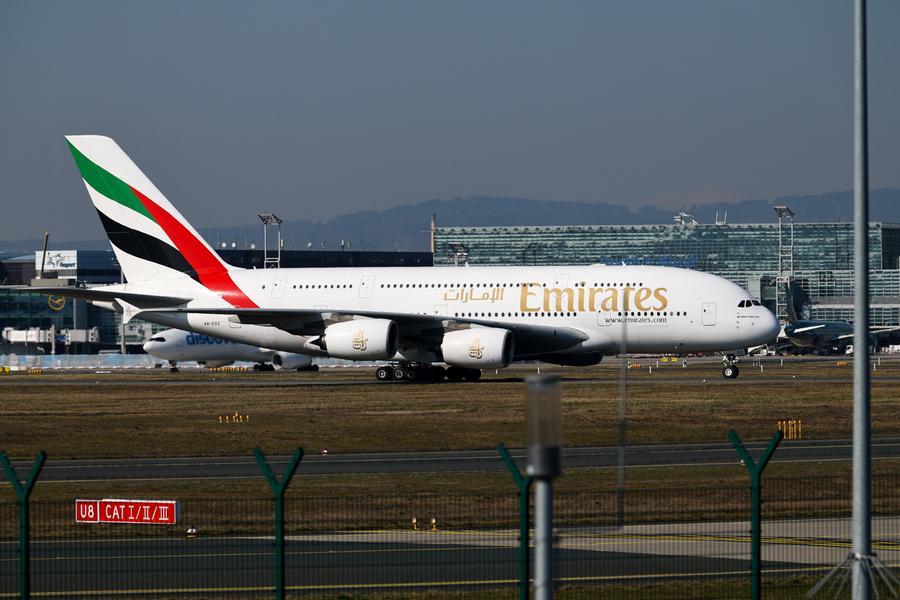
HONG KONG: Emirates and Etihad Airways resumed limited flight schedules from their hubs in the United Arab Emirates to major cities around the world on Friday, but continued threats of missile launches put pressure on airlines struggling to accommodate travellers.
Much of the Middle East’s airspace remains closed off to missile and drone concerns since the start of the U.S. and Israel’s war against Iran, with authorities arranging chartered flights and securing seats on limited commercial flights to evacuate tens of thousands of people.
French Transport Minister Philippe Tabarro said an Air France flight chartered by the government to bring French nationals home from the United Arab Emirates was forced to turn back Thursday due to missile firing in the surrounding area.
“This situation reflects the instability in the region and the complexity of repatriation operations,” he said.
Etihad Airways announced on Friday that it would resume a limited flight schedule until March 19. Flights will operate between Abu Dhabi and 25 destinations including London, Paris, Frankfurt, Delhi, New York and Toronto.
As of Thursday, traffic at Dubai Airport, usually the world’s busiest, was almost double what it was on Wednesday, but remained at about 25% of normal levels, according to plane-tracking website Flightradar 24.
Dubai-based Emirates, one of the UAE’s two flag carriers, announced late Thursday that it would operate a reduced schedule of flights to 82 destinations, including London, Sydney, Singapore and New York, until further notice, and that customers connecting in Dubai would only be accommodated if their connecting flight was operational.
Travelers on routes from Europe to the Asia-Pacific region have been particularly hard hit due to restrictions on operations at hubs in the Middle East.
Emirates, Qatar Airways and Etihad Airways combined typically fly around a third of their passengers from Europe to Asia, and more than half of all passengers from Europe to Australia, New Zealand and nearby Pacific Islands, according to Cirium data.
Qatar’s Doha hub remains closed but is arranging a limited number of relief flights from Oman and Saudi Arabia.
According to data from Cirium, more than 44,000 flights were scheduled to depart from the Middle East between February 28, when the conflict began, and March 5, with more than 25,000 flights cancelled.
Jet fuel prices soar, stock prices fall
Jet fuel in Singapore hit a record high of $225 a barrel this week as soaring oil prices pushed up the cost of jet fuel, which traders blamed on concerns about supply shortages from Middle Eastern refiners.
Prices fell slightly on Thursday to around $195 a barrel as some profit-taking took place, but they were still nearly twice as high as last week.
On Friday, Qantas’ shares fell more than 3%, Air New Zealand fell nearly 7%, Hong Kong’s flagship carrier Cathay Pacific fell more than 2% and Singapore Airlines fell more than 1%.
Hong Kong-listed stocks of major Chinese airlines, including Air China, China Eastern Airlines and China Southern Airlines, fell 2% to 4%.
Travelers describe chaos of hasty departures
Passengers spent huge sums of money trying to escape the Middle East, and some who managed to fly home from Oman on a commercial flight on Thursday said finding their way home from Dubai was “an utter mess”.
“I paid 1,500 pounds ($2,005.05) to cross to Muscat (Oman) to catch my flight,” said Ed Short, who arrived at London’s Heathrow Airport on a British Airways flight.
“I spent around £20,000 booking with Emirates instead, so I hope I get that money back.”
The conflict showed little sign of easing, and widespread disruption to aviation and air cargo appeared to be prolonged.
Saudi low-cost airline Flynas will operate limited flights between Saudi Arabia and Dubai starting Friday.
($1 = 0.7481 pounds)
(Reporting by Julie Zhu in Hong Kong; Additional reporting by Trixie Yap in Singapore; Writing by Anne Marie Roantree; Editing by Jamie Freed)
