


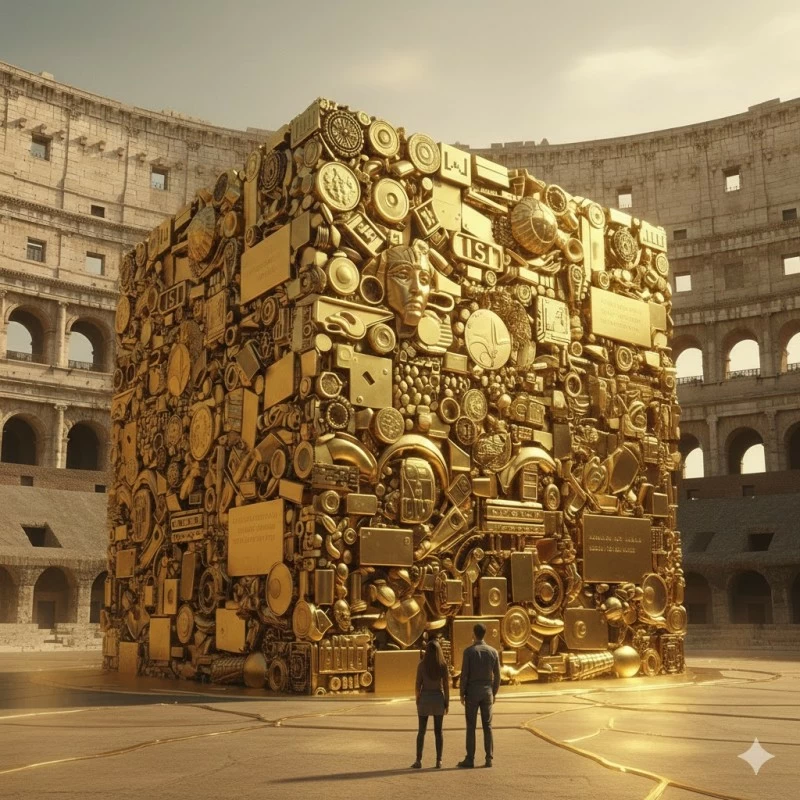
Did you know that all the gold that humans have extracted since the dawn of history to this day has been collected in a cube just under 22 meters long on a side? A small number compared to the value of the yellow metal that forms one of the pillars of the world’s economy.
According to World Gold Council data, the total amount of gold mined by the end of 2024 will reach approximately 219,000 tonnes, most of which has been produced since 1950, reflecting the acceleration of mining activity in modern times.
The most important advantage of gold is that it is a metal that does not deteriorate or rust. This means that most of the gold extracted throughout history is either stored in central bank vaults or still exists today in the form of jewelry or investment bullion. Theoretically, some of the gold from ancient civilizations could still be stored within the modern financial system.
When gold is distributed around the world, the numbers show the following picture.
44% Jewelery 23% Bullion, coins and investment funds 18% held by central banks Remaining percentage goes to industry and technology
But a question arises. Could gold ever run out?
According to estimates, the known mineable reserves are only about 55,000 tonnes, and the potential resources amount to about 132,000 tonnes, some of which cannot be mined economically or technically.
This relative scarcity explains why gold remains a strategic asset and safe haven in times of crisis, and why its value will continue to influence the global economic equation for many years to come.
Did you know that all the gold extracted by humans from the beginning of recorded history to the present day fits into a cube less than 22 meters on a side? This number seems small compared to the value of the yellow metal, one of the pillars of the world economy.
According to data from the World Gold Council, the total amount of gold to be mined by the end of 2024 is approximately 219,000 tonnes, most of which has been produced since 1950, reflecting the acceleration of mining activity in modern times.
The most important characteristic of gold is that it is a metal that does not deteriorate or rust. This means that most of the gold extracted throughout history still exists, either in central bank vaults or in the form of bars in jewelry or investments. Theoretically, some of the gold from ancient civilizations could still be stored within the modern financial system.
When gold is distributed around the world, the numbers show a picture like this:
44% Jewelery 23% Bullion, coins and investment funds 18% held by central banks Remaining percentage goes to industry and technology
But the question that arises is, “Can gold run out?”
Estimates suggest that the known extractable stock is only about 55,000 tonnes, and the potential resource amounts to about 132,000 tonnes, some of which is not economically or technically possible to mine.
This relative scarcity explains why gold remains a strategic asset and safe haven in times of crisis, and why its value will continue to influence the global economic equation for many years to come.
