


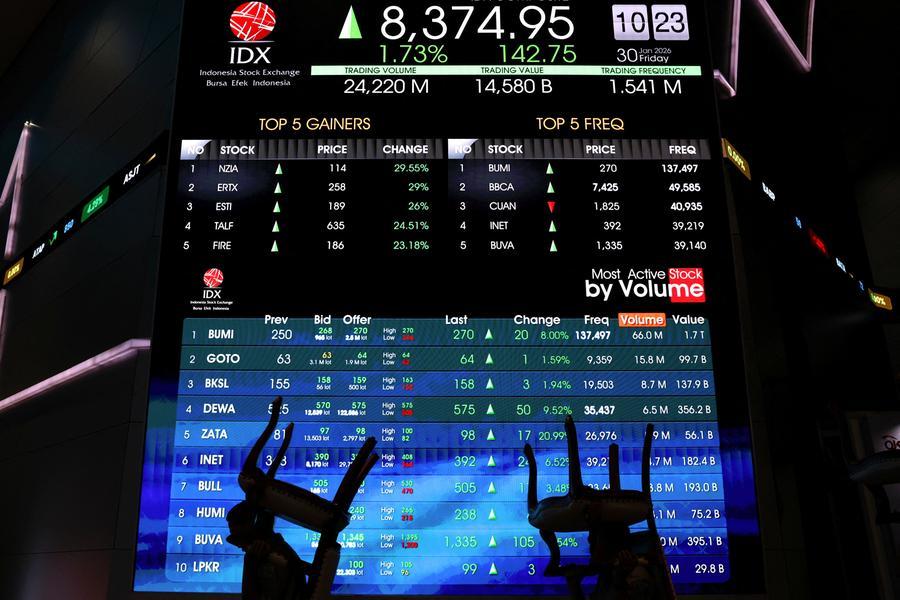
JAKARTA/SINGAPORE – Indonesia’s economic chief minister pledged on Friday to increase transparency in financial markets and improve corporate governance after the stock exchange chief resigned after taking responsibility for an $80 billion stock market crash.
Airlangga Hartarto told a press conference that authorities are working on stock market reform and the country’s economic fundamentals remain sound.
Proposed improvements include doubling the share float requirement to 15%, allowing pension and insurance funds to increase capital market investments from 8% to 20% of their portfolios, and verifying the affiliation of shareholders with less than 5% ownership.
“The government will ensure the protection of all investors by maintaining good governance and transparency,” Airlangga said.
Index provider MSCI warned on Wednesday that it could downgrade Indonesian stocks to “frontier” status over concerns about transparency in share ownership and trading, triggering the biggest two-day stock decline since April.
Indonesia Stock Exchange CEO Iman Rachman resigned on Friday.
“I hope this is the best decision for the capital markets. I hope that my resignation will lead to improvements in the capital markets,” Iman said at a press conference. “We hope that the index, which started positive this morning, will continue to improve in the coming days.”
The Financial Services Authority (OJK) will ensure that Iman’s resignation does not affect its operations, an OJK official told reporters. The official said he would lead the implementation of the reforms and aim to resolve MSCI’s concerns by May.
“We call on all investors to be calm and rational when making investment decisions,” said Inarno Djajadi, the regulator’s head of overseas capital markets.
The benchmark Jakarta Composite Index fell more than 8% on Wednesday and Thursday, but was last up 1.18% a day after authorities announced proposed measures to address MSCI’s concerns and ease investor fears.
The most recent value of the rupiah was 16,790 rupiah to the dollar, which is close to the all-time low of 16,985 rupiah hit last week.
Mohit Mirpuri, a portfolio manager at Singapore’s SGMC Capital, said someone had to take responsibility for the loss of trust, referring to Iman.
“The big picture is a reset and an opportunity for exchanges to become stronger with clearer standards and governance,” Mirpuri said.
Concerns over President Prabowo Subianto’s widening budget deficits and greater state involvement in financial markets have led to an increase in foreign capital outflows.
The appointment of his nephew Thomas Ziwandono to the central bank this month and the sacking of respected finance minister Sri Mulyani Indrawati last year have shaken confidence in Prabowo’s stewardship.
The regulator said it has had good communication with MSCI and is awaiting a response to the proposed measures and looks forward to implementing them in the near future.
Their quick action appears to have eased investor concerns, but sentiment remains fragile.
“Policymakers want to solve this problem,” said Paul Dmitriev, senior analyst and co-portfolio manager at GlobalX ETF. “Governments have every incentive to resolve these issues, as systematic outflows could become large and have significant market impacts.”
Foreign investors sold a net worth of about $645 million in stocks during the two-day decline, currency data showed. They sold $1 billion worth of stock in 2025.
(1 dollar = 16,780 rupiah)
(Reporting by Ananda Teresia, Francisca Nangoi and Jibran Pesimam in Jakarta, Ankur Banerjee and Gregor Stuart Hunter in Singapore; Writing by Raju Gopalakrishnan; Editing by Jacqueline Wong, Christian Schmollinger and Christopher Cushing)
