


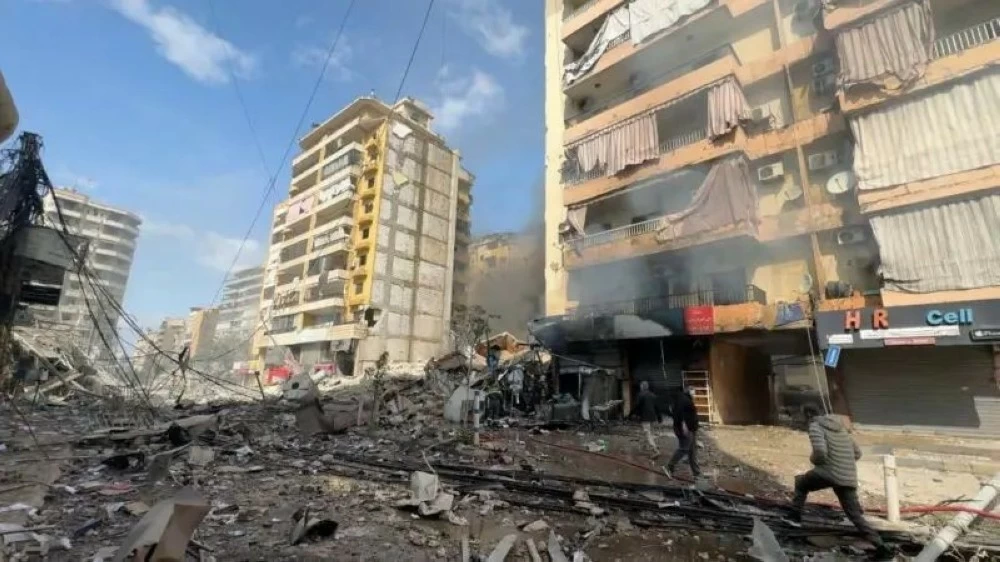
DUBAI – Iran launched new attacks on Israeli and American bases early Thursday after a U.S. submarine sank an Iranian warship in the Indian Ocean, while Israel announced it had launched a “major” attack on Tehran as the conflict entered its sixth day.
The fighting continued after the United States and Israel stepped up shelling on Iranian security forces and other symbols of power on Wednesday.
Iranian state television said additional attacks also targeted U.S. military bases.
Israel announced multiple missile attacks, and sirens were sounded in Tel Aviv and Jerusalem.
The Israeli military announced it had launched targeted attacks against Hezbollah militants in Lebanon and a major attack on infrastructure in the Iranian capital. Shortly after, explosions were heard in multiple locations in Tehran.
The US Navy sank an Iranian warship in the Indian Ocean on Tuesday night, killing at least dozens of Iranian sailors, a move Iranian Foreign Minister Abbas Araghchi denounced on Thursday as an “atrocity at sea.”
“The Indian Navy passenger frigate Dena, carrying around 130 sailors, was collided in international waters without warning,” he wrote on social media. “Mark my words. The United States will deeply regret the precedent it set.”
The United States and Israel began a war on Saturday, targeting Iran’s leadership, missile arsenal and nuclear program, while hinting that the goal is to overthrow the government. However, the exact objectives and schedule have changed repeatedly, suggesting endless conflict.
Wednesday’s attacks on Iran by the United States and Israel were so violent that a memorial service for Iranian Supreme Leader Ayatollah Khamenei, who was killed at the start of the civil war, was forced to be postponed.
Countries in the region braced for potential danger Thursday, a day after Iran’s paramilitary Revolutionary Guards threatened “total destruction of the region’s military and economic infrastructure.”
Qatar’s interior ministry said authorities were evacuating residents near the US embassy in Doha as a temporary precautionary measure, but did not provide further details.
Fighter jets could be heard over the United Arab Emirates city of Dubai, and Saudi Arabia said it had destroyed a drone in the state, which borders Jordan.
A new attack off the coast of Kuwait appears to have expanded the area where commercial ships are at risk.
The British Maritime Trade Operations Center, run by the British military, said the explosion occurred early Thursday morning and shook the area. Officials say the tanker was apparently attacked, but have not said what caused it.
Israel said buildings linked to Iran’s internal security forces and the Basij, the all-volunteer wing of the paramilitary Revolutionary Guards, which killed thousands in a bloody crackdown on protesters in January, were attacked.
Iran’s Foreign Minister Abbas Araghchi said the country’s armed forces have decentralized leadership, with each unit acting largely on its own, which could blunt the effectiveness of attacks against the center of supreme command and control.
U.S. and Israeli military officials said launches from Iran were decreasing as Iranian attacks destroyed ballistic missiles, launchers and drones. The Israeli Home Army has announced that it will ease restrictions on closing workplaces across the country. Workplaces may reopen on Thursday if there is a shelter nearby, he said. Schools will remain closed.
Still, explosions rang out in Israel early Thursday as Israeli defense systems announced they were working to intercept at least three waves of Iranian missiles.
Related articles

Hegseth says US ‘cannot stop all’ Iranian shelling
The Iranian Martyrs and Veterans Foundation announced Wednesday that at least 1,045 people have been killed in Iran. Eleven people died in Israel. Six U.S. military personnel were killed, including a major whose identity was made public Wednesday.
Eight more people were killed in Lebanon, two of them on Thursday when Israeli forces attacked a building in the Bedawi refugee camp in the coastal city of Tripoli, and three on a coastal highway, authorities said. The Israeli military did not immediately say who was targeted in the attack.
Two near-simultaneous Israeli drone attacks late Wednesday on the southern outskirts of Beirut caused two vehicles to collide, killing three people and injuring six others, the Health Ministry said. The Israeli military said it had targeted Hezbollah members, adding that further details would be forthcoming.
The Israeli military also said it had attacked “multiple command centers” used by Hezbollah in Beirut and showed video footage of the attacked buildings, but gave no further details.
Israeli Defense Minister Yisrael Katz said the attack on Iran was originally planned for mid-2026, but “we had to move everything forward to February.”
He cited events in Iran, President Trump’s position, and the possibility of “creating joint operations” as reasons.
White House press secretary Caroline Levitt said Wednesday that the United States launched the operation out of concern that Iran would first attack American personnel or assets in the region. Trump’s phone call with Israeli Prime Minister Benjamin Netanyahu before the airstrike began was also “important in terms of schedule,” she said.
Iran’s paramilitary Revolutionary Guards issued its fiercest threat yet, saying an attack on Iran would lead to “the complete destruction of the region’s military and economic infrastructure.”
A Maltese-flagged container ship was attacked on Wednesday while transiting the Strait of Hormuz, the narrow mouth of the Arabian Gulf through which about a fifth of the world’s oil is transported. Malta’s Transport Minister Chris Bonnet said the ship was hit by two missiles and a fire broke out. 24 crew members were rescued.
Shipping tracker MarineTraffic.com said Wednesday that tanker traffic through the strait has fallen by about 90% compared to pre-war levels.
Oil prices have soared as Iranian attacks disrupted traffic across the strait, and global stock markets have been hit by concerns that soaring oil prices will weigh on the global economy. — Agency
