


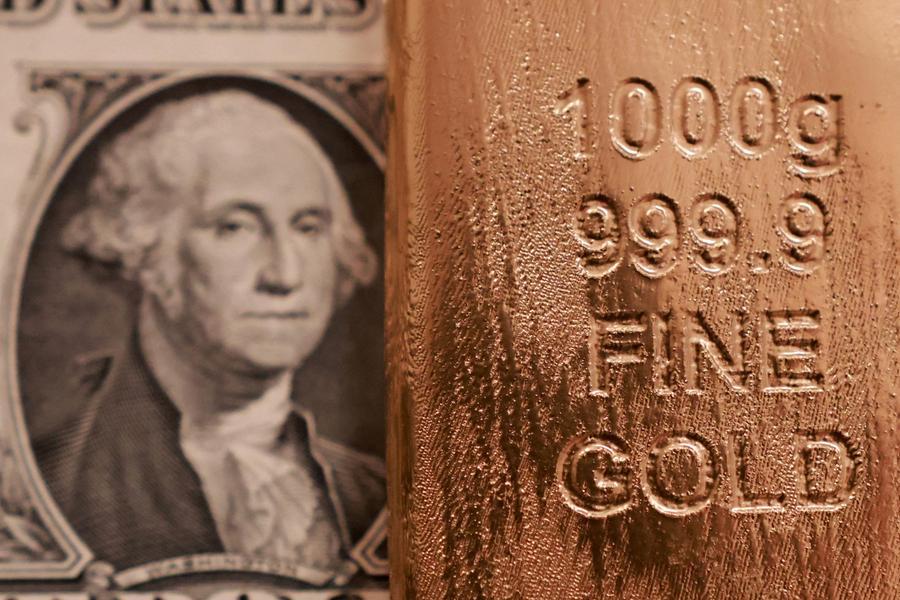
The turmoil in the Middle East has investors once again scrambling for safety, reigniting debate over which assets can truly protect in times of stress.
The choice is complicated by the unpredictable behavior of traditional shelters. Gold prices soared and the dollar, which had been unpopular over the past year, rebounded.
Let’s see how some of our favorites stack up:
green screen passes the test
The dollar was arguably the best performer among safe-haven assets this week.
The dollar index, which tracks the U.S. currency against six other currencies, rose 1.5%. The dollar has also strengthened against the Swiss franc and yen, both of which typically outperform during times of market stress.
The situation is particularly acute after the dollar weakened last April when the tariff scandal sent equities into decline and called into question its safe-haven status.
Flow data shows that short-term dollar cash is in demand, not other dollar assets.
Of course, the United States is a net exporter of energy, so a crisis like this one, with benchmark Brent crude above $80 a barrel, should help.
“The dollar has some safe-haven characteristics, but it’s situational,” said James Lord, head of foreign exchange strategy at Morgan Stanley.
And that won’t always be the case, he said, as U.S. policy uncertainty erodes the currency’s safe-haven nature.
Sovereign is not safe
Treasuries have struggled to attract the kind of safe-haven flows that typically occur during geopolitical shocks, with investors trading them primarily on the basis of their inflation prospects rather than their defensive capabilities.
Fiscal concerns, such as Germany’s easing of the debt brake, and broader concerns about rising government borrowing also outweigh its appeal as a haven.
Yields on German 10-year Bundestags, the euro zone’s benchmark, have risen 14 basis points (bp) so far this week.
“Germany is an escape investment in quality, but if you’re going to raise more debt you don’t want to play in the long bull market,” said Bryn Jones, head of fixed income at Rathbones.
Gold’s safe street Trust is solid
Gold’s safe-haven credibility is strong, judging by its 240% rally so far in the past decade.
Yes, it also proved volatile and plummeted on Tuesday. Analysts believe this is partly because investors sold their best-performing assets to offset losses elsewhere as concerns over Middle East conflict rattled market sentiment.
However, this does not undermine gold’s status as a safe-haven asset, given concerns over inflation, geopolitics and high debt levels, they added.
State Street said its portfolio remains under-held in gold, with its allocation to gold exchange-traded funds still accounting for less than 1% of global fund assets, below the 5% to 10% strategic allocation range.
“In our base case, we’re more likely to see $6,000 this year than $4,000, and just above $5,000,” said Aakash Doshi, head of gold strategy at State Street Investment Management. “That’s a clear point.”
Classic FX refugee tested
The Swiss franc and Japanese yen, long considered currency havens, have fallen 1.2% and 0.8% so far this week.
“The one that looks relatively more attractive from a valuation standpoint is probably the Japanese yen. It stands out to me as a currency that can provide protection in this environment,” said Justin Onukwusi, chief investment officer at St. James’s Place.
However, political uncertainty has further heightened risks to the yen’s outlook, following reports that Prime Minister Sanae Takaichi has expressed reluctance to raise interest rates further.
Meanwhile, analysts have warned that the franc’s upside could be constrained after the Swiss National Bank warned it was ready to intervene to curb excesses.
“This shock is likely to weaken the SNB’s haven characteristics, given the heightened risk of Swiss central bank intervention,” said Teresa Alves, a strategist at Goldman Sachs.
Defense stocks are useless.
Stocks often underperform during times of market stress, but some so-called defensive sectors, such as utilities and consumer staples, typically experience smaller declines.
But that didn’t happen this time.
The S&P Utilities and Consumer Staples sectors fell 1% and 2.8%, respectively, this week, while the S&P 500 was flat. In Europe, utilities are down 3% and consumer staples are down 4.5%, compared to a 3% decline in the STOXX 600.
This is partly because they are already doing well. At least until the outbreak of the war, one of the major investment themes was the purchase of “hard assets” such as infrastructure and industry.
More broadly, defensive value stocks outperformed growth stocks, and some did very well.
“If you’re investing in classic defensive sectors at current interest rate levels, you need to be more disciplined about relative prices,” said James Bristow, portfolio manager at Templeton Global Investments.
“For example, I own Pepsi stock…[Pepsi Co.]is not the highest quality company, but the starting point was very low…It’s a different margin of safety than if you were buying Nestlé stock, for example.”
(Reporting by Niket Nishant, Alun John and Dhara Ranasinghe; Editing by Amanda Cooper and Jan Harvey)
