


Gulf markets reversed earlier trends by Tuesday’s close as investors remained cautious in volatile trade ahead of the third round of U.S.-Iran nuclear talks scheduled for Thursday.
Saudi Arabia’s benchmark stock index fell 0.7% after a modest recovery earlier as the country’s fiscal deficit widened quarter-on-quarter due to increased spending.
Losses were widespread, with Saudi Telecoms falling 2.1% and Saudi Aramco falling 0.5%. Energy giant Aramco has sold several shipments of ultra-light crude from its $100 billion Jafra gas plant to a major US company and an Indian refiner ahead of its first export later this month, Reuters reported, citing trade sources. Antoine Nadaf, country manager at GiveTrade, said the market was well placed to build on its strong fundamentals as external pressures eased.
In the Dubai market, the main stock index fell by 0.6% after rising nearly 2% in the previous session. Weighing on bank stocks, Emirates NBD Bank fell more than 4%, its biggest one-day decline in nearly three months, while Dubai Islamic Bank fell 1.6%.
Abu Dhabi’s stock index held steady and ended flat after rebounding in early trade from two days of declines to record highs. ADNOC Gas fell 0.3%, while Abu Dhabi Commercial Bank rose 0.3%, continuing Monday’s gains.
Nadaf noted that although oil price fluctuations remain a key point to monitor, the Abu Dhabi market retains upside potential, backed by strong fourth-quarter results and solid economic forecasts.
Oil prices, a key catalyst for Gulf markets, are hovering near seven-month highs as traders assess supply risks from military escalation as a renegotiation of the U.S.-Iranian nuclear deal looms.
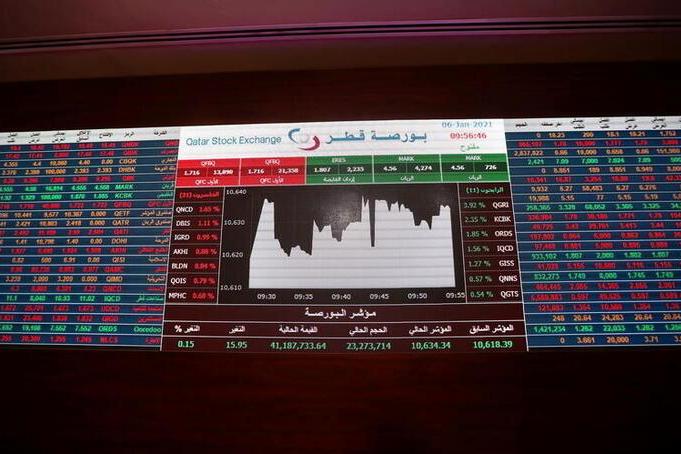
The Qatari stock index rose 0.1%, led by banking stocks. Qatar National Bank, the region’s largest financial institution, rose 0.5%, building on momentum from its best daily performance since mid-October in previous trading.
5C Investment Partners, a US-based private credit investment company, has announced a strategic partnership with Qatar Investment Authority to expand its direct lending platform.
Outside the Gulf, Egypt’s blue-chip index fell 0.9% on selling led by banking stocks. Commercial International Bank, the country’s largest private lender, fell 1.3%. Talat Mustafa Group fell 1.6%, reversing gains from the previous session, after the property developer reported a 43% rise in full-year profit on Monday and secured promotion to the mid-cap segment of the FTSE Russell Global Equity Index Series.
The International Monetary Fund announced that its board will meet on February 25 to consider Egypt’s Extended Fund Facility program. This could result in $2.3 billion in spending.
Saudi Arabia decreased by 0.7% to 10,906 people Abu Dhabi remained unchanged at 10,638 people Dubai decreased by 0.6% to 6,669 people Qatar increased by 0.1% to 11,290 people Egypt decreased by 0.9% to 50,390 people Bahrain increased by 0.1% to 2,059 people Oman increased by 1.6% to 7,292 people Kuwait decreased by 0.9% to 9,156
(Reporting by Amna Mariyam; Editing by Shailesh Kuber)
