


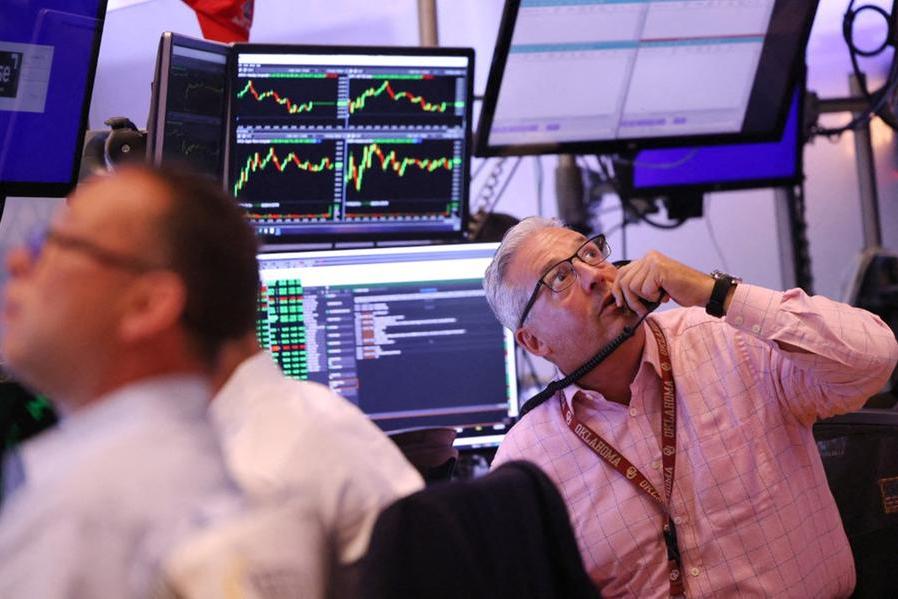
LONDON/SYDNEY – Stock markets rose on Wednesday on a rally in tech stocks around the world, with investors setting aside concerns over U.S. tariffs, at least for now, setting the stage for Nvidia’s earnings report.
MSCI’s global stock index rose 0.3%, Europe’s STOXX600 index rose 0.46%, returning to a record high, and U.S. futures also hinted at gains after Tuesday’s index rally.
There were even more dramatic gains in Asia, with the Asia-Pacific (excluding Japan) benchmark gaining 1.44% on the strength of chip-heavy stock exchanges such as South Korea and Taiwan, and Japan’s Nikkei Stock Average rising 2.2%.
Shares in Samsung Electronics and SK Hynix have doubled since October as a global memory chip shortage sent cash into the AI supply chain to the highly popular chipmakers.
The AI fever, which has battered software stocks globally in recent weeks on fears that business models will collapse, continued to rebound on Wednesday. Software stocks rose in the U.S. and Europe on Tuesday after artificial intelligence research institute Anthropic announced several new plugins developed with partners.
Mohit Kumar, chief European economist at Jefferies, said the event “helped the software sector by the fact that it emphasized partnerships rather than displacement.”
Still, he said AI disruption will remain a market theme.
This recent rally in tech stocks could be strengthened or challenged by the results of Nvidia, the world’s largest company by market capitalization, to be released after the U.S. close.
Forecasts call for earnings to rise 62% and revenue to rise 68% in the quarter ending in January, but the market may be expecting more since Nvidia has exceeded revenue estimates for 13 consecutive quarters. However, it’s not just tech stocks that are driving growth. Shares in HSBC, Europe’s largest bank, rose 5.5% in London after the bank reported better-than-expected profits and raised its key profit target.
Global Anxiety There is widespread optimism in the stock market even as investors grapple with a range of political and geopolitical concerns, allowing U.S. President Donald Trump to boast about the stock market’s rise in his State of the Union address.
Trump also said he wanted “almost every” country and company to honor previous tariff and investment agreements with Washington, but did not specify his plans for Iran amid signs he was inching closer to military conflict with Tehran.
“We think the market is quite optimistic about geopolitical risks. We don’t expect the conflict to be protracted, but any attack from the US is likely to have an Iranian response and cause some volatility in risk assets,” Kumar said.
Concerns over AI, Iran and tariffs have supported U.S. and especially European government bonds in recent days, but yields rose visibly on Wednesday.
The benchmark 10-year Treasury yield rose nearly 2 basis points to 4.05%, but remains close to Monday’s nearly three-month low of 4.017%.
Bond yields move inversely to prices.
Yields on most European 10-year bonds also rose by about 1 basis point, but again to their lowest levels in months and, in the case of British and Italian bonds, to their lowest levels in more than a year.
By contrast, yields in Japan soared on Wednesday after the appointment of two academics seen as dovish to the central bank’s board.
Short-term interest rates, which are sensitive to interest rates, fell, but long-term interest rates rose as expectations that the Bank of Japan’s interest rate hikes would be less immediate led to concerns that the Bank of Japan was behind the curve.
Yields on Japan’s longest-term 40-year bonds rose 10 basis points (bps) to 3.615%, the steepest rise in a month.
This also weighed on the yen, with the dollar appreciating 0.17% against the Japanese currency to 156.18 yen, and the euro appreciating 0.3% to 184.18 yen.
Otherwise, the dollar was slightly weaker, with the euro gaining 0.16% to $1.1792 and the pound gaining 0.25% to $1.352.
NVIDIA’s performance is also attracting attention in the foreign exchange market. Francesco Pesore, senior currency analyst at ING, said a failure could hurt broader risk sentiment and currency impacts, hurting the strong Australian and New Zealand dollars and the Norwegian Crown.
In the commodity market, crude oil prices continued to rise on the back of concerns about Iran, hovering around seven-month highs.
U.S. crude rose 0.55% to $65.99 per barrel, and Brent rose 0.4% to $71.07 per barrel.
Copper also rose, with spot gold up 0.7% to $5,184 an ounce as Chinese market participants bet on traders’ replenishment demand after returning from a nine-day Lunar New Year holiday.
