


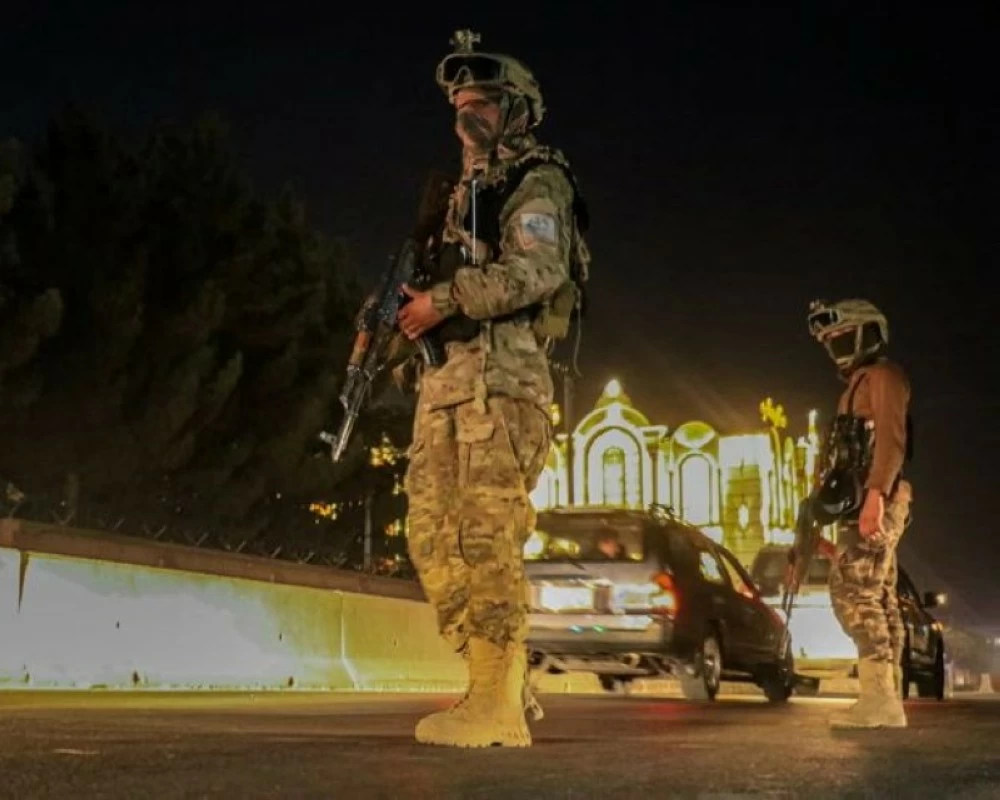
KABUL/ISLAMABAD — Pakistan bombed Afghanistan’s capital Kabul and two other provinces on Friday, hours after a cross-border attack in the latest escalation of violence between the two neighboring countries.
After months of tit-for-tat clashes, Afghan forces attacked Pakistani border forces on Thursday night, which the Taliban government claimed was in retaliation for earlier deadly airstrikes.
At least three explosions were heard in Kabul several hours later on Friday morning, but there was no immediate information on the exact location of the bombing or potential casualties in the Afghan capital.
Pakistan’s Prime Minister Shehbaz Sharif said Friday that his country’s military could “subdue” the invaders following airstrikes on neighboring Afghanistan.
“Our armed forces are fully capable of crushing any offensive ambitions,” Sharif said, according to Pakistan’s government page X. “The entire nation stands shoulder to shoulder with the Pakistan Army,” he said.
Relations between the neighbors have deteriorated in recent months, with most land border crossings closed since major fighting in October that killed more than 70 people on both sides.
Islamabad has accused Afghanistan of failing to act against militants carrying out attacks in Pakistan, a charge the Taliban government denies.
U.N. Secretary-General António Guterres urged both countries to protect civilians as required by international law and “continue efforts to resolve any differences through diplomacy,” U.N. spokesman Stephane Dujarric said.
An Afghan government spokesperson earlier confirmed that Pakistan had launched airstrikes on Kabul and two other Afghan provinces early in the day.
Government spokesman Zabihullah Mujahid said Pakistan also carried out airstrikes in Kandahar in the south and Paktia province in the southeast.
Pakistan’s Defense Minister Khawaja Asif declared “war” against the Taliban government in a post on X shortly after the attack. “Our patience has reached its limit. Now an all-out war has begun between us and you,” he wrote.
Explosions and gunfire rang out in the cities of Kabul and Kandahar, and Pakistan’s Interior Minister Mohsin Naqvi said the attack on Afghanistan was a “befitting response”.
“Pakistani military has responded appropriately to the open aggression of the Afghan Taliban,” Naqvi said.
Two senior Pakistani security officials told The Associated Press that Pakistan’s military carried out airstrikes targeting alleged military installations in Kabul, Kandahar and Paktia province, destroying two brigade bases, without citing potential casualties.
Afghanistan claimed its military launched an offensive across the border into Pakistan late Thursday and captured more than a dozen Pakistani military positions, in retaliation for Pakistan’s deadly airstrikes on Sunday’s border areas.
Pakistan’s government described last Sunday’s airstrikes as an attack on militants hiding in the area, but called Thursday’s attack on Afghanistan unprovoked and denied claims that military positions had been captured.
“In response to the repeated mutinies and mutinies of the Pakistani military, a large-scale offensive operation has been launched against Pakistani military bases and military installations along the Durand Line,” President Mujahid said in a post on X-TV on Thursday night.
Related articles
India and Israel pledge to strengthen ties in defense and technology
Afghanistan’s Ministry of Defense said the retaliatory attacks occurred along the borders of six provinces.
The 2,611 km long border between the two countries, known as the Durand Line, is not officially recognized by Afghanistan.
Afghanistan’s Defense Ministry said 55 Pakistani soldiers were killed, including some whose bodies were taken to Afghanistan, and “several others were captured alive.” The government’s own casualty figures are 8 people killed and 11 injured. The ministry announced that 19 Pakistani military posts and two bases had been destroyed, and the fighting ended at midnight, about four hours after the attack began.
However, Pakistan’s Information Minister Ataullah Tarar said the number of Pakistani soldiers killed was two and three others injured. He said 36 Afghan fighters were reported killed. In a post on X, he said Pakistan was providing a “strong and effective response” to the unprovoked firing from Afghanistan.
Mosharraf Ali Zaidi, spokesman for Pakistani Prime Minister Shehbaz Sharif, denied that Pakistani soldiers had been captured.
Later, in a post on X, he added that at least 133 Afghan fighters have been killed and more than 200 wounded, and said 27 Afghan garrisons have also been destroyed and nine fighters taken prisoner. He did not say where the victims died, adding: “It is estimated that there will be more casualties in attacks on military targets in Kabul, Paktia and Kandahar.”
Both sides also reported gunfire in the Torkham border area.
Qureshi Badron, chairman of the Torkham Information and Awareness Committee, said Afghan authorities were evacuating a refugee camp near the Torkham border crossing after several refugees were injured. The Ministry of Defense announced that 13 civilians, including women and children, were injured in the missile attack on the camp.
Police said residents on the Pakistani side of the border had been evacuated to safe areas, and some Afghan refugees waiting to enter Afghanistan had also been moved to safe areas. Pakistan launched a sweeping crackdown on migrants in October 2023, expelling hundreds of thousands of people.
Pakistani police said a mortar shell fired from Afghanistan landed in a nearby village, but there were no reports of civilian casualties.
The Afghan army released footage of military vehicles moving at night and the sounds of heavy gunfire. This video could not be independently verified.
Tensions between the two neighbors have escalated in recent months, with border clashes in October resulting in the deaths of dozens of soldiers, civilians and suspected militants. The violence followed an explosion in Kabul that Afghan officials blamed on Pakistan. At the time, Islamabad carried out attacks deep in Afghanistan targeting insurgent hideouts.
A Qatar-brokered ceasefire between the two countries has largely remained in place, but the two countries still engage in occasional gunfire across the border. Several rounds of peace talks in November failed to result in a formal agreement.
Pakistan has seen a surge in militant violence in recent years, much of which Pakistan blames on the Pakistan Taliban (TTP) and outlawed Baloch separatist groups. The TTP is a separate organization from the Afghan Taliban, but they work closely together. Islamabad accuses the TTP of operating from inside Afghanistan, a charge denied by the group and Kabul. — Agency
