


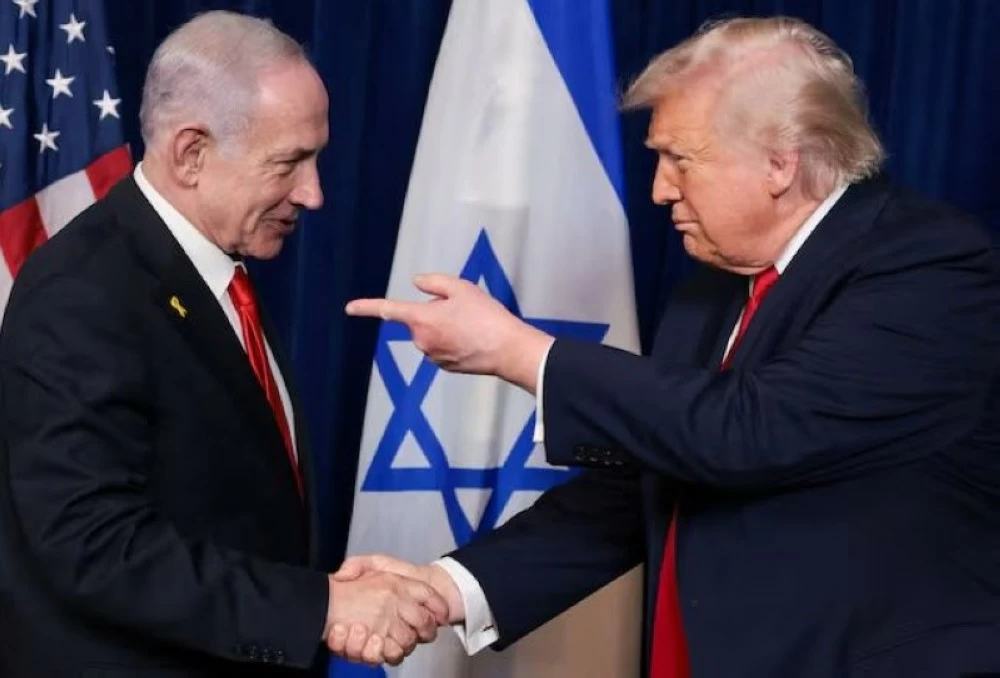
WASHINGTON – U.S. President Donald Trump said after a meeting with Israeli Prime Minister Benjamin Netanyahu on Wednesday that he had not reached a “definitive” agreement on how to proceed with Iran, but insisted that negotiations with Iran will see if a nuclear deal can be reached.
In an unusually low-key meeting at the White House, Prime Minister Benjamin Netanyahu was brought in through a side door where cameras were not visible, and the two leaders spoke for nearly three hours.
Trump did not hold a press conference afterward.
President Trump said in a post on Truth Social that the summit went “very well.”
“Other than my insistence that negotiations continue with Iran to see if a deal can be reached, no definitive agreement was reached,” he said.
He added that he was “hopeful” for a deal, but if no deal was reached “we’ll just have to wait and see what the outcome is.”
Netanyahu’s visit will be Trump’s sixth visit to the United States since he returned to office, more than any other world leader.
The Israeli Prime Minister’s Office announced that the two leaders discussed “the security needs of the State of Israel in the context of negotiations” and agreed to continue “close cooperation and relations.”
Prime Minister Benjamin Netanyahu was expected to press Trump to expand diplomacy with Iran beyond its nuclear program and include limiting its missile arsenal, but he stressed the need to take Israel’s security interests into account, but there was no sign that he had fulfilled the commitments the president had sought.
Iran has signaled it is willing to limit its nuclear program in exchange for sanctions relief, but has rejected other demands.
Ahead of the White House meeting, Iranian President Masoud Pezeshkian warned that his country would not “give in to excessive demands.”
Prime Minister Netanyahu arrived in Washington on Tuesday and met with President Trump’s special envoy Steve Witkoff and son-in-law Jared Kushner. The Prime Minister’s Office said the two men “provided an update on the first round of negotiations with Iran last Friday.”
Netanyahu’s visit comes as the United States strengthens its military presence in the Middle East, with President Trump threatening to attack Iran unless it reaches an agreement on its nuclear program and stops killing protesters.
The president said Tuesday that he is “considering” sending a second carrier strike group to the Middle East.
The USS Abraham Lincoln Strike Group was sent to the region last month after President Trump threatened to attack Iran to stop the government from cracking down on mass protests that have killed thousands of people.
“We have an armada heading there, and there could be another armada heading there,” Trump said in an interview with Axios. He said Iran “very much wants a deal,” adding that a diplomatic solution remains a possibility.
Speaking at a rally in Tehran on Wednesday to mark the 47th anniversary of the Iranian Islamic Revolution, Pezeshkian said: “Our country, Iran, will not succumb to aggression, but we continue to do our best to communicate with neighboring countries in order to establish peace and tranquility in the region.”
The Iranian president also reiterated that his country “does not seek to acquire nuclear weapons.” “We have reiterated this and we are open to any verification,” he added.
Israeli officials also said the country reserves the right to take military action against Iran if it fails to reach a nuclear deal with the United States.
Experts say Prime Minister Benjamin Netanyahu is under pressure from far-right allies in his administration to use his ties to President Trump to push for a broader U.S.-Iran deal that addresses Israel’s security concerns.
Netanyahu’s visit comes as the Trump administration presses Israel and Hamas to implement the next phase of the Gaza ceasefire agreement.
On Wednesday, he met with Secretary of State Marco Rubio to register as a member of President Trump’s Peace Commission. — Agency
Related articles

