

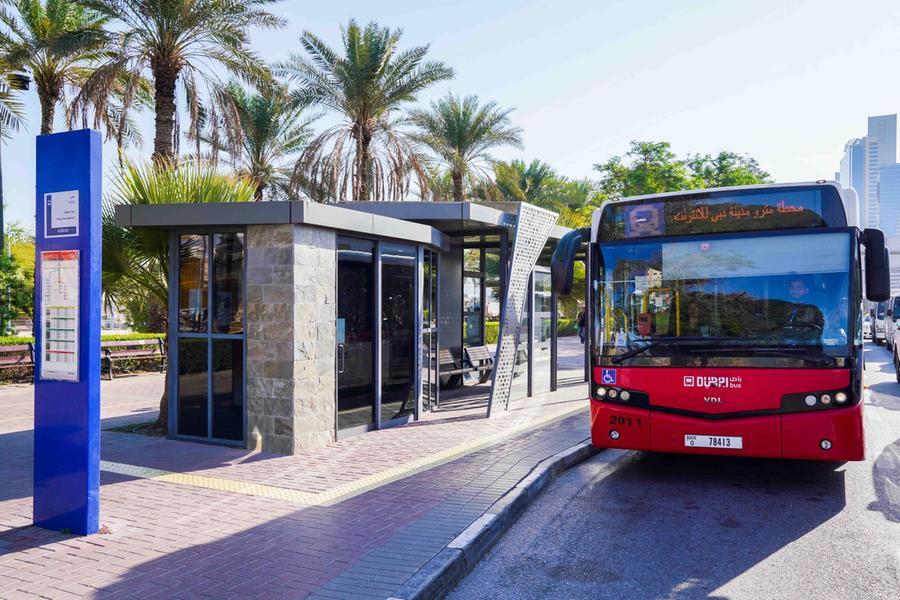
Dubai: Dubai Roads and Transport Authority (RTA) announced that 802.1 million people will use public transport, shared mobility and taxis in 2025, compared to 747.1 million in 2024, an increase of 7.4 percent.
This figure includes users of Dubai Metro, Dubai Trams, public buses and maritime transport (abras, ferries and water taxis), as well as app-based vehicles, hourly rental vehicles, and on-demand buses and taxis operated by Dubai Taxi Corporation and franchised companies.
Average daily passenger numbers reached 2.2 million, up from 2 million in 2024. Premium limousine service passengers, not included in total public transport passengers, were 23.6 million compared to 19.2 million in 2024.
Total public transport, shared mobility and taxi rides totaled 167.3 million, including 120 million taxi rides and over 41 million shared mobility rides. October and November each recorded the highest number of trips with 15.1 million people.
October 2025 saw the highest number of monthly passengers at 72.8 million, followed by November at 72.6 million and December at 71.4 million. Passenger numbers in the remaining months ranged from 61 million to 69 million.
Matar Al Tayer, RTA Executive Director and Chairman of the Board, said the sustained increase in the use of public transport and shared mobility, reaching 7.4% last year, and a 30% increase in shared mobility compared to 2024, reflects a structural change in mobility patterns across the emirate.
He added that these results reflect long-term investments in infrastructure, smart technology and integration between different modes of transport, reinforcing public transport as a central pillar of sustainable urban planning and a key enabler of economic growth.
Mr. Al Tayer further said, “The continued increase in demand across Dubai’s public transport system, supported by the seamless integration of metro, tram, bus, maritime transport and shared mobility services, demonstrates that the network can operate with high efficiency. The diversity of options meets daily mobility needs and provides flexible and safe alternatives to serve different user groups.”
He added: “RTA continues to drive an intelligent, sustainable and integrated public transport system by expanding its metro, tram and bus networks, increasing the efficiency of maritime transport and supporting shared mobility solutions. In line with Dubai’s future dreams as a world-leading city, we are also introducing artificial intelligence technologies in data management and customer journey design, reinforcing our position as the world’s best city to live, work and visit.”
He added: “RTA will expand the dedicated bus and taxi lanes to 20 kilometers from 2025 to 2026, including the introduction of six new corridors with a length of 13 kilometers. These lanes will contribute to a 10 percent increase in passenger numbers, improve bus on-time performance by 42 percent, and reduce bus travel times by 41 percent.”
It is also considering a trackless tram project across eight locations in Dubai. This advanced, autonomous and environmentally friendly system runs on electricity and uses a virtual track guided by camera-based detection of painted road markings. It costs less and takes less time to implement than traditional streetcar systems. ”
Dubai Metro accounted for the largest share of total ridership at 37%, followed by taxis at 26%, down from 27% in 2024. Public buses accounted for 25%. The share of shared mobility services will increase from 7.5% in 2024 and 6.2% in 2023 to 9% in 2025. Maritime transport and Dubai Tram maintained stable shares of 2% and 1%, respectively.
This change reflects the continued increase in the use of public transport, supported by improved service reliability and greater integration between subways, buses and shared mobility services, reinforcing the system’s role in meeting the mobility needs of residents and visitors.
The sustained growth in passenger numbers also highlights the impact of ongoing system development and continued adjustment of demand and services, particularly in peak hour management and mobility enhancements for all public transport modes.
Dubai Metro recorded 294.7 million passengers on its Red and Green lines in 2025, an increase of 7% compared to 2024.
Burjuman metro station and Al Rigga metro station, which serve as interchanges for both lines, recorded the highest number of passengers for the year. Burjuman handled 17.8 million riders, an increase of more than 1.5 million compared to the previous year, while Al Rigga recorded 13.8 million riders.
On the Red Line, Union Station metro station recorded the highest ridership with 13.6 million passengers, followed by Mall of the Emirates metro station with 11.2 million and Burj Khalifa Dubai Mall metro station with 10.9 million.
On the Green Line, Sharaf DG metro station ranked first with 10.5 million passengers, followed by Baniyas Square station with 8.4 million passengers, followed by Stadium station with 7.5 million passengers.
The number of passengers on public buses was 197.2 million last year, an increase of 5% compared to 2024. Sea transport passenger numbers, including abras, water taxis and Dubai ferries, totaled 18.4 million, an increase of 3%. Dubai Trams carried 9.9 million passengers and reflected a growth of 5%.
Shared mobility services, which consist of app-based vehicles, hourly vehicles, and on-demand buses, carried 72.9 million passengers and recorded 30% growth.
Dubai taxis transported 209 million passengers, an increase of 4% year-on-year. Premium limousine services carried 23.6 million passengers in 2025, an increase of 22% compared to 2024.
